
The short answer
What did the Assembly’s resolutions and a large supporting petition establish separately?
Evidence comparison
Read the records together
The records were created for different purposes and support different kinds of claims.
| Record | What it establishes | Question to keep open |
|---|---|---|
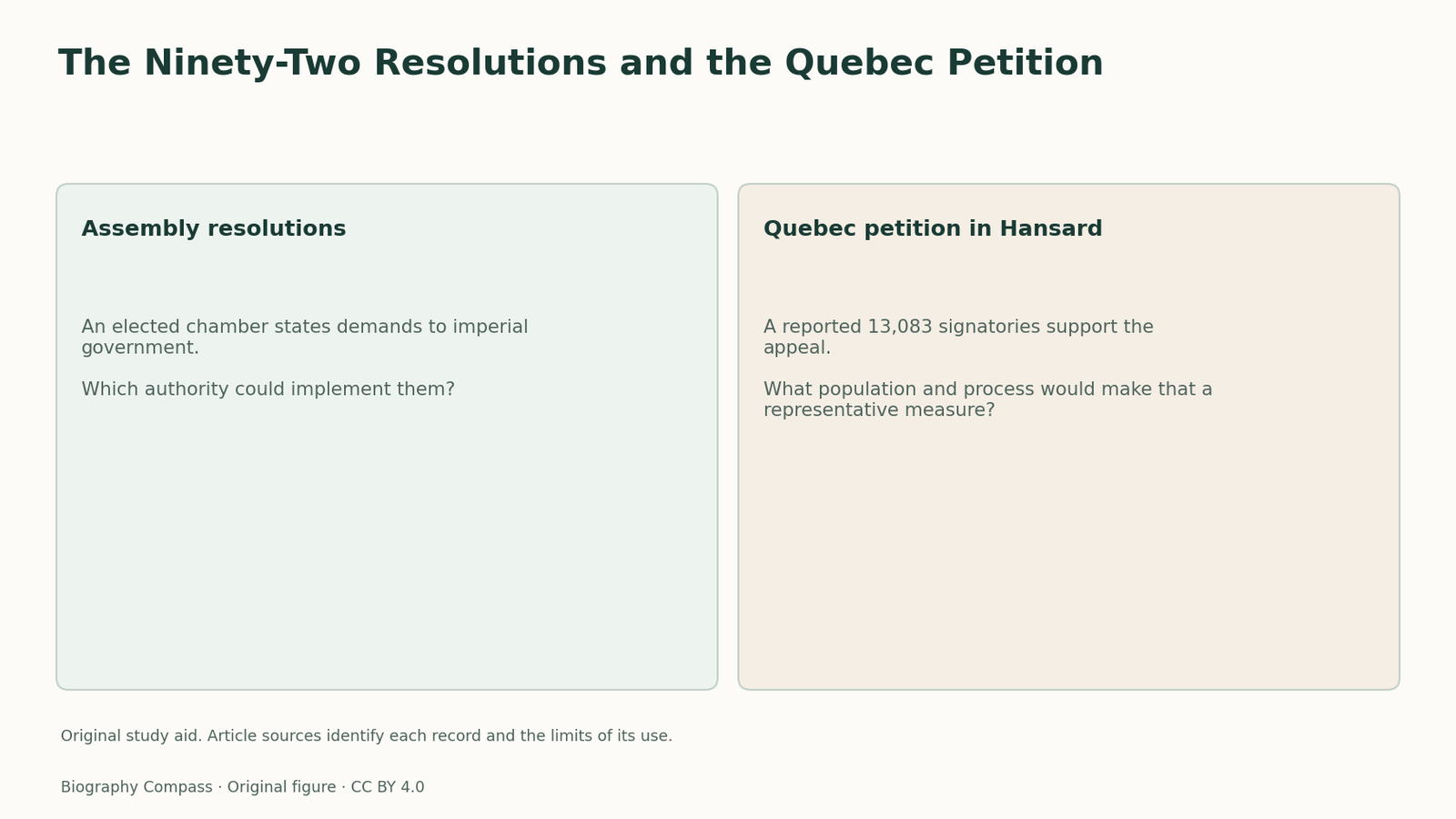
| Assembly resolutions | An elected chamber states demands to imperial government. | Which authority could implement them? |
| Quebec petition in Hansard | A reported 13,083 signatories support the appeal. | What population and process would make that a representative measure? |
Chronology
A timeline of the turning points
Resolutions and petition
Demands and support reach the imperial debate.
British response
The Russell resolutions reject key demands.
Begin with the Assembly statement
The Lower Canadian Assembly adopted ninety-two resolutions in February 1834 and sent them to London. Their institutional origin matters: they recorded a programme endorsed in the elected chamber. They were demands addressed to another authority, rather than an enacted replacement for the colony’s constitutional arrangements. A reader should preserve that status when explaining what the document accomplished at the moment of adoption.
Count support without changing its meaning
The British Commons record of 4 August reports a Quebec petition supporting the resolutions and gives 13,083 signatories. That number measures the support reported for a particular petition. It is not a count of parliamentary votes, all inhabitants of Lower Canada or the proportion of eligible people who agreed. Before using it as evidence of popular opinion, identify the collection process and the population against which any proposed percentage would be calculated.
Sources for this section: [2]
Follow the request to its recipient
The political meaning of the resolutions also depends on what happened after they reached Britain. Library and Archives Canada’s history identifies the Russell resolutions as a later response rejecting the Assembly’s demands. Papineau’s 1834 language about local autonomy adds context for the constitutional arrangement being sought. Neither the petition’s scale nor the Assembly’s endorsement guaranteed acceptance by the imperial government, which held a different source of authority.
Build a petition route
Draw a route with boxes for Assembly, supporting petition, Westminster presentation and British response. Place a different verb under each: adopts, supports, presents and decides. A defensible answer keeps the signature total at the support stage. It also leaves room to inspect the wording of each demand separately. This prevents the route of a political appeal from becoming a misleading story in which a large petition itself enacted the requested reforms.
Continue the chronology
Related history guides
Biography context
Explore Canada through connected lives
Connected biographies
People behind the records
1786–1871
Louis-Joseph Papineau
Patriote leader and parliamentarianPapineau led Lower Canadian reform and argued for local political authority, with the 1834 resolutions carrying grievances to the British government.Read biographyQuick answers
Common questions
- Did the resolutions themselves change the constitution?
- Their adoption recorded Assembly demands. Implementation depended on the response of the authorities to whom they were addressed.
Primary and institutional sources
How this history was checked
Sources support the chronology and the record comparison. The reading exercise is original. This article was reviewed on 7 November 2026.