
The short answer
What did McGee mean by equivalent protection for two different religious minorities?
Evidence comparison
Read the records together
The records were created for different purposes and support different kinds of claims.
| Record | What it establishes | Question to keep open |
|---|---|---|
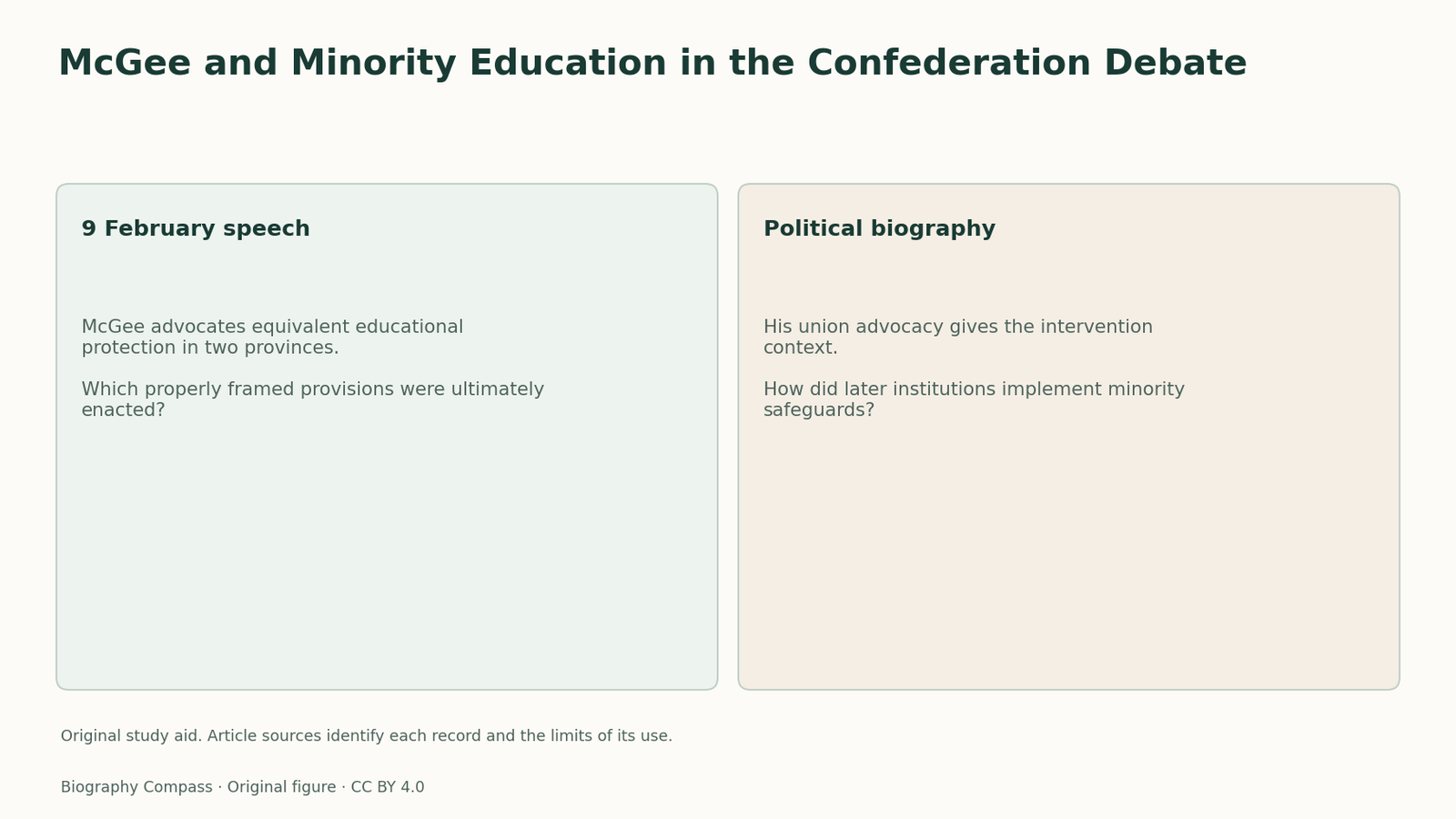
| 9 February speech | McGee advocates equivalent educational protection in two provinces. | Which properly framed provisions were ultimately enacted? |
| Political biography | His union advocacy gives the intervention context. | How did later institutions implement minority safeguards? |
Chronology
A timeline of the turning points
Minority argument
McGee discusses educational parity in the union debate.
Assassination
His parliamentary career ends in Ottawa.
Identify both minorities
McGee discussed Protestants in Lower Canada and Catholics in Upper Canada. Their minority position depended on the province, rather than on one community being a minority everywhere. This matters when summarising his demand for parity. An account that substitutes French and English for the religious categories would change the terms of the passage. Begin by recording the community, jurisdiction and educational interest that he actually named.
Sources for this section: [2]
Read the condition attached to support
He expressed willingness to support properly framed amendments protecting the Protestant educational system in Lower Canada. He then argued that any special guarantees should place Upper Canadian Catholics in an equivalent position. The language looks toward provisions that needed to be framed and accepted. It records a political commitment and a standard of comparison. It does not, on its own, supply a final enacted guarantee or demonstrate that protection operated evenly in practice.
Sources for this section: [2]
Connect the argument with his larger project
McGee’s career as an advocate of union helps explain why he treated minority protection as part of the Confederation settlement. A common political structure would have to accommodate communities with different institutional interests. His biography provides that context, while the dated speech supplies the specific argument. The relationship is useful precisely because the general support for union does not tell readers which educational safeguards he was prepared to endorse.
Draft a comparison without a verdict
Make parallel rows for Lower Canadian Protestants and Upper Canadian Catholics. In each enter jurisdiction, educational interest and the protection McGee advocated. Leave a final column for enacted wording until that wording is independently examined. A sound answer reports parity as his proposed standard. It avoids declaring complete equality achieved merely because a speaker argued for it, and it identifies the additional statutory and implementation evidence needed to test the outcome.
Continue the chronology
Related history guides
Biography context
Explore Canada through connected lives
Connected biographies
People behind the records
1825–1868
Thomas D’Arcy McGee
Journalist and Confederation politicianMcGee moved from Irish nationalism to Canadian union, using journalism and parliamentary argument to support Confederation and minority safeguards.Read biographyQuick answers
Common questions
- Does the speech itself create educational rights?
- It records an argument in the Confederation debate. Enacted rights require examination of the final legal provisions.
Primary and institutional sources
How this history was checked
Sources support the chronology and the record comparison. The reading exercise is original. This article was reviewed on 7 November 2026.