
The short answer
Can a governor remove a premier without a vote in the legislature, and does the answer settle an emergency takeover? Western Nigeria’s 1962–1963 litigation shows why these were distinct questions with changing legal answers.
Original litigation comparison
One crisis contained several legal questions
The rows separate the relevant acts and remedies.
| Country | Issue | Evidence | What it establishes |
|---|---|---|---|
| Removing the premier | Section 33(10), July 1962 answer | Governor’s constitutional authority | Majority originally required House proceedings |
| Emergency administration | Section 65, June application and regulations discussed | Federal intervention and restrictions | A separate legal challenge; pleaded allegations remain attributed |
| Reversal | 27 May report / 30 May 1963 approval | Privy Council result recorded by later court | Original wording interpreted in Adegbenro’s favour |
| Retrospective amendment | 27 May law / 3 June ratification reported | New majority-resolution requirement effective from 2 October 1960 | Premiership settled for Akintola |
| Costs | 28 October 1963 Supreme Court ruling | Accrued appeal costs | Adegbenro’s costs survived the amendment |
Chronology
A timeline of the turning points
A disputed change of premier
Governor Aderemi removed Akintola and appointed Adegbenro.
Federal emergency intervention
Parliament declared an emergency and the federal administration acted under emergency regulations.
Interlocutory application
Adegbenro sought to restrain the administrator pending his case.
Federal Supreme Court answer
The majority required legislative proceedings as the basis for removal.
Regional government resumed
Contemporary analysis records Akintola’s return after emergency administration.
Reversal and regional amendment
The Privy Council report favoured Adegbenro; an amendment was enacted in the Region that day.
Order in Council
The Privy Council report was approved.
Federal ratification reported
The October court record states the amendment was ratified by federal Parliament.
Costs application decided
Adegbenro retained his costs despite the retrospective change benefiting Akintola.
A regional dismissal posed a textual question
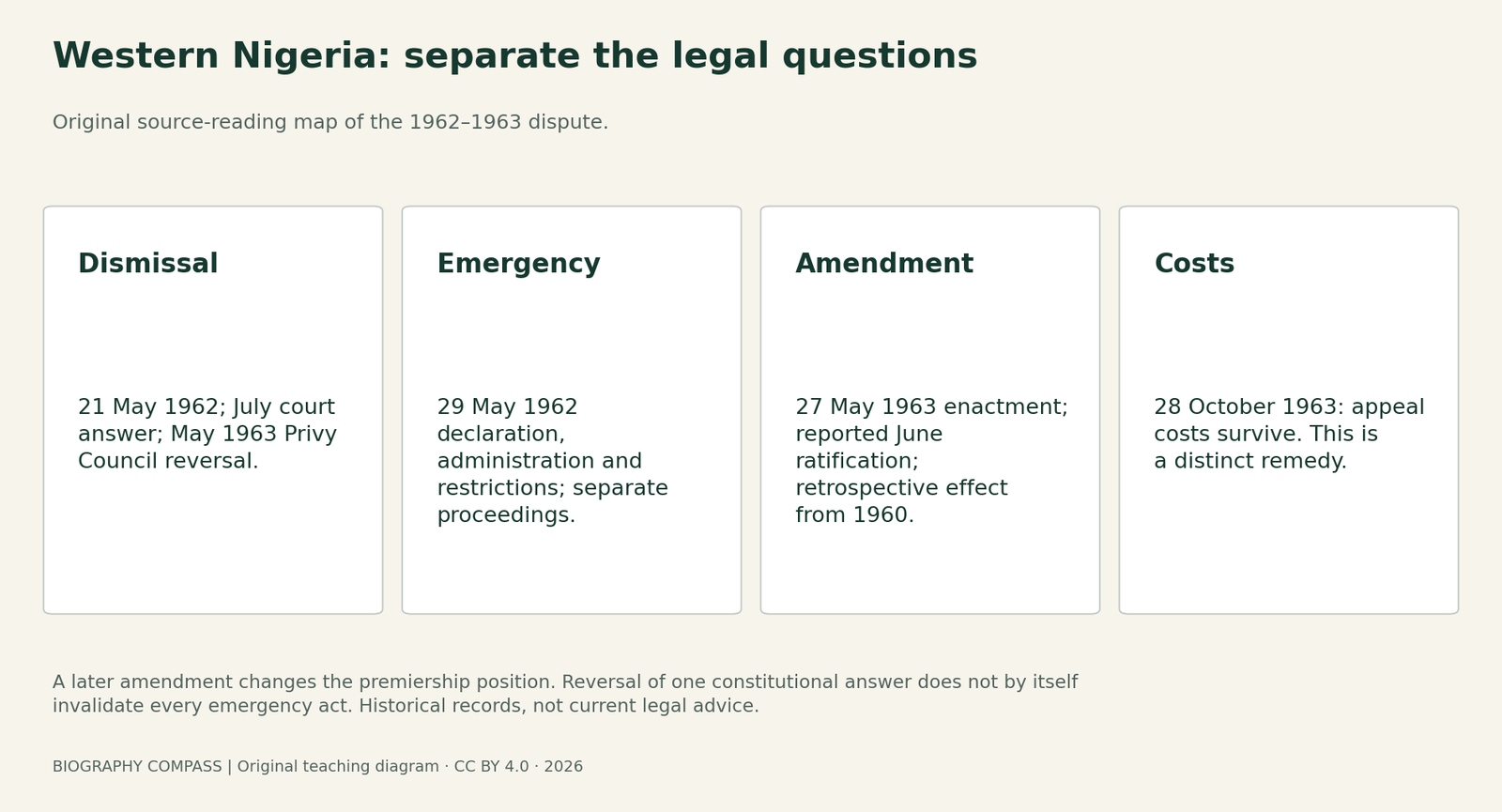
On 21 May 1962 Governor Adesoji Aderemi removed Samuel Ladoke Akintola as premier and appointed Dauda Adegbenro. The original Western constitution restricted removal to circumstances in which the governor considered that the premier had lost majority support in the House of Assembly. The dispute was whether that judgment required a prior resolution or other proceedings on the House floor. The July 1962 Federal Supreme Court majority answered yes. This constitutional question arose within an Action Group split involving Awolowo’s political organisation, but it was a case about the governor’s authority, not an adjudication of every allegation between the rival factions.
Emergency intervention created a separate dispute
Federal Parliament declared a public emergency on 29 May 1962. Section 65 of the federal constitution defined the relevant parliamentary emergency mechanism and enlarged federal legislative power. Emergency regulations and restriction orders then displaced the regional government’s practical exercise of its functions and installed administrator Moses Majekodunmi. Adegbenro sought an interlocutory injunction against that intervention. The June court transcript records his argument that disorder had been confined to the legislature and did not justify displacing his government. Those statements were his pleaded case and affidavit evidence. Their appearance in a judgment does not turn them into findings accepting his description of every disturbance.
Legal authority and coercive effect require separate evidence
The June record describes police dispersal of assembly members with tear gas and an order restricting Adegbenro to an area around Oshogbo. The record’s statement of claim dates the failed confidence meeting to 25 May, while its affidavit narrative refers to 28 May; that textual discrepancy is retained in the source note rather than silently resolved. The restriction order mattered because it prevented the claimant from carrying out governmental work regardless of his legal claim to office. A declaration, a regulation, police action and a restriction order were different acts. Establishing one does not automatically establish the constitutional validity or factual justification of all the others.
The 1963 reversal did not end the story
The October 1963 Supreme Court judgment records that the Privy Council reversed the earlier constitutional answer in Adegbenro’s favour. Its report was dated 27 May 1963 and approved by Order in Council on 30 May. Meanwhile, the Western legislature enacted an amendment on 27 May, and the October court said it had been told that federal Parliament ratified it on 3 June. The amendment expressly required a majority House resolution and was deemed operative from 2 October 1960. That retrospective change settled the premiership question in Akintola’s favour. The original interpretive answer and the later legal position therefore must be dated separately.
The costs ruling protected a distinct interest
Adegbenro still applied for the costs awarded through his appeal. Akintola argued that the retrospective amendment also defeated that consequence. The Supreme Court disagreed on 28 October 1963: the amendment did not mention the case, parties or costs, and the court would not infer an intention to confiscate the applicant’s accrued entitlement. Akintola prevailed on the premiership issue but had to pay Adegbenro’s costs. This narrow result is more useful than saying simply that one side “won the case”. The court separated a changed constitutional position from the financial consequence of exercising an existing right of appeal.
Sources for this section: [4]
Worked evidence exercise: identify the missing step
A student writes: “The Privy Council ruled in May 1963 that Adegbenro was right, so Akintola could not lawfully remain premier, and every emergency restriction was invalid.” Correct the reasoning. The first inference omits the retrospective constitutional amendment recorded in the October judgment. The second treats a dismissal case as though it decided the separate emergency-power and restriction disputes. A sound answer identifies the governing text, the date of each ruling, the later amendment and the specific remedy requested. It also distinguishes an actor’s allegations from judicial findings. These are historical events and instruments, not a statement of current Nigerian emergency law.
Continue the chronology
Related history guides
Connected biographies
People connected with these institutions
1909–1987
Obafemi Awolowo
Lawyer, Western Region premier and opposition leaderObafemi Awolowo built the Action Group, led Western Nigeria and became the federal opposition leader. Imprisoned in 1963, he later served as finance commissioner under military government and contested the presidency.Read biography1904–1996
Nnamdi Azikiwe
Journalist, nationalist and Nigeria’s first presidentNnamdi Azikiwe used journalism and party organisation to oppose British colonial rule. He later became governor-general and Nigeria’s first president within a parliamentary system led in government by Prime Minister Tafawa Balewa.Read biographyQuick answers
Common questions
- Was the emergency case the same as the dismissal case?
- No. The authority to remove a premier, federal emergency intervention and individual restrictions were separate questions.
- Did the Privy Council reversal restore Adegbenro permanently?
- The retrospective amendment subsequently recognised by the Supreme Court settled the premiership issue for Akintola.
- Why could Akintola win but still pay costs?
- The court found no intention in the amendment to deprive Adegbenro of the costs obtained through his constitutional appeal.
Primary and institutional sources
How this history was checked
Historical legislation and contemporary records anchor the explanation. The comparison and evidence exercise are original reader aids; historical law is not presented as current legal advice. This article was reviewed on 27 October 2026.
- UK Government / The National ArchivesNigeria (Constitution) Order in Council 1960, as made
- Federal Supreme Court of Nigeria; LawCare transcriptAkintola v Aderemi and Adegbenro, FSC 187/1962, 7 July 1962
- Federal Supreme Court of Nigeria; LawCare transcriptAdegbenro v Attorney-General of the Federation and others, FSC 170/1962, interlocutory application, 7 June 1962
- Supreme Court of Nigeria; LawCare transcriptAdegbenro v Akintola, FSC 187/1962, costs application, 28 October 1963
- Malaya Law Review / National University of Singapore repositoryEmergency Powers in Nigerian and Malayan Federalism, July 1964, pp. 83–99