
The short answer
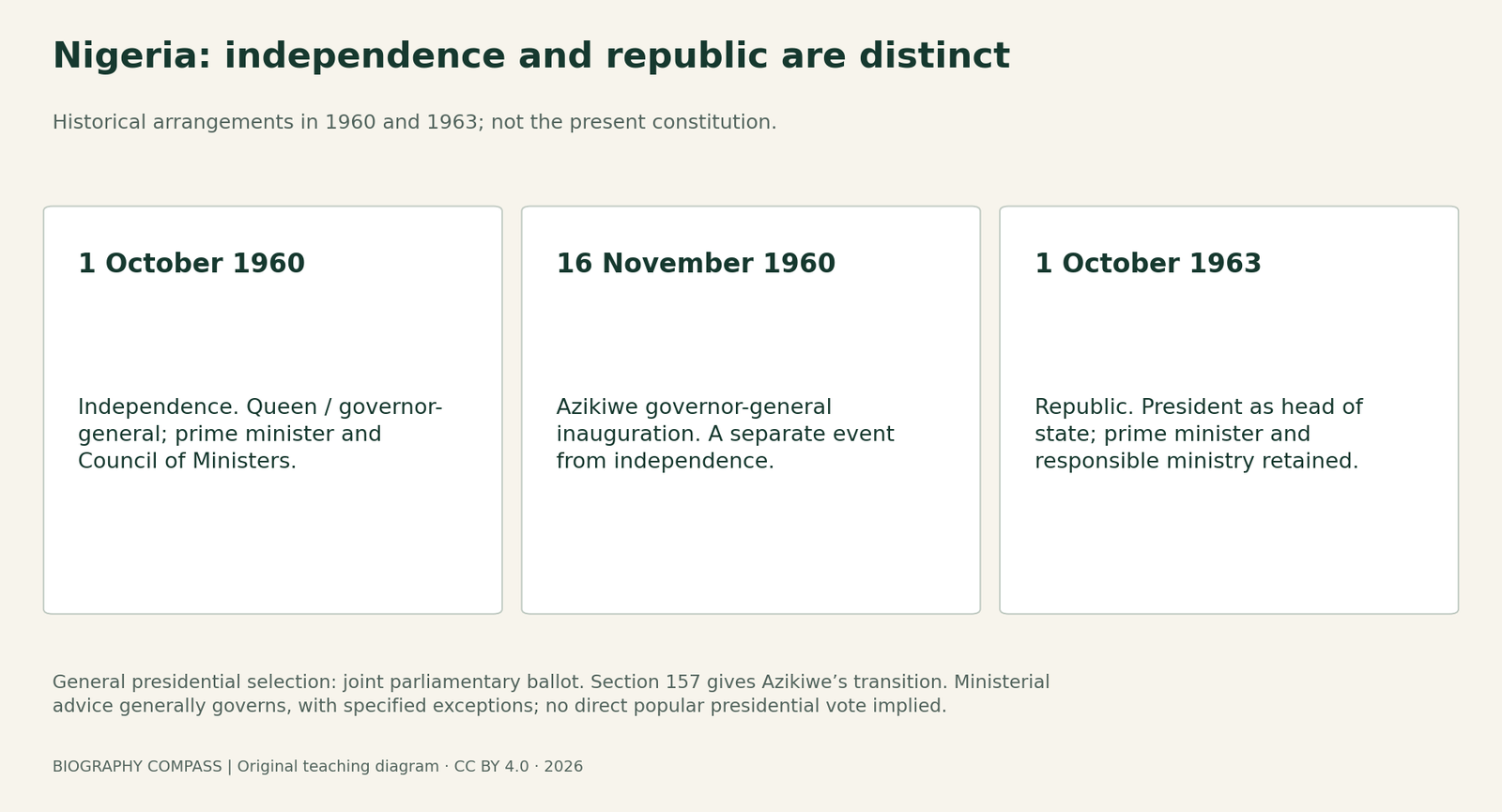
How could Nigeria become independent in 1960 but establish a republican presidency only in 1963? The answer requires separating sovereignty, the head of state and the government’s responsibility to Parliament.
Original comparison
Change of head of state, continuity of government
The rows ask identical questions of the two historical settlements.
| Country | Question | 1960 arrangement | 1963 arrangement |
|---|---|---|---|
| Head of state | Head of state | Queen; represented by a governor-general | President of the republic |
| Head of government | Head of government | Prime minister and Council of Ministers | Prime minister and Council of Ministers retained |
| Presidential selection | Presidential selection | No republican presidency | General joint parliamentary ballot; section 157 transitional rule for Azikiwe |
| Formal executive action | Formal executive action | Advice-based parliamentary arrangement | Ministerial advice generally required; section 93 lists exceptions |
Chronology
A timeline of the turning points
Independence Act
UK legislation prepared the legal transition.
Independence
The appointed day ended UK responsibility for Nigeria’s government.
An invitation documents the office
Azikiwe invited Martin Luther King Jr. to the November inauguration.
Governor-general inauguration
Azikiwe became the Queen’s Nigerian representative.
Republic
A Nigerian president replaced the monarchical head of state within a parliamentary constitution.
The independence Act answered a sovereignty question
Section 1 of the Nigeria Independence Act 1960 fixed 1 October as the appointed day and ended the United Kingdom government’s responsibility for Nigeria’s government. It also prevented later UK Acts from extending automatically as Nigerian law. Those provisions are direct evidence of a legal transfer of responsibility. They did not require an elected republican president as the condition for independence. Reading a later presidential list backwards can therefore obscure what changed in 1960: Nigeria became a sovereign state while retaining the Queen as head of state under a distinct Nigerian constitutional arrangement.
The 1960 constitution divided offices
The Nigeria (Constitution) Order in Council 1960 supplied the federal and regional constitutions. At federal level it provided a governor-general, a prime minister, ministers and Parliament. The governor-general represented the Queen; the prime minister and Council of Ministers conducted parliamentary government. Azikiwe’s dated letter of 26 October 1960 is especially useful evidence because it identifies both his impending 16 November inauguration and his representative relationship to the Queen. Independence day and inauguration day were separate events. The letter should be read as evidence of the office he was about to occupy, rather than as an announcement of a republican presidency.
The 1963 constitution changed the head of state
The constitution commencing on 1 October 1963 established the Federal Republic. Section 34 identified the president as head of state and commander-in-chief. Section 35 provided for presidential election by secret ballot at a joint meeting of both Houses of Parliament. The transitional provision, section 157 in the body of the reproduced text, deemed Nnamdi Azikiwe elected president on commencement. That specific transition should be distinguished from the general electoral procedure. It does not support a claim that Nigerians voted for Azikiwe in a nationwide direct presidential election in October 1963.
A republic could retain parliamentary government
Section 87 retained a prime minister appointed from the House of Representatives on the basis of likely majority support. Sections 89 and 90 organised the Council of Ministers and its collective responsibility. Section 93 generally required the president to act on ministerial advice, with specified exceptions involving matters such as appointment of the prime minister and dissolution. Thus a republican head of state did not mean adoption of the later executive-presidential model. Tafawa Balewa remained head of government. Describing the president as largely ceremonial captures the broad arrangement, but should not erase the constitution’s expressly reserved functions.
Compare provisions rather than symbols alone
An original comparison should ask the same questions of both texts: who holds the head-of-state office, how does a prime minister enter office, and whose advice ordinarily governs formal executive action? The answers show constitutional change alongside continuity. A flag ceremony or a new title cannot by itself establish a different system of executive accountability. Contemporary analysis in Malaya Law Review likewise identified responsible Cabinet government in both arrangements. These are historical constitutional provisions. They should not be used as a statement of Nigeria’s present institutions or as advice about the validity of any current government action.
Worked evidence exercise: test three claims
Consider three statements: “Nigeria became independent when Azikiwe was inaugurated on 16 November 1960”; “a republic always has an executive president”; and “the 1963 constitution required the president to follow advice without exception.” Test each using a named record. The answers are: section 1 of the Independence Act fixes independence on 1 October; sections 87–90 retain a prime minister and responsible ministry after the republic; and section 93 states a general advice rule together with exceptions. Azikiwe’s letter confirms the distinct inauguration date. The method is to match each claim to a provision or dated document, rather than using one celebrated event to answer every constitutional question.
Continue the chronology
Related history guides
Connected biographies
People connected with these institutions
1904–1996
Nnamdi Azikiwe
Journalist, nationalist and Nigeria’s first presidentNnamdi Azikiwe used journalism and party organisation to oppose British colonial rule. He later became governor-general and Nigeria’s first president within a parliamentary system led in government by Prime Minister Tafawa Balewa.Read biography1909–1987
Obafemi Awolowo
Lawyer, Western Region premier and opposition leaderObafemi Awolowo built the Action Group, led Western Nigeria and became the federal opposition leader. Imprisoned in 1963, he later served as finance commissioner under military government and contested the presidency.Read biographyQuick answers
Common questions
- Was Nigeria independent before it became a republic?
- Yes. Independence came on 1 October 1960; the republic began on 1 October 1963.
- Did Azikiwe become a directly elected executive president in 1963?
- No. The constitution retained parliamentary government and contained a specific transitional provision for his presidency.
- Why does the section number need checking?
- One later transcription’s contents list gives 156, while its body and the scanned reproduction place the Azikiwe transition in section 157.
Primary and institutional sources
How this history was checked
Historical legislation and contemporary records anchor the explanation. The comparison and evidence exercise are original reader aids; historical law is not presented as current legal advice. This article was reviewed on 27 October 2026.
- UK Parliament / The National ArchivesNigeria Independence Act 1960, original section 1
- UK Government / The National ArchivesNigeria (Constitution) Order in Council 1960, as made
- Stanford University, Martin Luther King, Jr. Research and Education InstituteFrom Nnamdi Azikiwe, 26 October 1960: letter and editorial notes
- Federal Ministry of Information, Nigeria; reproduced in Peaslee and hosted by Citizenship Rights in AfricaConstitution of Nigeria, 1 October 1963, historical text
- Nigeria; Global Citizenship Observatory document collection1963 Constitution of Nigeria, later transcription
- Malaya Law Review / National University of Singapore repositoryEmergency Powers in Nigerian and Malayan Federalism, July 1964, pp. 83–99
- Central Bank of NigeriaDr. Nnamdi Azikiwe: currency biography