
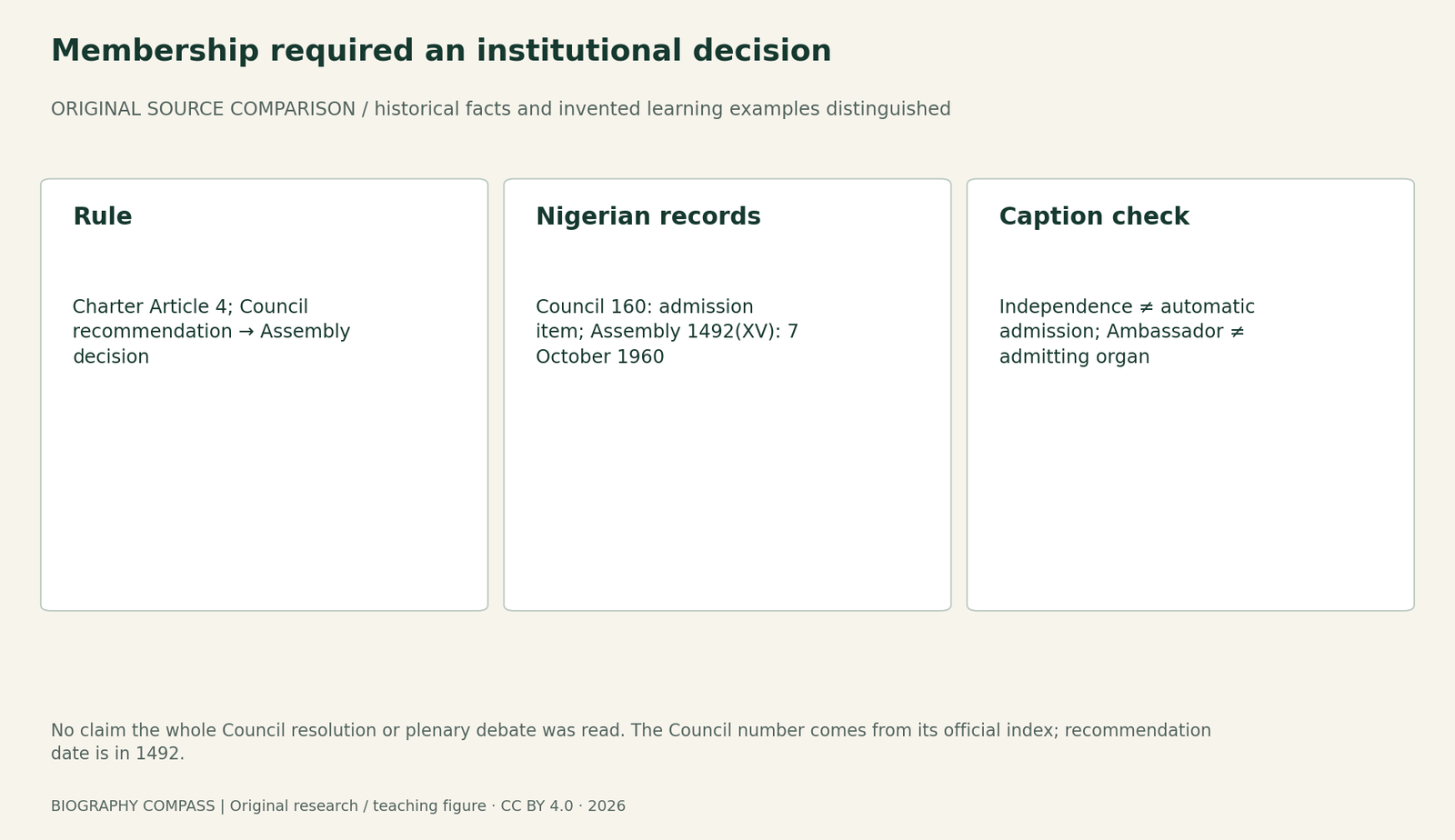
The short answer
Nigeria became independent on 1 October 1960 and entered the United Nations on 7 October. Reading the operative records explains why those dates and decisions should remain distinct.
Documentary comparison
Three records, different evidentiary jobs
Match the claim to the institution, date and kind of record.
| Record | What it supports | What it does not establish |
|---|---|---|
| UN Charter Article 4 | Recommendation followed by Assembly decision | Automatic admission at independence |
| Council 1960 index | Resolution 160 concerns Nigeria’s admission | A full reading of the Council’s operative text |
| Assembly 1492(XV) | Admits Nigeria on 7 October 1960 | Every negotiation or speech preceding admission |
Chronology
A timeline of the turning points
Independence
A national constitutional transition, distinct from UN admission.
Council recommendation
The date recited in the admission resolution.
Assembly decision
Resolution 1492(XV), 893rd plenary meeting.
Start with the rule, not the celebration
Article 4 of the UN Charter separates eligibility for membership from the institutional act of admission. It describes states that accept the Charter’s obligations and are judged able and willing to carry them out. It then assigns different parts of admission to two organs: a Security Council recommendation and a General Assembly decision.
That division is the first thing to preserve when reading a short resolution or an anniversary account. A speech can welcome a new state, a government can submit an application and a diplomat can negotiate support. None of those actions is interchangeable with the Assembly’s admission decision. The Charter supplies the rule against which the later records can be read.
Sources for this section: [1]
The Nigerian decision is unusually concise
General Assembly resolution 1492(XV), adopted at the 893rd plenary meeting on 7 October 1960, records receipt of the Security Council recommendation of the same date. It considers the Federation of Nigeria’s application and then decides to admit the country. The operative action belongs to the Assembly.
The original printed page also contains other resolutions, including the end of the Mali admission text immediately above Nigeria’s. Reading the heading, operative paragraph and meeting line together prevents a neighbouring date or decision from being accidentally attributed to Nigeria. Footnotes identify the application and the Council communication, but a reference to a document is not equivalent to having examined its whole contents.
Sources for this section: [2]
Recommendation, decision and representation
The Security Council’s official 1960 index identifies resolution 160 as the Nigerian admission item. The Council recommendation’s date is also expressly recited in the Assembly resolution. Here the latter is the inspected primary text establishing the relationship; the index is evidence of the number and subject.
Jaja Wachuku’s pioneering UN representation belongs within this process, but his biography and the membership resolution answer different questions. The biography identifies the official who represented the country and describes his diplomatic work. The resolution identifies the organ that admitted the state. Nigeria’s membership was not a personal status conferred on its ambassador.
Exercise: repair three historical captions
Consider three fictional captions written for an exhibition: A, “Nigeria joined the UN automatically when it became independent on 1 October”; B, “Security Council resolution 160 admitted Nigeria”; C, “Ambassador Wachuku’s appointment was Nigeria’s membership decision.” For each, identify the unsupported substitution and write a corrected sentence using the evidence available here.
Before reading the answer, note which record would be necessary to check an additional claim about the exact wording of Nigeria’s application or an individual delegate’s remarks. Neither a footnote nor a commemorative biography supplies the complete original telegram or meeting transcript. A good caption can be accurate without pretending to answer every related diplomatic question.
Worked answer and the remaining limits
Caption A should distinguish independence on 1 October from admission on 7 October 1960. Caption B should say that the Council recommended admission and the General Assembly admitted Nigeria through resolution 1492(XV). Caption C should identify Wachuku as a representative of Nigeria, while reserving the membership decision to the General Assembly under Article 4.
To check the application’s exact words, consult the cited application record rather than reconstructing it from the resolution’s summary. To investigate the debate, read the plenary transcript. The records inspected here establish the institutional sequence and dates; they do not establish every negotiation, vote explanation or participant’s influence. This method is useful whenever two public events occur close together but perform different constitutional or international functions.
Continue the chronology
Related history guides
Who Supervised Banks When the CBN Opened?
Use a 1959 appointment notice and the CBN’s supervision history to separate a bank’s opening, board appointments and the transfer of examination work.
Read the timeline1975–1976Did the Aguda Committee Create Abuja’s Powers?
Compare Abuja’s capital-location inquiry with the original 1976 decree to distinguish recommendations, territorial creation and development powers.
Read the timelineBiography context
Explore Nigeria through connected lives
Connected biographies
People in this history
1918–1996
Jaja Wachuku
Lawyer, first Nigerian Speaker and pioneering foreign ministerJaja Wachuku brought legal training and debating experience to Nigeria’s independence movement, parliament and early international diplomacy.Read biography1912–1966
Abubakar Tafawa Balewa
Nigeria’s first prime ministerAbubakar Tafawa Balewa became prime minister in 1957 and continued after independence in 1960. His diplomacy combined African cooperation with Commonwealth ties; his government ended in the January 1966 coup.Read biographyQuick answers
Common questions
- Were independence and UN admission the same event?
- No. They occurred on 1 and 7 October 1960 and involved different institutions.
- Does the Assembly resolution reproduce Nigeria’s application?
- No. It considers the application and cites its record, A/4527, but does not reproduce the original telegram.
Primary and institutional sources
How this history was checked
Read the cited records alongside their dates, purposes and institutional roles. This article was reviewed on 27 October 2026.
- United NationsUN Charter, ChapterII, Article 4
- United Nations General Assembly, 7 October 1960Admission of the Federation of Nigeria, resolution 1492(XV)
- United Nations Security CouncilSecurity Council resolutions adopted in 1960: S/RES/160
- Patrick Geoghegan, Trinity College DublinJaja Wachuku: Trinity Monday Discourse 2025