
The short answer
Why did Insull distinguish energy from maximum demand?
A worked comparison
What each part contributes
Use the specific distinctions developed in the study.
| Part or record | What it establishes | Why the distinction matters |
|---|---|---|
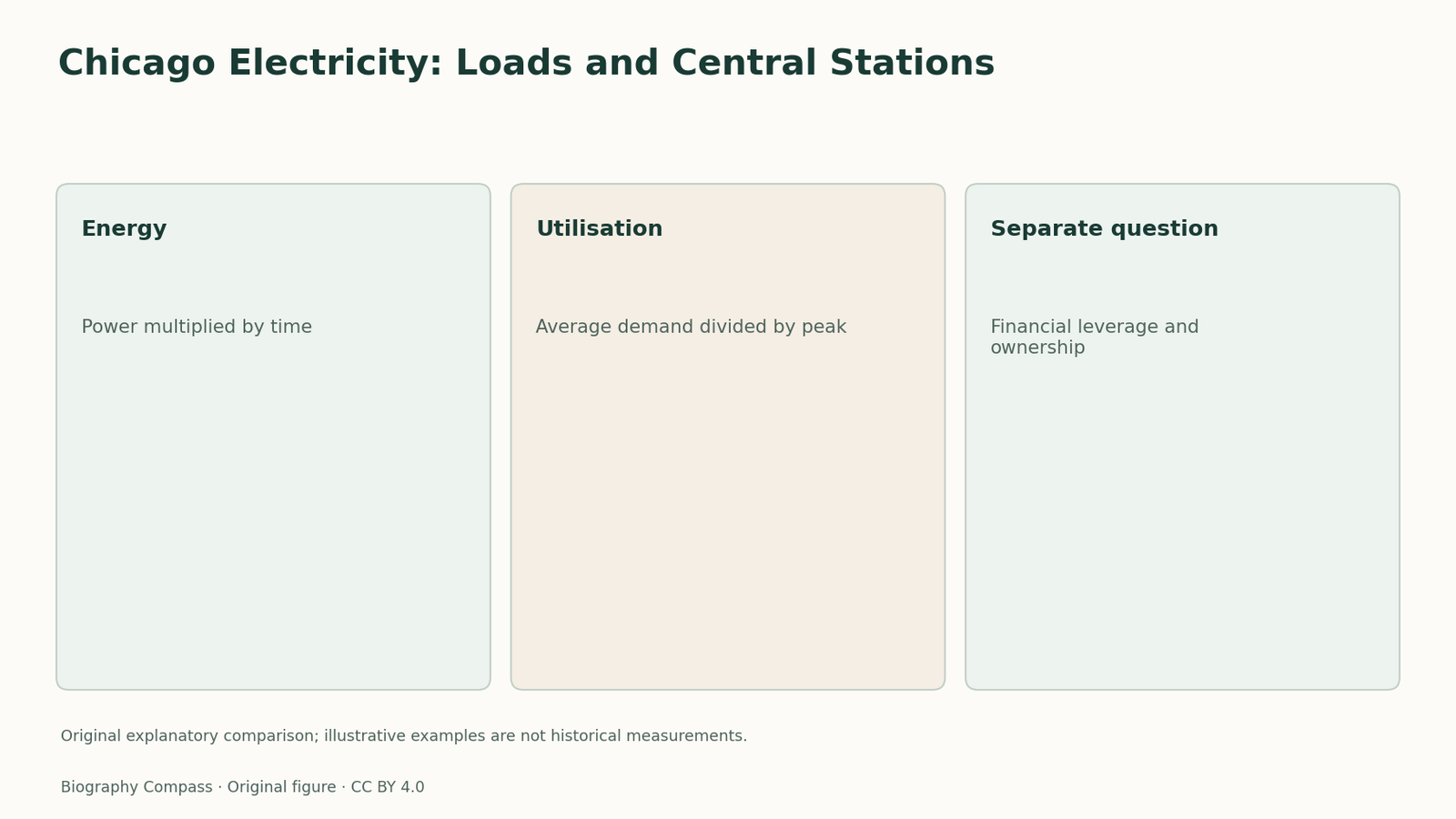
| Energy | Electricity consumed over time | Equal energy need not mean equal peak demand |
| Load factor | Average relative to maximum demand | Requires a common stated period |
| Finance | Borrowing and ownership structure | Not established by a utilisation ratio |
Why did Insull distinguish energy from maximum demand?
In his address of 17 May 1898 to Purdue’s electrical engineering department, Samuel Insull argued that the economics of central-station electricity depended on how customers used the system over time. Scientific American Supplement published the address on 25 June. The central distinction was between the electricity sold and the capacity required to supply it. Two users could purchase the same amount of energy yet present different peak demands. Insull’s explanation connects an engineering quantity with a business decision, while leaving the fairness and detailed design of any particular tariff open to further evidence.
Sources for this section: [4]
Load factor compares average demand with a peak
The address defines load factor through average use relative to maximum demand over the period considered. A system averaging fifty kilowatts while reaching a one-hundred-kilowatt maximum has a fifty per cent load factor. The period must be specified: an annual average cannot simply be compared with a peak measured over an unrelated interval. Insull supplied examples of different business types to illustrate varying utilisation. Those were his historical examples, not a modern sample that can be transferred unchanged to today’s offices, shops or homes.
Sources for this section: [4]
Installed capacity carried costs while use varied
Insull emphasised the capital committed to buildings, machinery and distribution. Equipment and conductors could be provided in anticipation of greater demand, while some expenses did not rise in direct proportion to every additional unit sold. This was the basis of his argument for considering utilisation when comparing costs. It did not mean that extra electricity had no production cost or that a higher load factor automatically made every investment profitable. His argument joined fixed commitments with the changing amount of useful service obtained from them.
Sources for this section: [4]
Metering and tariff proposals addressed different information
The address discussed several ways to charge for service, including different prices by time and arrangements related to maximum demand or hours of use. These approaches required information beyond a single undifferentiated energy total. A meter recording total consumption answered how much electricity had been used; another arrangement might establish when it was used or the maximum demand. The source therefore offers a useful comparison among measurements, rather than one universal formula. It also shows why the ability to measure a quantity and the decision to charge on that basis were connected but separate steps.
Sources for this section: [4]
Equal-energy exercise and checked answer
Consider two fictional customers: one uses ten kilowatts for four hours; the other uses five kilowatts for eight hours. Both consume forty kilowatt-hours, but their individual maximum demands differ. A total-energy bill alone would not display that difference. Can their individual peaks simply be added to establish the station’s actual peak? Only if the timing supports that calculation; non-coincident use produces a different combined pattern. Finally, would a high load factor prove that a holding company’s borrowing was safe? No. The checked answer separates utilisation of electrical capacity from leverage and financial structure, preserving the distinction between Insull’s operating argument and the later collapse of his business empire.
Continue the chronology
Related history guides
Biography context
Explore United States through connected lives
Connected biographies
People and wider context
1859–1938
Samuel Insull
electric-utility executive and business organiserSamuel Insull was an electric-utility executive and business organiser, known for Chicago central-station development, electricity pricing and regional utility finance.Read biographyQuick answers
Common questions
- Do two customers using equal kilowatt-hours necessarily create the same maximum demand?
- No. Ten kilowatts for four hours and five kilowatts for eight hours both use forty kilowatt-hours, but their individual peak demands differ.
Primary and institutional sources
How this history was checked
The source notes distinguish original records, institutional descriptions and later historical interpretation. Exercises and comparisons are original editorial analysis. This article was reviewed on 8 November 2026.
- Harold L. Platt, Encyclopedia of Chicago, Chicago History Museum and Newberry LibrarySamuel Insull: Electric Magnate
- Loyola University Chicago ArchivesSamuel Insull Papers: selected biographical notes and scope
- IEEE Engineering and Technology History WikiHistory of IEEE: central-station technical development
- Samuel Insull, Scientific American Supplement No. 1178; Project Gutenberg transcriptionThe Development of the Central Station, 25 June 1898