
The short answer
How did Ngee Ann Kongsi’s legal incorporation differ from its earlier community founding?
Compare the documents
Authority, evidence and limits
These records describe different responsibilities; one should not silently substitute for another.
| Record | What it establishes | What it does not establish |
|---|---|---|
| Kongsi institutional history | Distinguishes 1845 formation, 1933 incorporation and later schools. | The dates are not rival labels for an identical event. |
| Ordinance, preamble | Names Seah and other merchants in the earlier organisation. | A historical recital is not every later operative power. |
| Later revised legal text | Records the incorporated institution’s continuity and property framework. | Amended wording should not be silently dated back to 1845. |
Two dates describe different institutional events
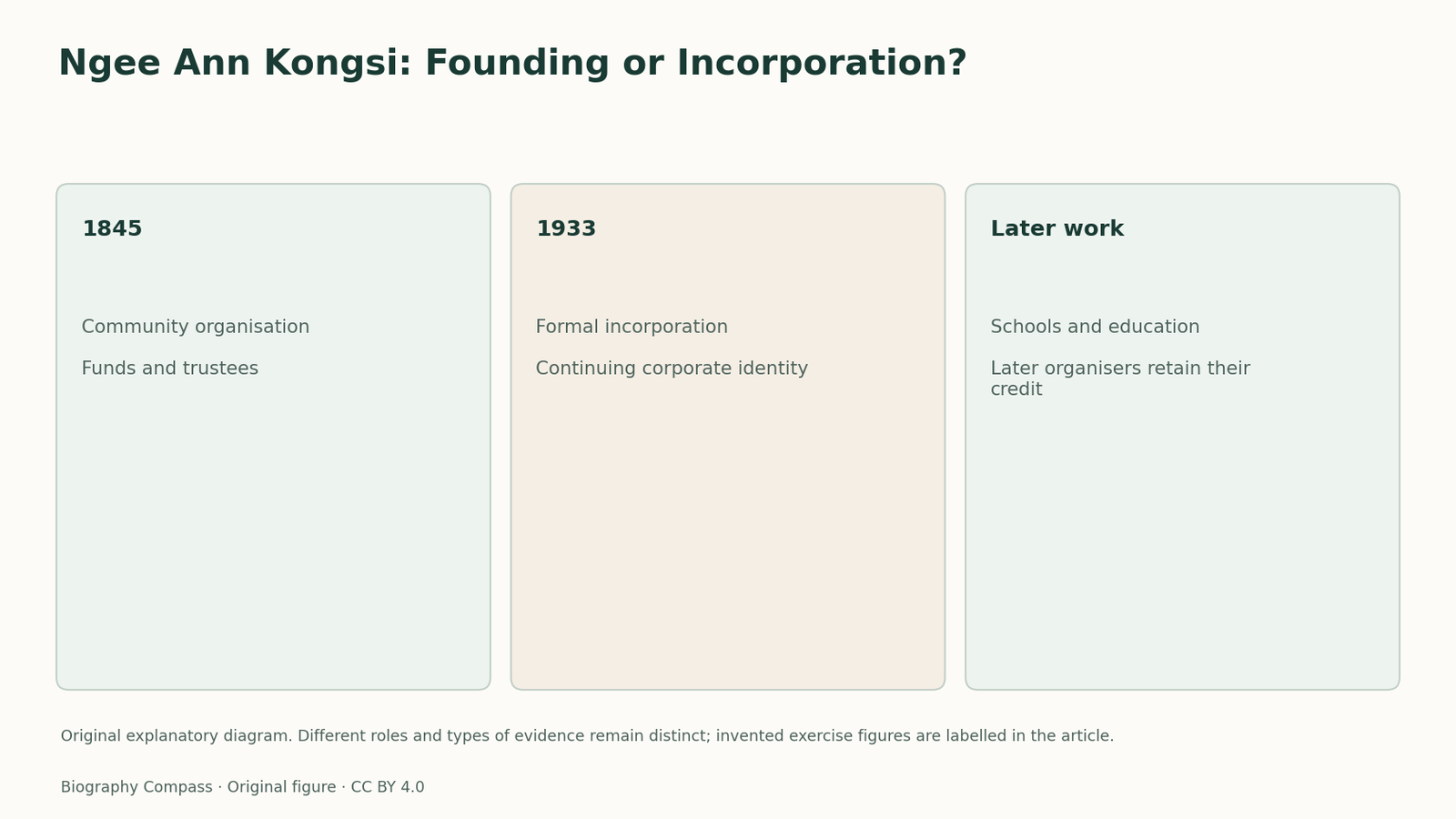
The Ngee Ann Kongsi’s own history dates its formation to 1845 and its formal incorporation to 1933. Those dates need not compete for a single true founding moment. The first concerns people organising resources and activities; the second concerns a later legal form. An institution can exist through trustees, meetings and shared purposes before receiving a corporate identity. That distinction prevents a search result headed 1933 from making the earlier community work disappear. It also avoids the reverse mistake of assuming that every legal power of the later body was already available in exactly the same form to the 1845 organisers.
The ordinance remembers a collective beginning
The ordinance’s preamble names Seah Eu Chin and twelve other merchants and records the earlier raising of funds and holding of property for religious and charitable purposes. A preamble can preserve the institution’s account of its origin while an operative provision changes its legal organisation. These parts of a document do different work. A reader should therefore distinguish the historical recital from the provisions concerning a continuing corporation and its property. The text consulted is a later revised version of the 1933 ordinance. Later amendments and expanded powers are not automatically evidence that the original founders adopted those same provisions in 1845.
Sources for this section: [4]
Continuity does not mean one person did everything
The institution’s history identifies schools and educational support developing after incorporation. Seah had died in 1883, so later educational milestones cannot be placed in his personal timeline as completed acts. They can be discussed as part of the continuing organisation’s legacy. This is a useful distinction between inheritance and authorship: a founder may help establish resources and relationships that others later use differently. The museum’s biographical account supplies the merchant’s nineteenth-century context, while the institutional chronology follows later work. Reading them together preserves continuity without turning decades of other people’s decisions into the accomplishment of a single celebrated founder.
Date-and-function exercise with reference answer
Prepare three original cards labelled 1845 community funds, 1933 incorporation and 1940 school. Ask which records would support a statement about the organisers, which would establish the corporate form, and which would concern later educational provision. The answer assigns the institutional history and ordinance’s founding recital to the first, the legal incorporation provisions to the second, and the later history to the third. Now test the sentence Seah founded the 1940 school. It fails on chronology because he died in 1883. A better sentence attributes the school to the continuing Kongsi and separately identifies his part in its earlier formation. The example is a reading exercise rather than a transcription of minutes; it shows why the dates on community, legal and educational records should remain attached to their actual functions.
Continue the chronology
Related history guides
Biography context
Explore Singapore through connected lives
Connected biographies
People behind the collaboration
1805–1883
Seah Eu Chin
Merchant and Teochew community organiserSeah Eu Chin combined a successful gambier-trading career with Teochew community organisation, helping establish the institution that became Ngee Ann Kongsi.Read biography1916–1983
Hon Sui Sen
Civil servant, development banker and finance ministerHon Sui Sen helped connect Singapore’s industrial promotion, development banking and public finance through leadership of EDB, DBS and the finance ministry.Read biographyQuick answers
Common questions
- Was Ngee Ann Kongsi created only in 1933?
- Its institutional history dates formation to 1845. The 1933 date concerns formal incorporation, a different event in the organisation’s development.
Primary and institutional sources
How this history was checked
The bibliography distinguishes contemporary records, retrospective participant accounts and later institutional research. Access limits and uncertain attributions are identified in the article; the exercise is an original teaching example. This article was reviewed on 7 November 2026.
- National Heritage Board SingaporePeranakan Museum gallery guide: Seah Eu Chin
- Singapore Biographical Database / National University of SingaporeSeah Eu Chin, biographical record
- The Ngee Ann KongsiHistory of The Ngee Ann Kongsi
- Singapore Statutes Online, current revised textNgee Ann Kongsi (Incorporation) Ordinance 1933