
The short answer
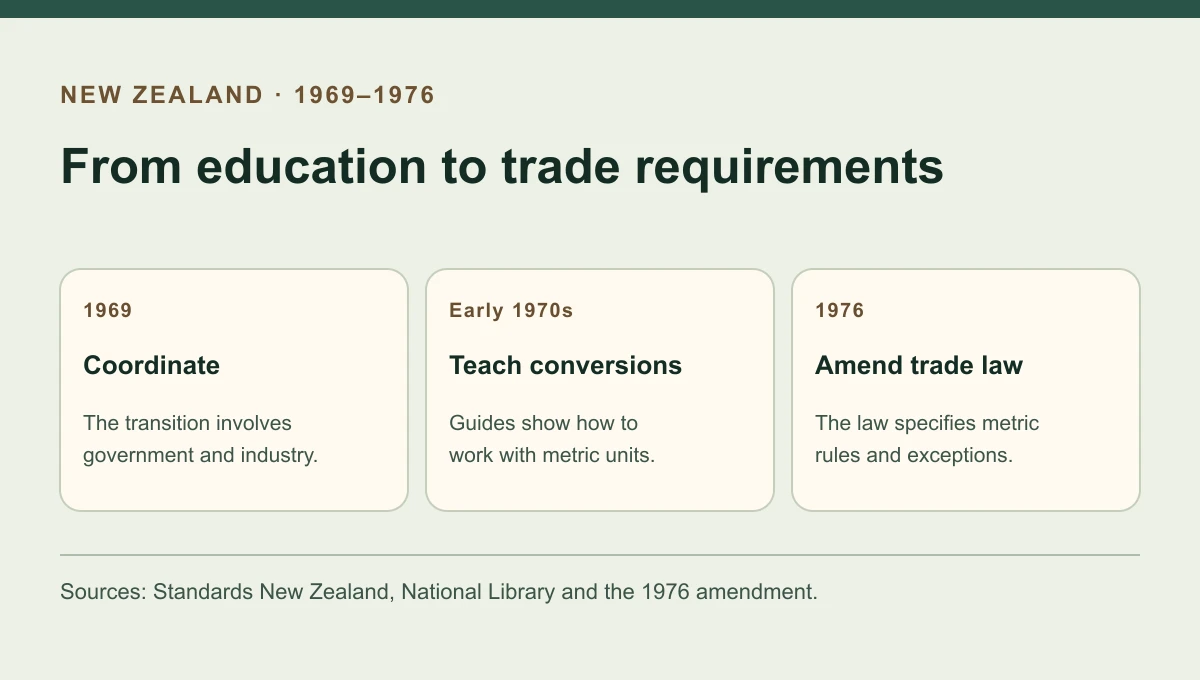
New Zealand began coordinating metrication in 1969 and changed its weights and measures law in December 1976. The years in between produced guidance on conversions, decimal arithmetic and standards. The legislation tied those preparations to the quantities in which traders sold and advertised goods.
Connecting public guidance to a transaction
What had to change in a shop?
A customer could meet the new system in a label, a weighing device and an advertisement.
| Point of contact | Example | Use of the unit |
|---|---|---|
| Weighing | Apples weighed in kilograms | The scale establishes the quantity. |
| Pricing | A price is quoted per kilogram | The unit tells the customer how to compare prices. |
| Advertising or packaging | A quantity is stated on a label or in an advertisement | The declared unit lets the customer compare offers before purchase. |
Chronology
A timeline of the turning points
A programme begins
Government adopts a phased approach and the Metric Advisory Board advises on voluntary conversion.
A standards publication supports adoption
New Zealand Standard 6501 sets out the International System of Units and its application.
Conversion guidance reaches workplaces
Booklets, tables and industry publications are produced.
Trade law changes
The amendment formalises the role of metric measurements in selling goods.
Why the board started with coordination
Standards New Zealand dates the decision to move to metric weights and measures to 1969. Its account describes an advisory board encouraging progressive voluntary adoption. The National Library’s collection shows what that work looked like in practice. Training publications covered decimal arithmetic, and industry guides supplied conversion factors for their readers.
Converting a set of measurements could mean preparing new worksheets, order forms and references for staff. That work could be done before a new requirement applied at a shop counter.
What the 1976 law changed for trade
A later government account dates the Weights and Measures Amendment Act to 14 December 1976 and explains its effect on selling and advertising by weight or measure. A measurable quantity mattered in several places at once: the instrument, the price and the quantity described to the customer.
The official account also distinguishes the policy in 1976 from the detailed rules under the 1987 Act. Later exceptions, including certain labels for imported products, need to be read against the relevant legislative text rather than treated as part of every earlier rule.
Why familiar speech could survive a statutory change
A person might still describe height in feet or refer to a pint in ordinary conversation. A trader needs to know how to declare a quantity under the applicable rules so that it can be compared with other offers. The distinction helps explain how metrication could visibly change the market while leaving customary expressions in daily life.
Continue the chronology
Related history guides
How New Zealand Separated Fair Trading and Consumer Guarantees
Follow later consumer statutes dealing with the accuracy of claims and the quality of goods.
Read the timeline1977How Canada Converted Its Building Code to Metric Values
Compare metric changes needed for technical building specifications.
Read the timeline1958–1959How Six Countries Agreed on the International Yard and Pound
Read about New Zealand’s participation in the earlier international yard and pound agreement.
Read the timeline1970–1981How Australia Put the Metric System on Its Roads
See how its neighbour converted road transport displays and public guidance.
Read the timelineConnected biographies
People connected to this history
Quick answers
Common questions
- When did New Zealand begin coordinating metrication?
- The Metric Advisory Board was established in 1969.
- When did the trade measurement amendment become law?
- The government’s anniversary account identifies 14 December 1976.
Primary and institutional sources
How this history was checked
Dates, legal milestones and historical claims are checked against the official and institutional records below. This article was reviewed on 19 November 2026.