
The short answer
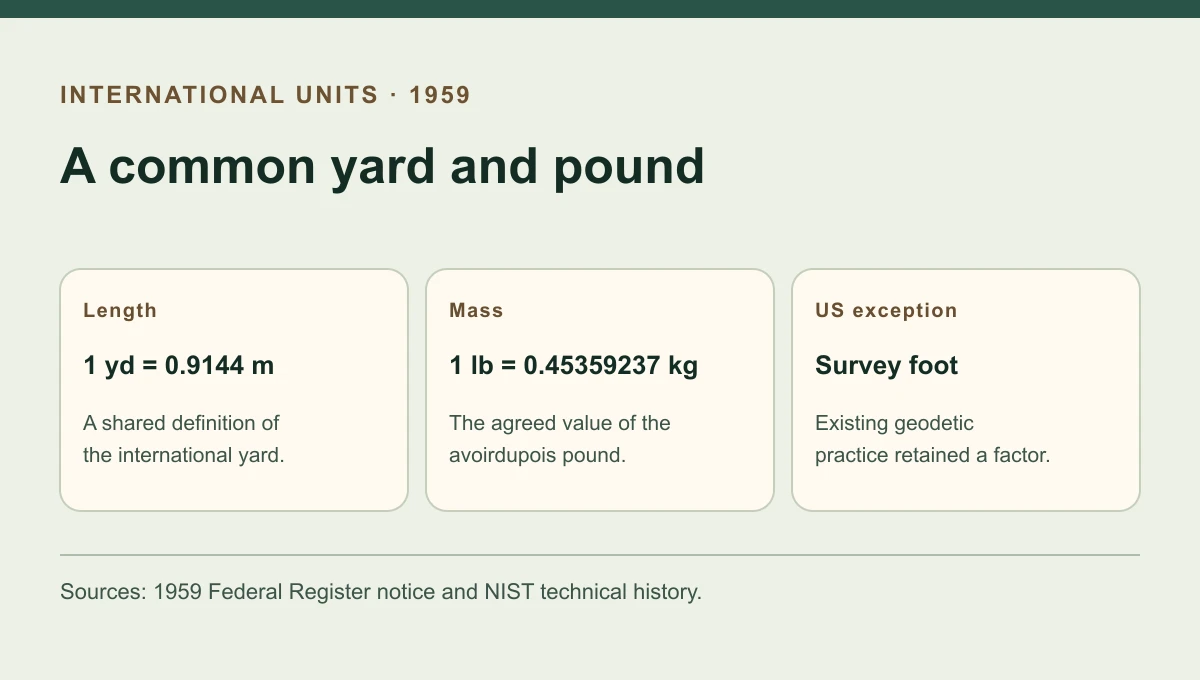
In 1959 the United States adopted the same yard and pound values as national standards laboratories in Australia, Canada, New Zealand, South Africa and the United Kingdom. One international yard became exactly 0.9144 metres and one international avoirdupois pound exactly 0.45359237 kilograms. A special provision retained the older foot for geodetic survey data in the United States.
Read the unit on the document
Three exact relationships
The notice specifies general definitions and a particular surveying exception.
| Reference | Exact stipulated value | Scope |
|---|---|---|
| International yard | 0.9144 m | Common length reference for the participating laboratories. |
| International avoirdupois pound | 0.45359237 kg | Common mass reference for the participating laboratories. |
| U.S. survey foot | 1,200/3,937 m | Older geodetic relationship retained by the U.S. notice for its stated survey purpose. |
Chronology
A timeline of the turning points
U.S. values tied to metric references
The underlying U.S. yard-to-metre relationship differs slightly from the later international value.
Standards officials coordinate
A meeting brings together officials from national measurement laboratories.
The U.S. values take effect
A Federal Register notice documents the definitions and preserves an exception for geodetic survey data.
U.S. survey foot is deprecated
New U.S. federal surveying applications transition to the international foot with provision for legacy data.
Why two yard values were worth reconciling
When countries derived the yard and pound from different national standards, small differences could appear when instruments were compared at high precision. The 1959 notice describes effects around a few parts per million or less, depending on the quantity and old comparison. The participating countries’ common exact values made precision specifications easier to exchange.
A person buying goods by the pound would see the same practical scale. At a precision workshop, an exact conversion gives the designer and the manufacturer the same basis for comparing measurements. Dividing the revised yard into 36 inches makes one inch exactly 25.4 millimetres.
Why the new foot needed an exception
Survey coordinates already published using the older ratio described a network of positions. Reinterpreting every coordinate as an international foot would alter its metric equivalent. The U.S. notice therefore preserved the old relationship for geodetic survey data rather than requiring a reinterpretation.
The international foot is 0.3048 metre. The survey foot is about two parts per million longer. If a legacy survey value is expressed in feet, knowing the stated reference and the survey context matters when converting it to metres.
Continue the chronology
Related history guides
How Singapore’s Fabric Shops Switched from Yards to Metres
Work through the effect of converting a fabric price from yards to metres.
Read the timeline1975–1988What the U.S. Metric Conversion Act Actually Required
Compare the later U.S. policy for increasing metric use.
Read the timeline1969–1976How New Zealand Made Metric Units Standard in Trade
Follow New Zealand from exact customary equivalents to metric retail rules.
Read the timeline1970–1981How Australia Put the Metric System on Its Roads
Follow how Australia later coordinated metric speed and distance displays.
Read the timeline1965–1969How Britain Organised Industrial Metrication
See how Britain separately organised industrial metrication.
Read the timelineConnected biographies
People connected to this history
Quick answers
Common questions
- Which countries coordinated the international yard and pound in 1959?
- The U.S. notice identifies Australia, Canada, New Zealand, South Africa and the United Kingdom as taking up the same standards as the United States.
- Is the international foot the same as the U.S. survey foot?
- Their exact ratios differ slightly. The international foot is 0.3048 metre. The survey foot historically used 1,200/3,937 metre.
Primary and institutional sources
How this history was checked
Dates, legal milestones and historical claims are checked against the official and institutional records below. This article was reviewed on 19 November 2026.
- United States National Bureau of StandardsFederal Register, 1 July 1959: Refinement of Values for the Yard and the Pound
- United States National Bureau of Standards1959 Research Highlights and Annual Report
- National Institute of Standards and TechnologyNIST Guide to the SI, Appendix B: Conversion Factors
- National Institute of Standards and TechnologyU.S. Survey Foot: Federal Register Notices