
The short answer
How does Holland’s announcement differ from evidence of the emergency restrictions?
Evidence comparison
Read the records together
The records were created for different purposes and support different kinds of claims.
| Record | What it establishes | Question to keep open |
|---|---|---|
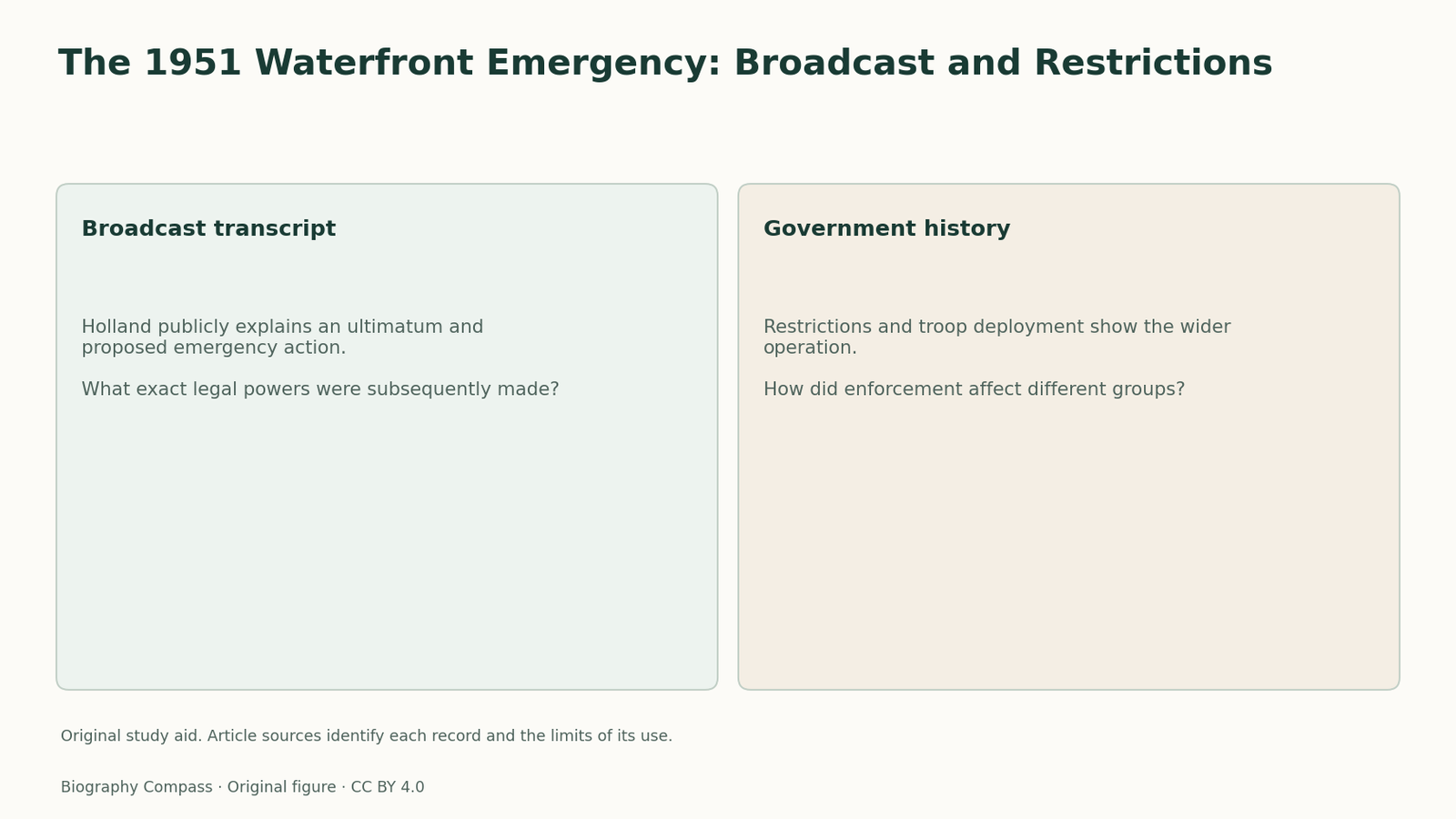
| Broadcast transcript | Holland publicly explains an ultimatum and proposed emergency action. | What exact legal powers were subsequently made? |
| Government history | Restrictions and troop deployment show the wider operation. | How did enforcement affect different groups? |
Chronology
A timeline of the turning points
Emergency announced
Holland explains the government’s position.
Troops deployed
Service personnel work the Auckland and Wellington wharves.
Identify the announcement’s argument
Holland’s broadcast described a warning to waterside representatives and an ultimatum about resuming normal work. He presented the emergency proclamation as a response to the failure of that condition. The transcript provides direct evidence of the public justification he chose. It does not supply the full legal wording of every regulation or establish that the workers accepted the government’s account of how the dispute had developed.
Sources for this section: [2]
Follow the restrictions beyond the broadcast
The government history describes censorship, expanded police powers and restrictions on assistance to strikers. It also dates the use of troops on the wharves to 27 February, after the emergency declaration. These are different events from the announcement itself. To explain the operation of emergency government, readers need the sequence of proclamation, restrictions and enforcement, rather than using a forceful speech as shorthand for everything that followed.
Sources for this section: [3]
Compare institutions and audiences
A broadcast addresses the public and seeks acceptance for executive action. Regulations create a legal framework, while police and troop activity demonstrate its enforcement. Holland’s political biography places those events within his government and the later election. The records can be connected without merging their evidentiary roles. Electoral support after the confrontation, for example, does not determine whether every restriction was necessary or show how each affected family experienced it.
Build a powers-and-impact chart
Write separate rows for speech, proclamation, censorship and troop deployment. In each row identify the actor, date where available and type of evidence needed to assess impact. A careful answer leaves the precise legal terms to the regulation text and uses the historical account for the documented restrictions. It can then ask about access to information, support for families and port activity without assuming that the announcement alone answers all three questions.
Continue the chronology
Related history guides
Biography context
Explore New Zealand through connected lives
Connected biographies
People behind the records
1893–1961
Sidney Holland
National Party leader and prime ministerHolland consolidated the National Party, became prime minister in 1949 and used emergency powers during the bitter waterfront confrontation of 1951.Read biographyQuick answers
Common questions
- Is the broadcast the text of the emergency regulations?
- No. It records Holland’s announcement and justification. The regulations and their enforcement require separate records.
Primary and institutional sources
How this history was checked
Sources support the chronology and the record comparison. The reading exercise is original. This article was reviewed on 7 November 2026.