
The short answer
What conditions stood between a district’s petition and the creation of a new province?
Evidence comparison
Read the records together
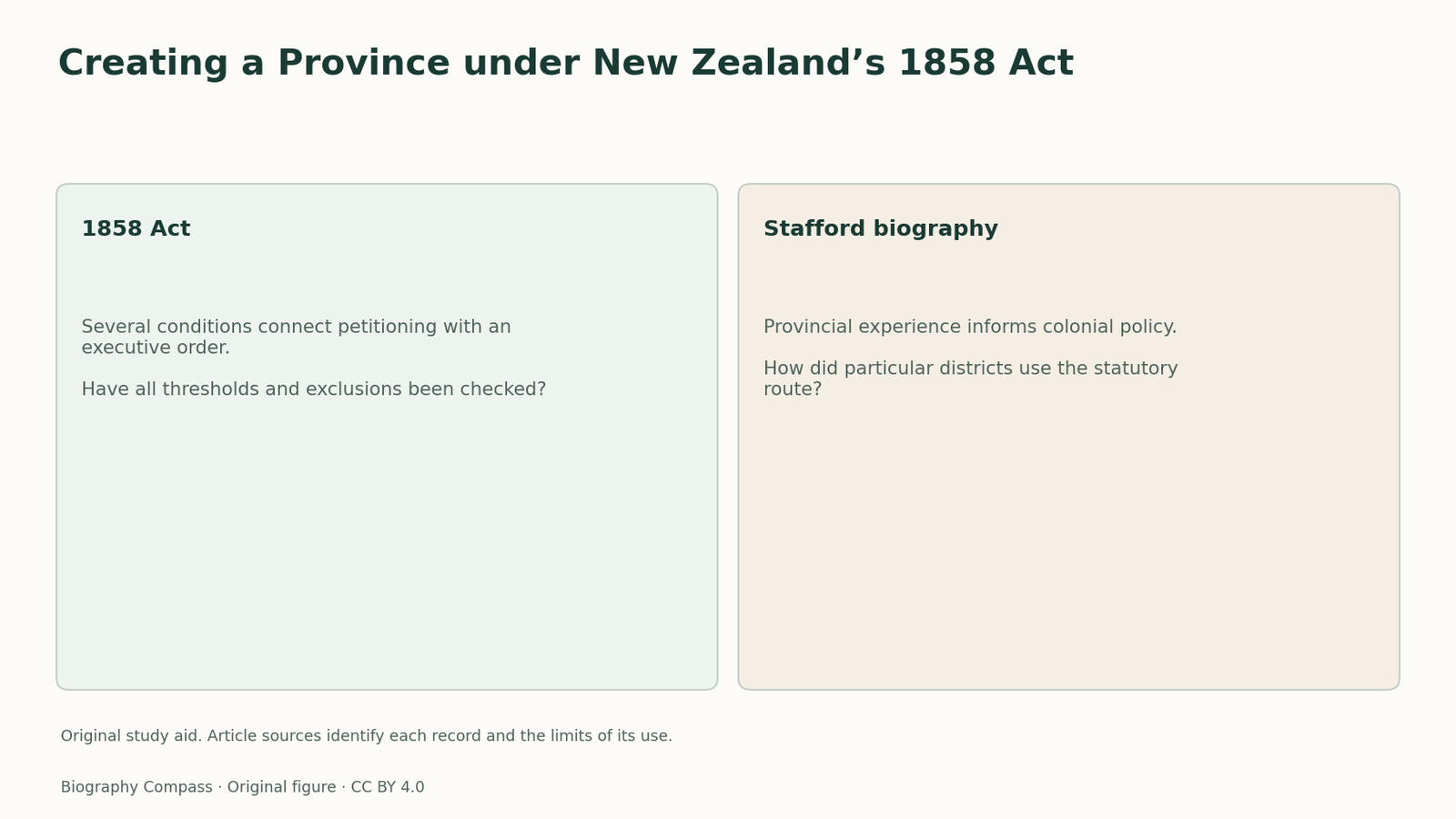
The records were created for different purposes and support different kinds of claims.
| Record | What it establishes | Question to keep open |
|---|---|---|
| 1858 Act | Several conditions connect petitioning with an executive order. | Have all thresholds and exclusions been checked? |
| Stafford biography | Provincial experience informs colonial policy. | How did particular districts use the statutory route? |
Chronology
A timeline of the turning points
Nelson superintendent
Stafford begins provincial leadership.
Colonial premier
He forms a ministry.
New Provinces Act
A statutory route to separation is established.
Read the petition threshold in full
The Act begins with a petition by at least three-fifths of specified registered electors resident in a sufficiently large district. It also sets a minimum number of signatories and further conditions. These tests work together. A district meeting one threshold did not thereby demonstrate that it satisfied every requirement. The statute expressly excluded Māori from parts of the qualifying counts, making the limits of colonial political recognition visible within its administrative machinery.
Sources for this section: [2]
Follow the petition to an order
The Governor in Council was to establish a qualifying province by an order published in the Gazette. A petition and the order therefore have different legal positions. The petition requests action and demonstrates the claimed support; the order identifies the government’s formal act. Other provisions deal with boundaries, timing, councils and the continuation of laws from the original province. Creation did not mean that every institution and rule had to begin from nothing.
Sources for this section: [2]
Place the mechanism in provincial politics
Stafford’s route from Nelson superintendent to colonial premier helps explain why provincial organisation was a central policy issue. Local self-government could be supported while disagreement continued over the scale and number of its units. The Act offered a defined mechanism within that debate. Its existence does not prove that every district wanted separation or that all residents were represented by the registered electors whose petitions counted under the statute.
Build a qualification checklist
Create separate boxes for elector share, minimum signatories, area, population and the executive order. Add a visible note about who was excluded from the historical counts. A sound answer checks every condition before marking a district qualified and keeps qualification separate from the published act of establishment. The checklist makes the procedure intelligible while avoiding a celebratory account that treats colonial registration as if it included everyone in the proposed province.
Continue the chronology
Related history guides
Biography context
Explore New Zealand through connected lives
Connected biographies
People behind the records
1819–1901
Edward Stafford
Provincial superintendent and colonial premierStafford moved from Nelson’s provincial leadership into colonial government, pursuing administrative coordination while the provinces’ powers were contested.Read biographyQuick answers
Common questions
- Did a petition alone create a province?
- The Act required qualifying conditions and a formal order. Petitioning was one part of the procedure.
Primary and institutional sources
How this history was checked
Sources support the chronology and the record comparison. The reading exercise is original. This article was reviewed on 7 November 2026.