
The short answer
Why did unions’ positions within the arbitration system matter during the strike?
Evidence comparison
Read the records together
The records were created for different purposes and support different kinds of claims.
| Record | What it establishes | Question to keep open |
|---|---|---|
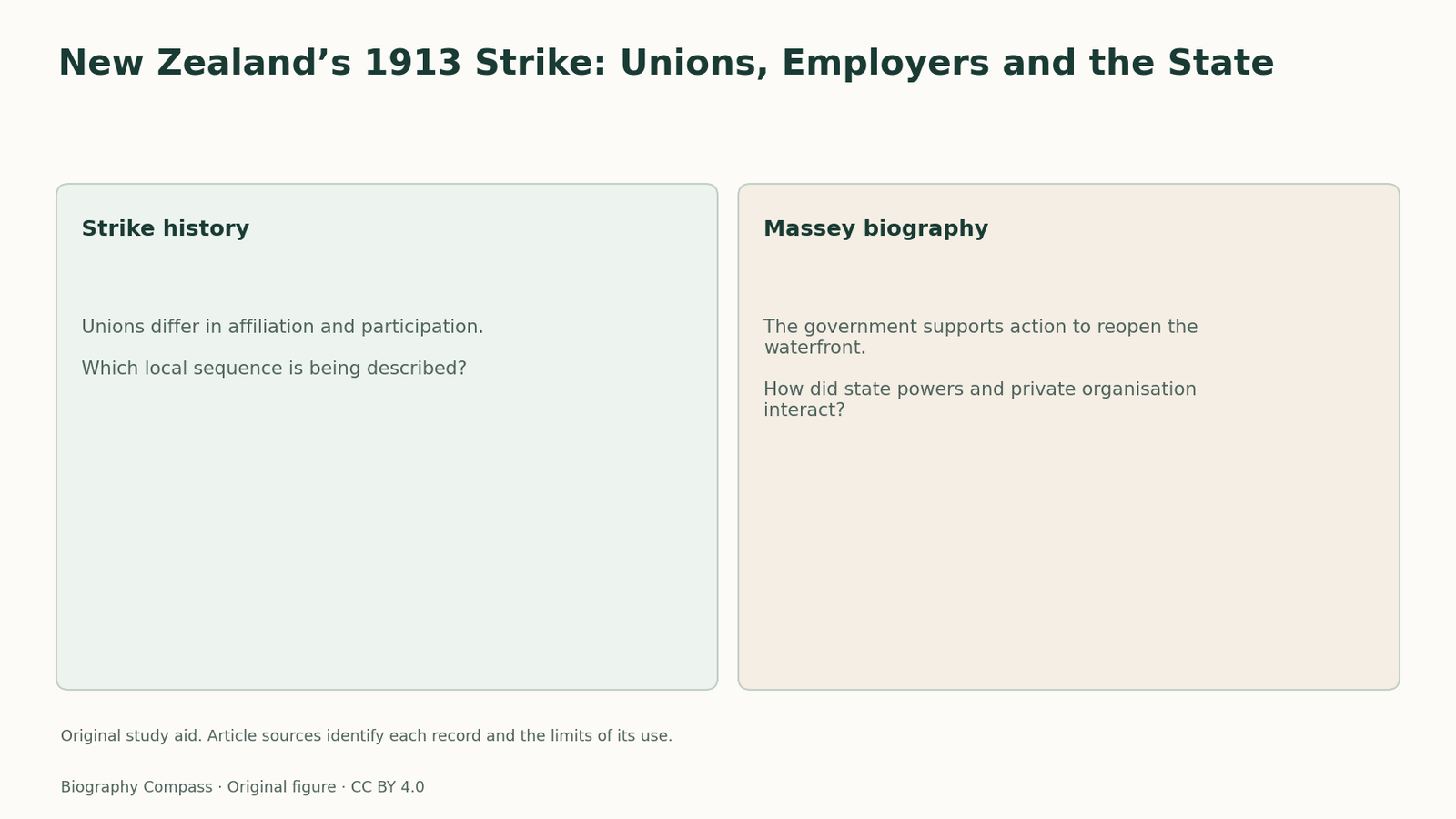
| Strike history | Unions differ in affiliation and participation. | Which local sequence is being described? |
| Massey biography | The government supports action to reopen the waterfront. | How did state powers and private organisation interact? |
Chronology
A timeline of the turning points
Reform takes office
Massey becomes prime minister.
Strike wave
Waterfront and mining disputes spread through several occupations.
Start with more than one dispute
The strike wave began with disputes at Huntly and the Wellington waterfront before spreading across occupations and places. It was therefore a connected series of stoppages rather than one workplace grievance scaled uniformly across the country. Identifying its points of origin helps explain why different unions joined at different times. The national description should preserve local sequences instead of implying that every participating worker received the same instruction on the same day.
Sources for this section: [2]
Locate the arbitration boundary
Many striking unions belonged to the United Federation of Labour and had withdrawn from the arbitration system in favour of direct negotiation. Other unions generally remained within that system and declined to join, although Auckland’s general strike brought wider participation. Registration and affiliation therefore help explain differences within labour. A claim that all unions were on one side would erase an institutional distinction that affected strategy and the willingness to take industrial action.
Sources for this section: [2]
Identify the state’s contribution
Massey’s government gave support to defeating the strike, while employer and farmer organisations mobilised their own resources. Mounted special constables, many from rural communities, entered port cities to help reopen the wharves. State action and organised private interests should both appear in the account. Their cooperation did not make them identical institutions, nor does the government’s success establish that all citizens accepted its interpretation of the conflict.
Map the actors before the outcome
Draw separate boxes for direct-action unions, arbitration unions, employers, farmer organisations and government. Connect the boxes only where the sources identify support or opposition. Mark Auckland as a case requiring attention to its own sequence. A useful answer explains why reopened wharves depended on institutional alliances as well as force. The map turns a two-sided slogan into a clearer account of the groups whose different positions shaped the confrontation.
Continue the chronology
Related history guides
Biography context
Explore New Zealand through connected lives
Connected biographies
People behind the records
1856–1925
William Massey
Reform Party leader and prime ministerMassey led Reform into government in 1912, backed action against the 1913 strikers and later governed through the pressures of the First World War.Read biographyQuick answers
Common questions
- Did every union join the strike?
- No. Participation varied, and unions remaining in arbitration generally took a different position, with important local exceptions.
Primary and institutional sources
How this history was checked
Sources support the chronology and the record comparison. The reading exercise is original. This article was reviewed on 7 November 2026.