
The short answer
How does following one household change the questions we ask about progress and economic change?
Compare the records
Weather, tenancy and industrial change
Use the categories to ask a more precise question of a particular passage.
| Pressure | Question to ask | Evidence needed |
|---|---|---|
| Weather | What happens to the harvest or household? | The particular narrated event. |
| Tenancy | Which obligation or land relationship persists? | The terms described in the story. |
| Industrial change | Who receives opportunities or bears costs? | An identified character and a supported causal connection. |
Begin with the voice telling the story
The publisher’s reader guide identifies Rukmani as a first-person narrator looking back over her life. That framing gives an immediate reading task: separate what she experienced, what she remembers and how she presents it. Her story is a fictional perspective, not a census of every Indian village or an autobiography by Markandaya. When studying a passage, identify the speaker and the moment being recalled before turning a statement about one family into a larger claim. The distance between experience and recollection is part of the narrative question.
Sources for this section: [3]
Distinguish several pressures on a household
The book descriptions place Rukmani and Nathan’s agricultural livelihood beside drought, monsoon damage, poverty and the expansion of a tannery. These pressures need not work in the same way. Weather can damage a harvest; tenancy concerns the conditions under which a family uses land; industrial change can redistribute work and opportunity. This comparison is an analytical aid rather than a list of interchangeable causes. A useful reading asks which pressure a particular scene makes visible and which family member bears its consequences.
Compare the publisher’s different frames
Penguin India introduces the novel through development in a newly independent nation. The Signet teacher guide emphasizes a conflict between agricultural culture and industrial capitalism. Those are useful frames to compare, but neither replaces the narration. Ask what becomes more visible when a synopsis highlights national hope, household endurance or economic transformation. The point is to test the frame against a passage in the reader’s edition. Terms such as progress or resilience need an identified subject: whose opportunities expand, whose security weakens and whose account the narrative permits us to hear.
Original evidence-sorting exercise
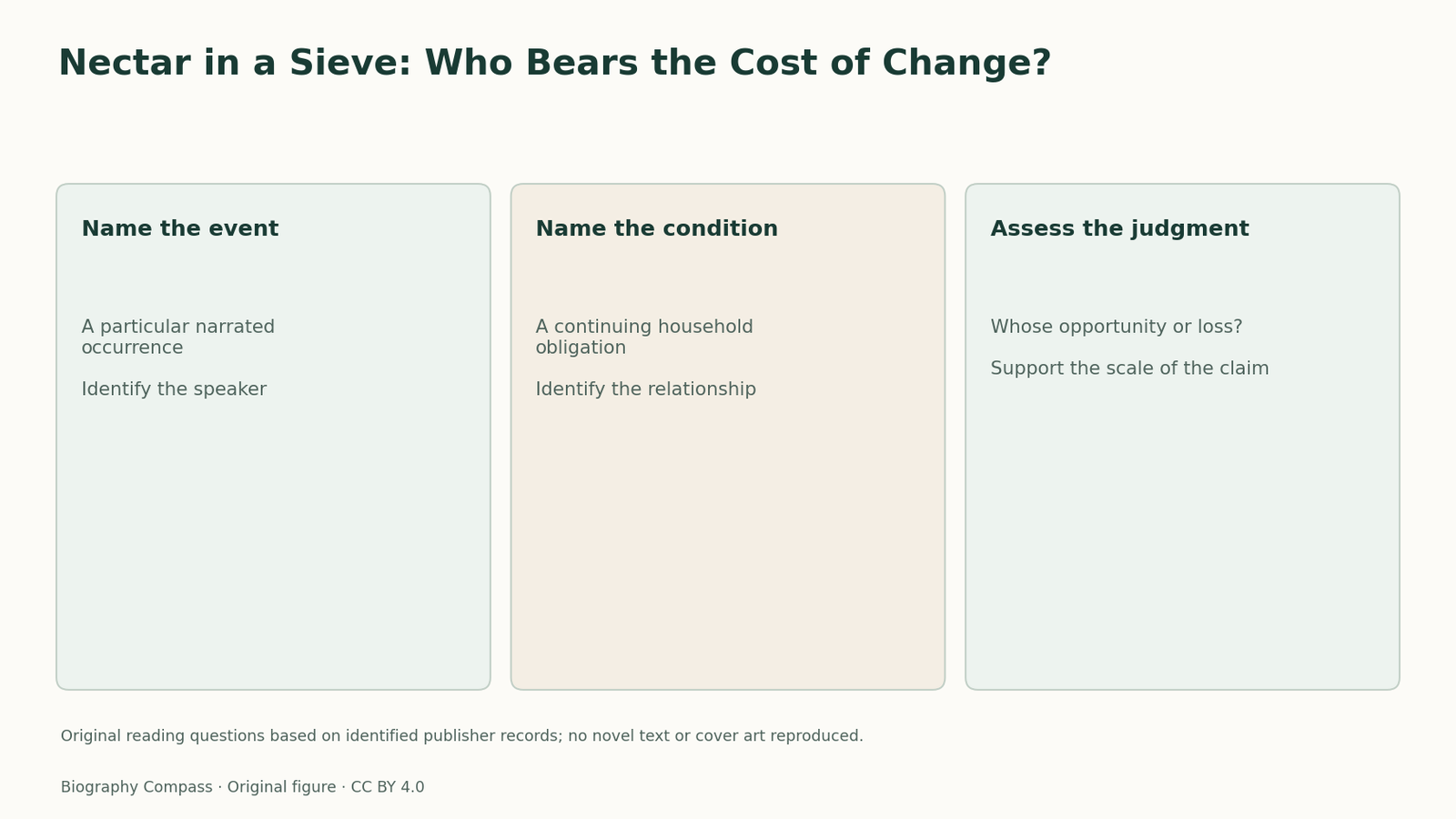
Make three columns labelled event, condition and interpretation. Place an explicitly described flood under event. Place a recurring obligation to pay rent under condition. Place a statement such as this change improves life for everyone under interpretation. These are editorial examples, not quotations from the novel. Then choose a passage from your copy and decide whether it actually supports all three kinds of claim. Record who speaks and what evidence is available in that passage. Do not fill a missing causal link merely because it would make a neat account of modernization.
Reference answer: keep the scale of the claim visible
A strong answer can explain why a damaged harvest and a continuing rent obligation affect the same household through different mechanisms. It can also recognize that a general judgment about industrial development requires more than the fortunes of one fictional family. This does not reduce the novel’s value: following particular lives can reveal questions that an aggregate description passes over. To develop the answer, compare a publisher’s introductory frame with Rukmani’s account, identify where they emphasize different things and support the comparison with a passage rather than an invented quotation.
Continue the chronology
Related history guides
Biography context
Explore India through connected lives
Connected biographies
Novelists and related reading
1924–2004
Kamala Markandaya
Novelist and journalist writing in EnglishKamala Markandaya, the pen name of Kamala Purnaiya Taylor, wrote Nectar in a Sieve and other novels after moving from India to England in 1948.Read biographyQuick answers
Common questions
- Is Rukmani the novelist?
- No. She is the novel’s narrator; Kamala Markandaya is its author.
- Does this guide reproduce the novel?
- No. It provides a source-based reading framework and original exercises; close textual claims should be checked against the reader’s edition.
Primary and institutional sources
How this history was checked
Publisher descriptions and identified teaching frames support this reading framework. No complete novel, foreword or afterword read is claimed. This article was reviewed on 8 November 2026.
- Penguin Random House IndiaNectar in a Sieve — author biography and edition record
- Penguin Random HouseNectar in a Sieve — Signet edition and author record
- Penguin Random HouseNectar in a Sieve — Reader’s Guide
- Signet / Penguin Random HouseA Teacher’s Guide to the Signet Classic Edition of Nectar in a Sieve
- ERIC, U.S. Department of Education repositoryNectar in a Sieve, selected teaching record