
The short answer
How does the novel’s temporal arrangement change the meaning of return and family memory?
Read the evidence
Sources, interpretation and production roles
The records answer different questions about this work. The final exercise is an original teaching model.
| Record or question | Supported reading | Boundary or contrast |
|---|---|---|
| Author interview | Explains a movement backwards into remembered experience. | It is not a full chapter-by-chapter structural inventory. |
| Publisher synopsis | Names the siblings and unequal responsibilities around the home. | A synopsis is not a substitute for quoting unseen scenes. |
| Original card exercise | Distinguishes life chronology, reading order and publication date. | No fictional prose or dialogue is copied. |
A return that opens into the past
Clear Light of Day was published in 1980. The publisher introduces Tara returning to the Das family home in Delhi, where Bim and Baba remain. A familiar place creates an encounter between lives that have moved differently. The apparent sameness of the house is therefore not the end of the story: it provides the conditions in which older relationships become newly visible.
The author’s account of narrative direction
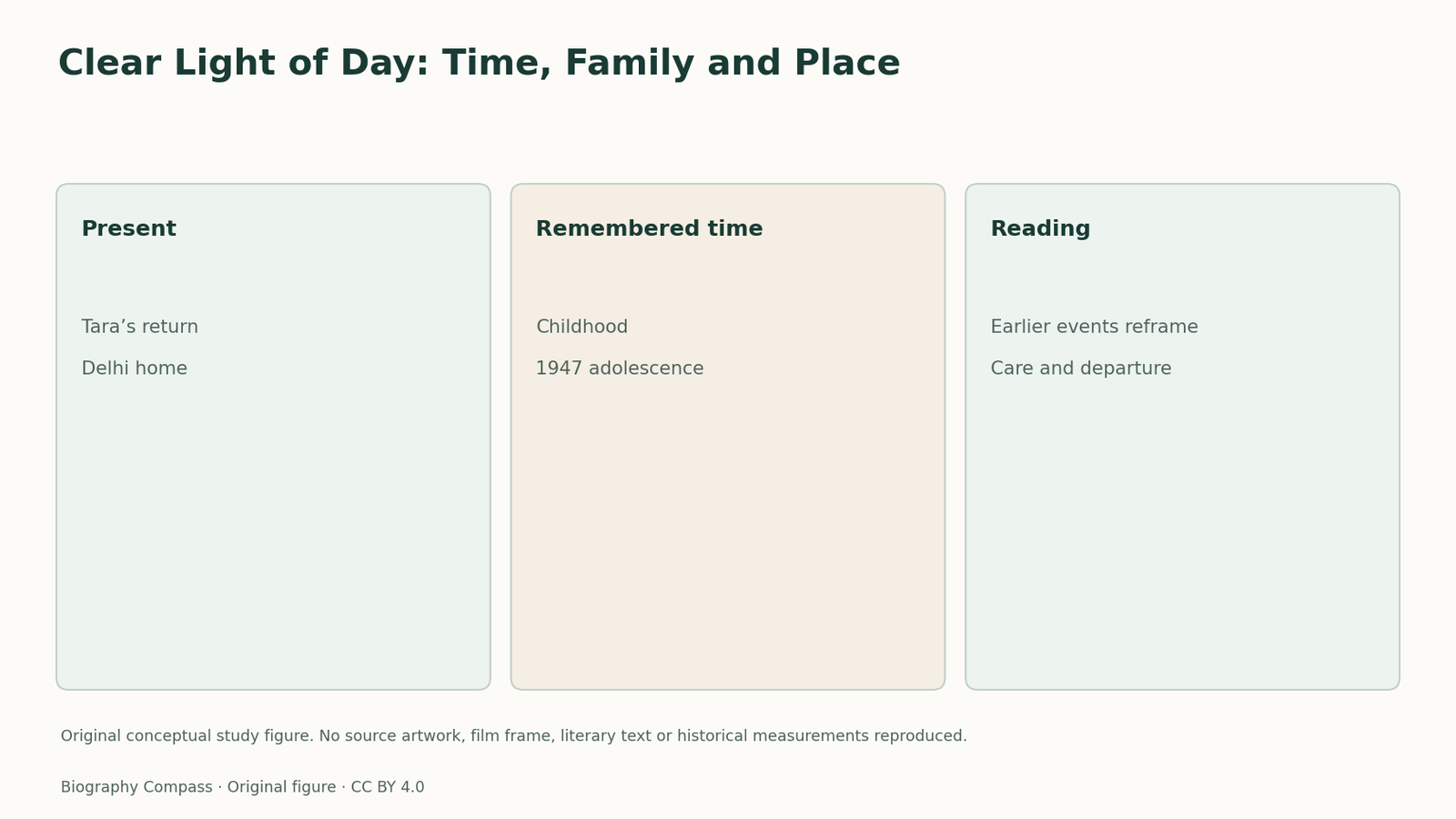
Desai told the Booker interviewer that she wanted the novel to move backwards into the past rather than simply travel forwards. The account distinguishes the order in which a reader learns from the chronological order of a family’s life. Earlier experiences can change the meaning of a present encounter even though the events themselves happened long before it. This is a positive function of memory within narrative, not merely an interruption of action.
Sources for this section: [1]
Care, departure and the same home
The publisher identifies Bim’s continuing responsibilities and the tensions surrounding Tara’s departure and Raja’s distance from the household. These roles make the house more than a scenic location. Remaining and leaving have consequences for who performs care and who remembers the past from elsewhere. Desai also distinguishes her remembered setting from invented characters. That makes the work a fiction about relationships, rather than a code in which every sibling must be matched to a real member of her family. The home’s apparent stability makes the difference especially sharp: one location can hold conflicting memories and changed responsibilities. Returning to it does not make the characters return to the same moment or the same position within the family.
Original exercise: two orders for three cards
Create three cards labelled childhood household, 1947 adolescence and adult return. Arrange them first as a life chronology and then as a reader’s movement from a present encounter into earlier experience. This is a study model based on the author’s account, not a claim that it reproduces every chapter’s exact sequence. A reference answer places childhood before adolescence in the chronology, while the second arrangement begins with the return and asks earlier events to explain it. Add a question about Bim: how might knowing more about care responsibilities change a reader’s response to conflict in the present? A supported answer says that an apparently difficult encounter can acquire a history of uneven obligations, without making any character’s interpretation automatically final. The exercise links form with an actual relationship rather than treating flashback as a decorative technique. Finally distinguish the 1980 first publication from a later publisher’s edition date. The work’s past, its narrative ordering and its publication history are separate timelines, each useful for a different question.
Continue the chronology
Related history guides
Biography context
Explore India through connected lives
Connected biographies
People and related creative practices
1937–present
Anita Desai
Indian novelist, short-story writer and teacherAnita Desai developed a fiction career attentive to language, memory and family relationships before extending her professional life into teaching in the United States.Read biography1906–2001
R. K. Narayan
Novelist, short-story writer, essayist and reteller of epicsR. K. Narayan built a long English-language writing career around Malgudi, an imagined South Indian town. Novels, stories, memoir and retellings of older narratives gave that small fictional world a wide international readership.Read biography1927–present
Nayantara Sahgal
Indian novelist, memoirist and political journalistNayantara Sahgal developed an English-language career spanning memoir, political journalism and fiction, repeatedly examining how public power enters private life.Read biographyQuick answers
Common questions
- Why distinguish chronology from narrative order?
- Earlier events can be revealed after a present encounter and change the reader’s understanding of it without changing when those events happened.
Primary and institutional sources
How this history was checked
Sources include production records, institutional collections and the specifically identified passages discussed here. Interpretations and teaching models are distinguished from credits and publication facts. This article was reviewed on 8 November 2026.
- The Booker Prizes, Sarah ShaffiAnita Desai interview on Clear Light of Day
- The Booker PrizesAnita Desai author and nominated books
- MIT LibrariesProfessor Anita Desai
- Penguin Random House IndiaClear Light of Day
- The Booker PrizesClear Light of Day, 1980 shortlist
- Alamgir Hashmi, International Fiction ReviewA Reading of Anita Desai’s Clear Light of Day
- Sahitya AkademiSahitya Akademi award list, English