
The short answer
A working register and a successful demonstration answer different questions. This study follows the boundary between what a device records and what a trained seller persuades a merchant to expect.
Evidence and interpretation
A machine, a lesson and an inference
Each part contributes something different to a merchant’s decision.
| Question | Record or explanation | What to keep distinct |
|---|---|---|
| Product function | Visible entry and accumulated receipts. | Not automatic verification of every sale. |
| Sales education | A repeatable explanation for agents. | Original lesson wording was not read. |
| Classroom case | Slips 20; cash 20; entries 13. | A discrepancy is a starting point for inquiry. |
Start with what the machine made visible
The Smithsonian describes a large display of the amount paid and a locked compartment tallying receipts. Its early Ritty object is either an original first machine or an early replica; NCR displayed it in a company-history exhibit by 1904.
The display lets a customer or observer see an entered amount. The tally provides a separate total to compare with cash. Neither feature, on its own, establishes that every sale was entered correctly. A machine changes the evidence available; it does not make the organisation using it incapable of error or theft.
Sources for this section: [1]
How experience became teachable
The NCR fellowship’s account dates the Hall of Education to 1893 and the Far Hills training tents to the following year. It connects the later primer to Joseph H. Crane’s explanation of his own selling experience.
A convention demonstration can show an action. Written instruction allows an organisation to repeat the explanation through different agents and places. That changes the business from dependence on one persuasive individual to a process others can learn. The original primer was not obtained, so this account does not invent its exact script, sequence or objections.
Sources for this section: [2]
Do not confuse a demonstration with an audit
The employee-community biography presents Patterson’s register purchase as a response to lost or unrecorded transactions. Its profit anecdote belongs to a retrospective founder story, not a comparative trial.
For a customer, the relevant question is not simply whether the keys move. Ask what record is produced, who can inspect it, when it is compared with the money and what happens if the two disagree. A staged correct entry demonstrates an operation. A period of reconciled records would be evidence about a merchant’s use of the device. These are complementary forms of evidence, with different limits.
Sources for this section: [3]
A useful classroom demonstration
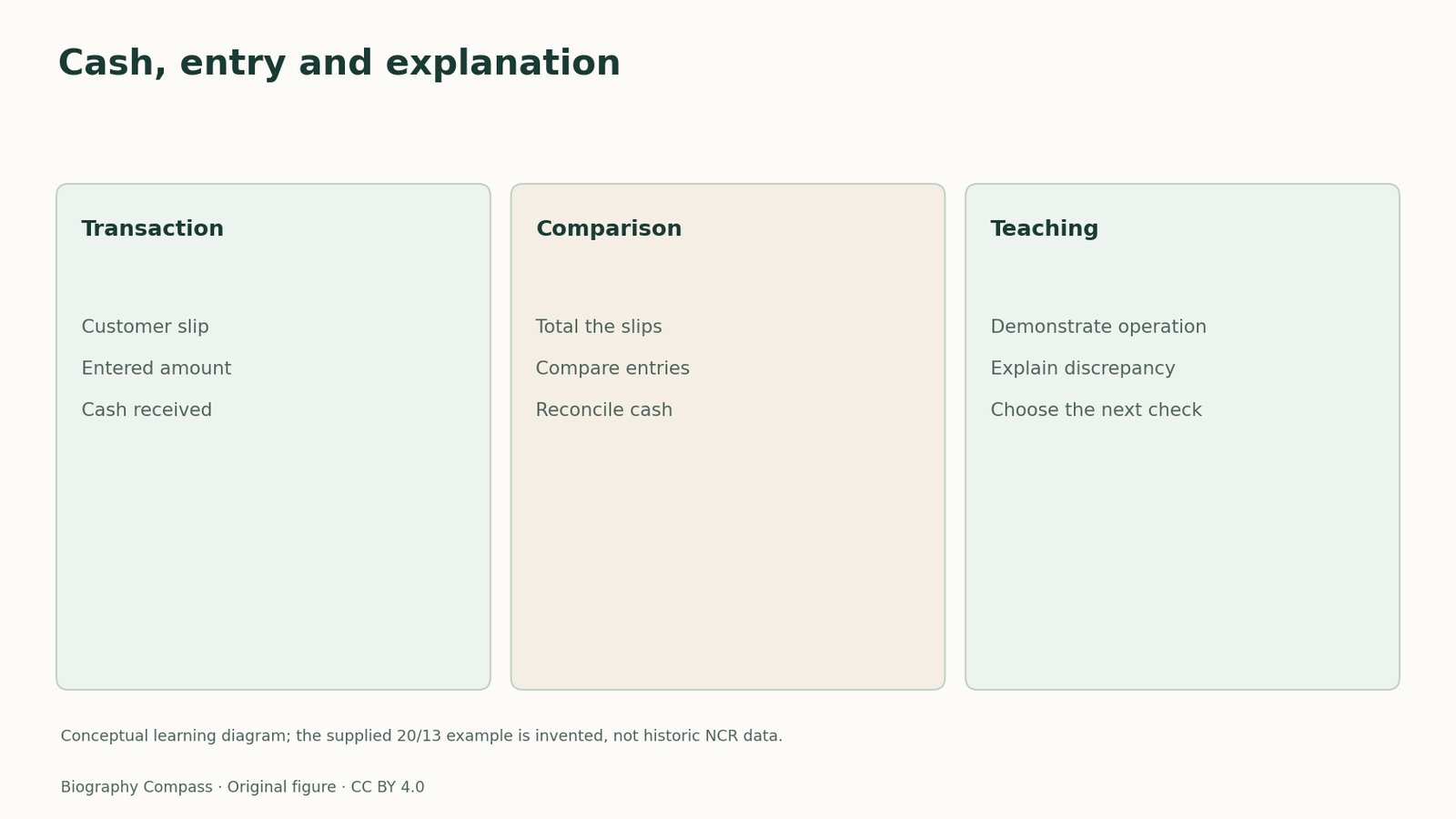
Use a made-up shop with three cash sales: 4, 7 and 9 units. Give one learner the customer slips, one the register entries and one the cash total. First enter all three sales. Then repeat with the middle sale missing from the register but its cash still in the drawer. What can each observer detect?
Reference answer: the slips and cash total are 20; the incomplete register total is 13. The discrepancy identifies a recording problem but does not, by itself, identify theft or the responsible person. Ask learners to propose the next record to inspect. This case illustrates why training has to include interpretation and a follow-up procedure as well as operating a machine. It is not a reconstruction of a historic NCR classroom.
Continue the chronology
Related history guides
Biography context
Explore United States through connected lives
Connected biographies
The working life
1844–1922
John Henry Patterson
NCR industrialistPatterson organised NCR’s selling and training.Read biographyQuick answers
Common questions
- What did sales training add to the register?
- Sales conventions helped agents present the register. Visible entries and totals still needed human checks.
Primary and institutional sources
How this history was checked
Selected passages and records support the discussion below. Original reasoning and invented classroom cases are labelled; no whole-archive or product-testing claim is made. This article was reviewed on 4 November 2026.