
The short answer
A chain needs money for another store and somebody able to run it. Penney’s early partnership arrangement addressed these linked problems, while central purchasing addressed a different one.
Evidence and interpretation
Three linked requirements for expansion
Capital, staffing and purchasing should not be collapsed into one label.
| Question | Historical mechanism or model | Question for further evidence |
|---|---|---|
| Capital | Manager and Penney contribute different shares. | Actual sums, liabilities and store terms. |
| Continuity | A manager trains a replacement before moving. | How the training was assessed. |
| Common function | Buying and accounting are coordinated. | Which local decisions remained independent. |
Separate the owner’s slogan from the mechanism
The business-history account identifies a partnership system through which a store manager could open and part-own a new store. It presents this as a solution to both raising capital and training managers.
The Golden Rule explains a stated principle of dealing with people. It does not, by itself, tell a researcher where capital came from or who would manage the next location. To understand expansion, move from the slogan to the sequence of responsibilities. A participant has to be prepared to manage, able to contribute resources and ready to leave a trained successor behind.
Sources for this section: [1]
A chain of people as well as stores
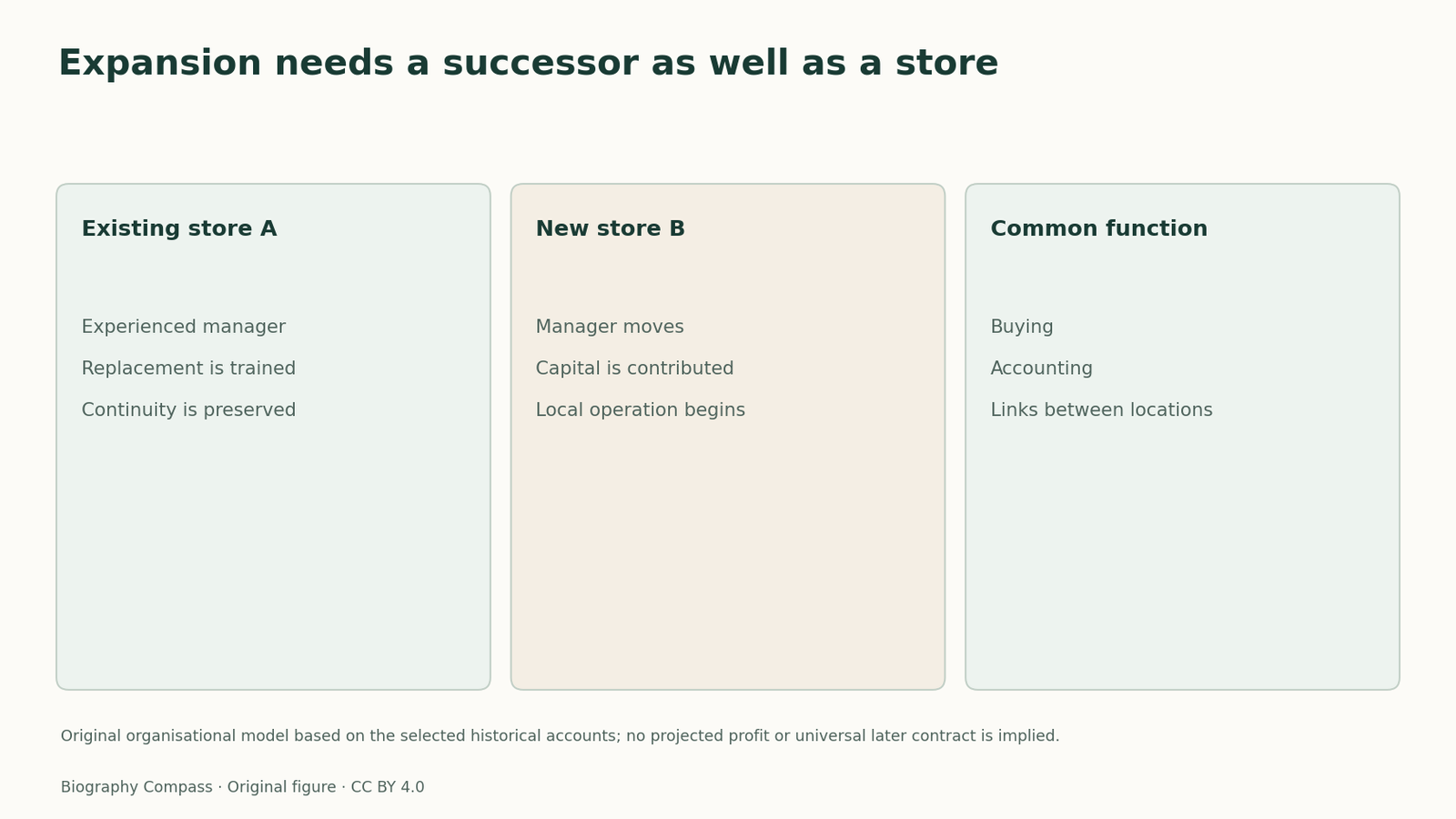
The NPS lesson describes the incoming manager contributing one third of the new store’s capital and Penney supplying two thirds. The manager agreed to prepare a replacement at the existing store, who could later follow the same route.
That links an outward movement to an inward repair. Opening a new shop would otherwise remove an experienced manager from the old one. Training the replacement makes the previous location part of the expansion mechanism. The historical account supports this particular arrangement, not the assumption that all later employee incentive schemes used the same terms.
Sources for this section: [2]
Central buying solved another problem
Penney later brought buying and accounting together at a headquarters; incorporation followed in 1913.
Local ownership can give managers a stake in a store, while coordinated purchasing can organise its relationship with suppliers. These are different layers of a chain. A diagram that labels the entire organisation “decentralised” misses the common functions; a diagram that shows only headquarters misses the local capital and management responsibilities. The useful question is which decisions were located where.
Sources for this section: [2]
Trace a new location without inventing a profit promise
Original model: label an existing location A and a proposed location B. Draw one arrow from A’s trained manager to B, a second from the replacement trainee to A’s management role, and two capital arrows into B. Then draw a purchasing link between B and the common buying function. No revenue forecast is supplied.
A reader should be able to explain why a training delay can obstruct expansion even if money is available, and why a completed new store need not imply that purchasing is locally independent. The model explains coordination; it does not calculate anyone’s earnings or assume a fair division of risk. Actual contracts and store accounts would be needed for those questions.
Continue the chronology
Related history guides
Biography context
Explore United States through connected lives
Connected biographies
The working life
1875–1971
James Cash Penney
Retail entrepreneurPenney expanded retail through managers and partners.Read biographyQuick answers
Common questions
- How did the partnership system help a chain expand?
- It linked expansion capital with manager training.
Primary and institutional sources
How this history was checked
Selected passages and records support the discussion below. Original reasoning and invented classroom cases are labelled; no whole-archive or product-testing claim is made. This article was reviewed on 4 November 2026.