
The short answer
What can a platform’s anniversary total establish about participation, complete answers and reliable knowledge?
Original source comparison
A total needs a unit and a method
Separate the publication’s observations from the conclusions a reader might be tempted to add.
| Record | What the record establishes | What it does not establish alone |
|---|---|---|
| 2022 component counts | Company-reported questions and answers, with an arithmetic sum of 800m items. | 800m complete pairs, verified facts or unique users. |
| 2022 annual additions | Reported questions and answers generated per pandemic year. | A two-decade accumulated stock or an independently measured quality trend. |
| 2023 CEO letter | Management’s account of hosted content within search strategy. | An independent test of answer accuracy or comparative search superiority. |
Chronology
A timeline of the turning points
KnowledgeiN launched
Launch date given by the company’s anniversary record.
Anniversary release
Reported accumulated and annual measures with inconsistent total wording.
Strategic retrospective
CEO letter discusses hosted user content in search.
Start with the date and the counted object
NAVER’s release of 6 October 2022 marked KnowledgeiN’s twentieth anniversary and dates its launch to 7 October 2002. It describes a service in which people voluntarily ask and answer questions. Before repeating its scale claims, identify what each number counts. Questions are content items; answers are a different set of content items; users are people or accounts under a measurement definition. These units can coexist in one release without being interchangeable. A useful source note records the observation date and the company’s wording, then asks which definitions or deduplication rules the release does not provide.
Sources for this section: [1]
The article contains an internal inconsistency
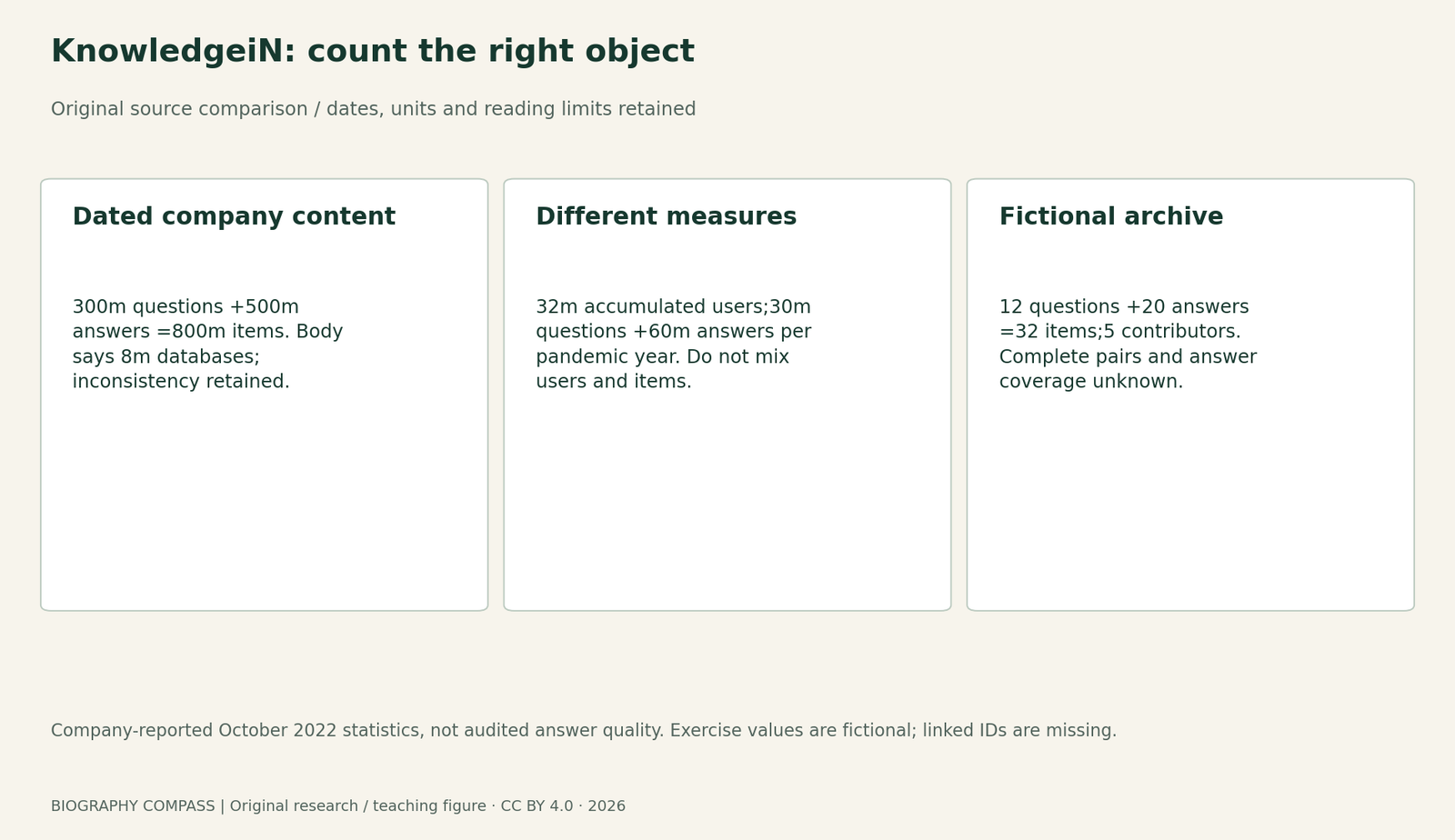
The English headline says 800 million accumulated Q&As. A body sentence instead says 8 million databases, immediately followed by 300 million questions and 500 million answers. The components add to 800 million items, not eight million. A careful reader should preserve the inconsistency rather than silently choose a convenient total. This guide uses the labelled components as company-reported figures and does not call them 800 million complete pairs. Checking the same article under Korean navigation did not solve the issue: it returned the same English content, so it is not an independent Korean-language confirmation.
Sources for this section: [1]
Accumulation is different from a yearly addition
The release reports 32 million accumulated users and, for each pandemic year it describes, 30 million questions plus 60 million answers. The latter components sum to 90 million newly generated content items per year in the company’s account. That annual flow is different from the accumulated stock across two decades. Nor should questions and answers be added to users: doing so combines unlike units. Without the underlying methodology, the release does not establish how deletions, repeated contributors or account changes affected the totals. Record the distinction before calculating growth, participation or content per user.
Sources for this section: [1]
Scale cannot substitute for a quality measure
The anniversary release discusses expert answers, institutional partners and measures intended to reduce unanswered questions. Those features identify mechanisms the company associates with reliability and participation. They do not independently show that every answer is correct or that every question has a useful response. The 2023 shareholder letter explains why hosted user content mattered to NAVER’s search strategy, but it is management’s retrospective strategic account. A quality assessment would need a defined sample, review criteria and evidence about errors or usefulness. More contributions can expand a service while leaving the accuracy of particular answers unresolved.
Original exercise: count a fictional archive
A fictional archive contains 12 question records and 20 answer records created by five distinct contributors during one month. No question-to-answer identifiers are provided. Calculate the total number of question and answer items. Decide whether the data establish 32 complete Q&A pairs, five answered questions or a 100% answer rate. Then design two additional fields that would let you measure the share of questions receiving at least one answer. Finally, propose one extra procedure needed before claiming that all answers are accurate. These are invented counts, not a sample taken from NAVER or a reconstruction of its underlying records.
Sources for this section: [1]
Reference answer: 32 items, with completeness unknown
There are 12 + 20 = 32 content items. The five contributors are a separate population, and the figures do not show how many questions each person asked or answered. The archive cannot establish 32 pairs: several answers might belong to one question, while others remain unanswered. To calculate an answer rate, retain a unique question identifier and an answer record’s linked question identifier; also define the observation cutoff. Count distinct question identifiers with at least one eligible answer, then divide by the 12 eligible questions. Accuracy requires a separate, documented review against appropriate evidence; record counts alone cannot provide it.
Sources for this section: [1]
Write a claim with an honest measurement boundary
A defensible note says that NAVER reported specified accumulated question and answer counts in an October 2022 anniversary release, whose total wording is internally inconsistent. It keeps those reported items separate from users, annual additions and verified knowledge. The company history provides a surrounding corporate chronology, while the shareholder letter supplies a later strategic explanation. Neither repairs a missing statistical methodology. This approach gives readers something more useful than a larger headline: a transparent account of what was counted, who reported it, when it was reported and which further data would be needed to answer a different question.
Continue the chronology
Related history guides
POSCO in 1973: First Iron Is Not Annual Output
How can one steelworks produce several correct milestone dates and still leave its annual output unknown?
Read the timeline1994–2026Nexon and NCSOFT: Read the Units First
Why do two businesses associated with Korean game founders require different currency labels before their revenue can be compared?
Read the timelineBiography context
Explore South Korea through connected lives
Connected biographies
Business lives in context
1967–
Lee Hae-jin
NAVER founder and technology business leaderLee Hae-jin is associated with NAVER’s founding and the development of a Korean-language internet platform built by teams and participating users.Read biographyQuick answers
Common questions
- Why not silently correct 8 million to 800 million?
- The components support an arithmetic sum, but the publication’s inconsistency remains part of the source record and is disclosed.
- Can 20 answers mean every one of 12 questions was answered?
- No. The answers may be unevenly distributed. Linked identifiers are needed to count distinct answered questions.
Primary and institutional sources
How this history was checked
Read the stated primary-record scopes. Corporate recollections and reported statistics are attributed. Exercises and reference answers are original; fictional values are labelled. Full filings and books were not read. This article was reviewed on 27 October 2026.