
The short answer
What can National Language Class tell us about a lesson and a political moment?
Compare the records
What the sources allow us to say
Read the object record alongside the contextual account.
| Record | Evidence | Reading limit |
|---|---|---|
| Collection record | National Language Class dates to 1959. | 1959 self-government should not be called 1965 independence. |
| Museum interpretation | Language learning belongs to civic and social history. | The painting is not a transcript of one documented lesson. |
Start with what the lesson shows
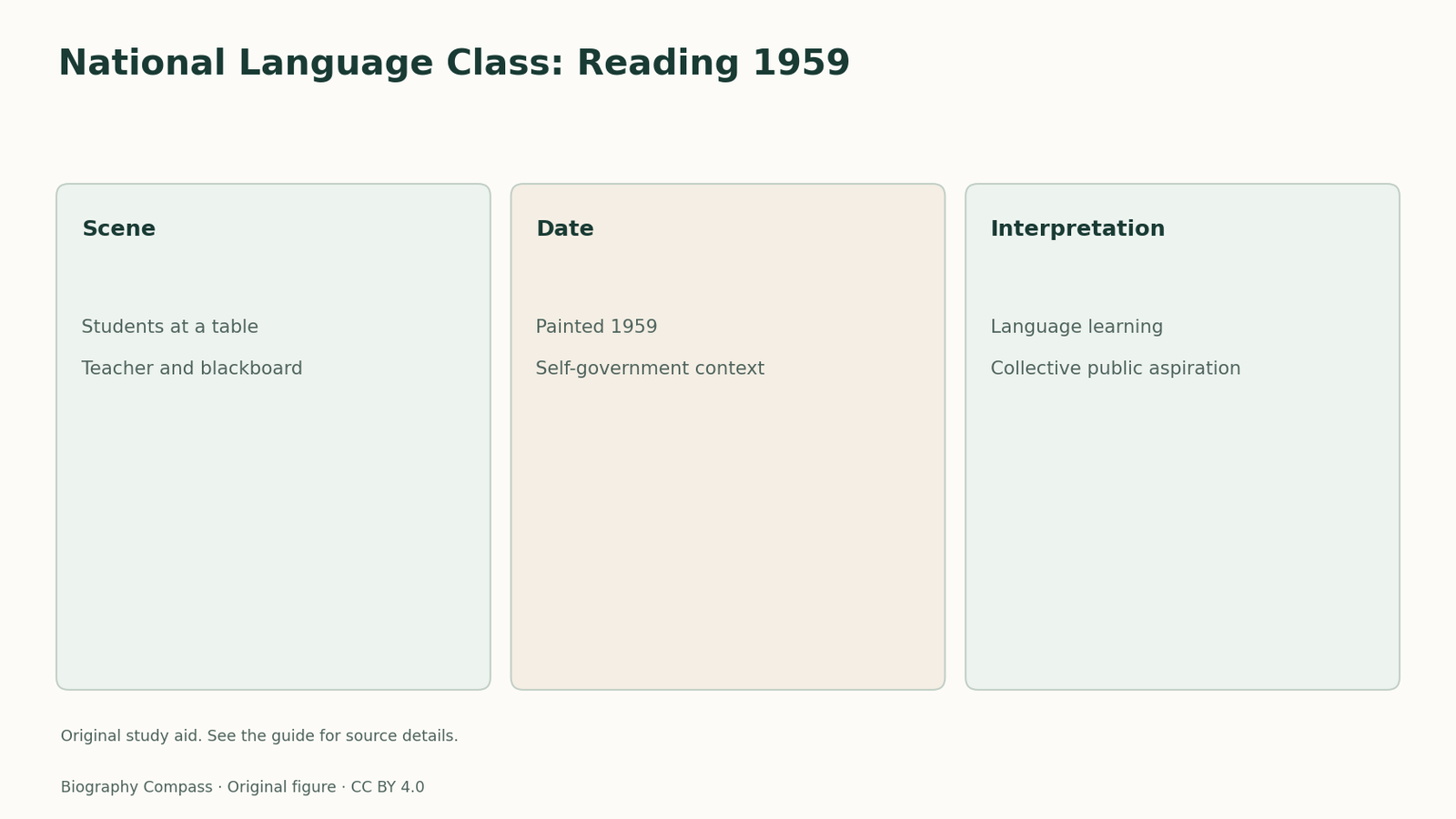
National Language Class groups Chinese students around a table while a teacher stands beside a blackboard. The National Gallery’s transcript identifies elementary Malay phrases, including a question asking a person’s name. Those details establish a language lesson and the activity connecting the figures. The arrangement also creates a shared centre of attention. Looking at who faces whom helps explain how a group scene can suggest collective effort without requiring every depicted person to have the same expression or pose.
Sources for this section: [2]
Place the date carefully
The gallery transcript describes the painting using broad independence language. The government-published G 20 catalogue more precisely connects 1959 with Singapore attaining self-government. These formulations should not be treated as interchangeable dates for the country’s later national history. The painting’s documented year can remain fixed while its context is stated carefully. Comparing the two accounts reveals how a short museum interpretation can compress history, and why a learning guide should distinguish a work’s date from the political milestones used to explain it.
Build a supported interpretation
Write three sentences about the painting. The first should identify the language-learning activity. The second should explain how the table, teacher and blackboard direct attention. The third should connect the lesson with the historical importance of Malay described by the sources. A strong answer keeps visible features and historical interpretation connected while marking their different evidential roles. The image supports an account of how the scene is staged. The catalogue supplies the reason that its 1959 setting carries a broader significance beyond a single classroom.
Continue the chronology
Related history guides
Biography context
Explore Singapore through connected lives
Connected biographies
Read the artist’s biography
1931–2026
Chua Mia Tee
Realist painterA realist painter who depicted Singapore’s people, labour and changing urban environment.Read biographyQuick answers
Common questions
- What language are the students learning?
- The institutional accounts identify Malay. The work dates to 1959, Singapore’s year of self-government.
Primary and institutional sources
How this history was checked
The listed records support the facts. Observation exercises and arguments are Biography Compass editorial interpretations. This article was reviewed on 7 November 2026.