
The short answer
What changes when a detail from Drying Salted Fish moves onto Singapore’s fifty-dollar note?
Compare the records
What the sources allow us to say
Read the object record alongside the contextual account.
| Record | Evidence | Reading limit |
|---|---|---|
| National Gallery painting | Drying Salted Fish is a 1978 painting. | The original object has its own material and scale. |
| Monetary Authority record | The painting appears on the fifty-dollar banknote. | A banknote reproduction is a separate designed object. |
Get the medium right
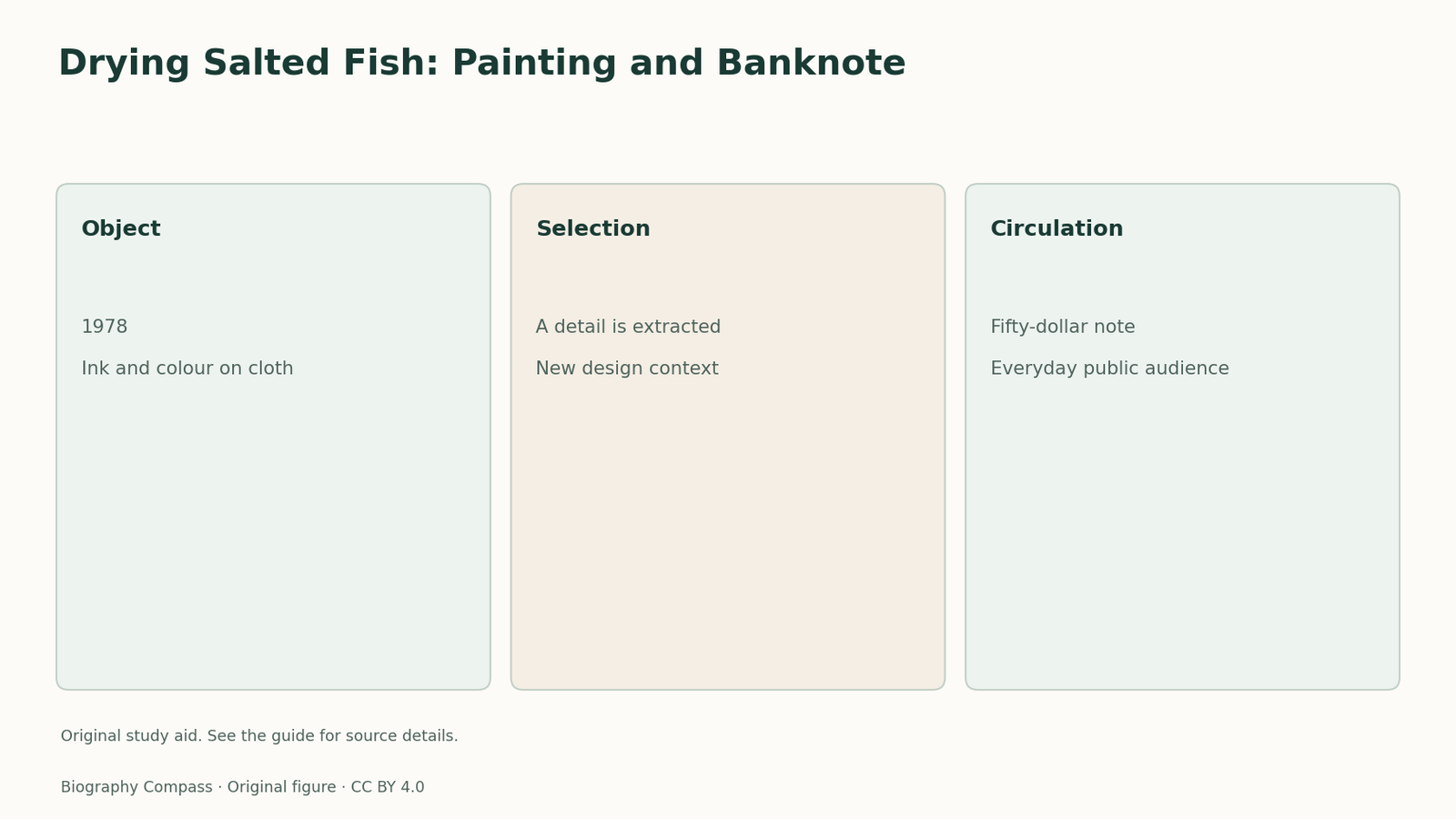
The National Gallery’s 2010 notice identifies Drying Salted Fish as a 1978 work in Chinese ink and colour on cloth. That information matters before any comparison with oil painting or a printed banknote. Cloth, pigment and ink belong to the object’s making. The later currency image has a different material form and function. Keep two records, one describing the painting and another describing its reproduction, so that a familiar public image does not replace the original artwork in the analysis.
A detail moves into another design
Both the gallery and the National Heritage Board connect the painting with Singapore’s fifty-dollar note. Roots specifically describes a detail from the work. A detail can make particular figures memorable while reducing the viewer’s access to the complete arrangement. The question is therefore about selection as well as recognition. Which information belongs to the artwork’s date and medium, and which belongs to the later design that placed an extract in everyday circulation as a national cultural reference?
Compare records without forcing agreement
The two institutional pages give different dimensions for the painting. A careful caption can retain the agreed title, date and medium while withholding a measurement until the collection’s authoritative object record resolves the discrepancy. For a short exercise, write one caption for the whole painting and one for the banknote reference. The first should identify cloth as the support. The second should say that a detail is reproduced. This answer preserves what both sources support and makes the change of scale and setting explicit.
Continue the chronology
Related history guides
Biography context
Explore Singapore through connected lives
Connected biographies
Read the artist’s biography
1917–1983
Cheong Soo Pieng
Painter and teacherA Singapore-based artist who joined Chinese painting traditions with modernist experiments and regional subjects.Read biographyQuick answers
Common questions
- Is Drying Salted Fish an oil painting?
- The institutional sources used here identify it as Chinese ink and colour on cloth.
Primary and institutional sources
How this history was checked
The listed records support the facts. Observation exercises and arguments are Biography Compass editorial interpretations. This article was reviewed on 7 November 2026.