
The short answer
How can photographs and drawings reveal different uses of a grid?
Compare the records
What the sources allow us to say
Read the object record alongside the contextual account.
| Record | Evidence | Reading limit |
|---|---|---|
| Museum exhibition | Drawings and photographs are separate parts of the practice. | A photograph is not automatically a preparatory drawing. |
| Institutional essay | Discusses line, rhythm and close visual attention. | Formal similarity does not establish a traced source. |
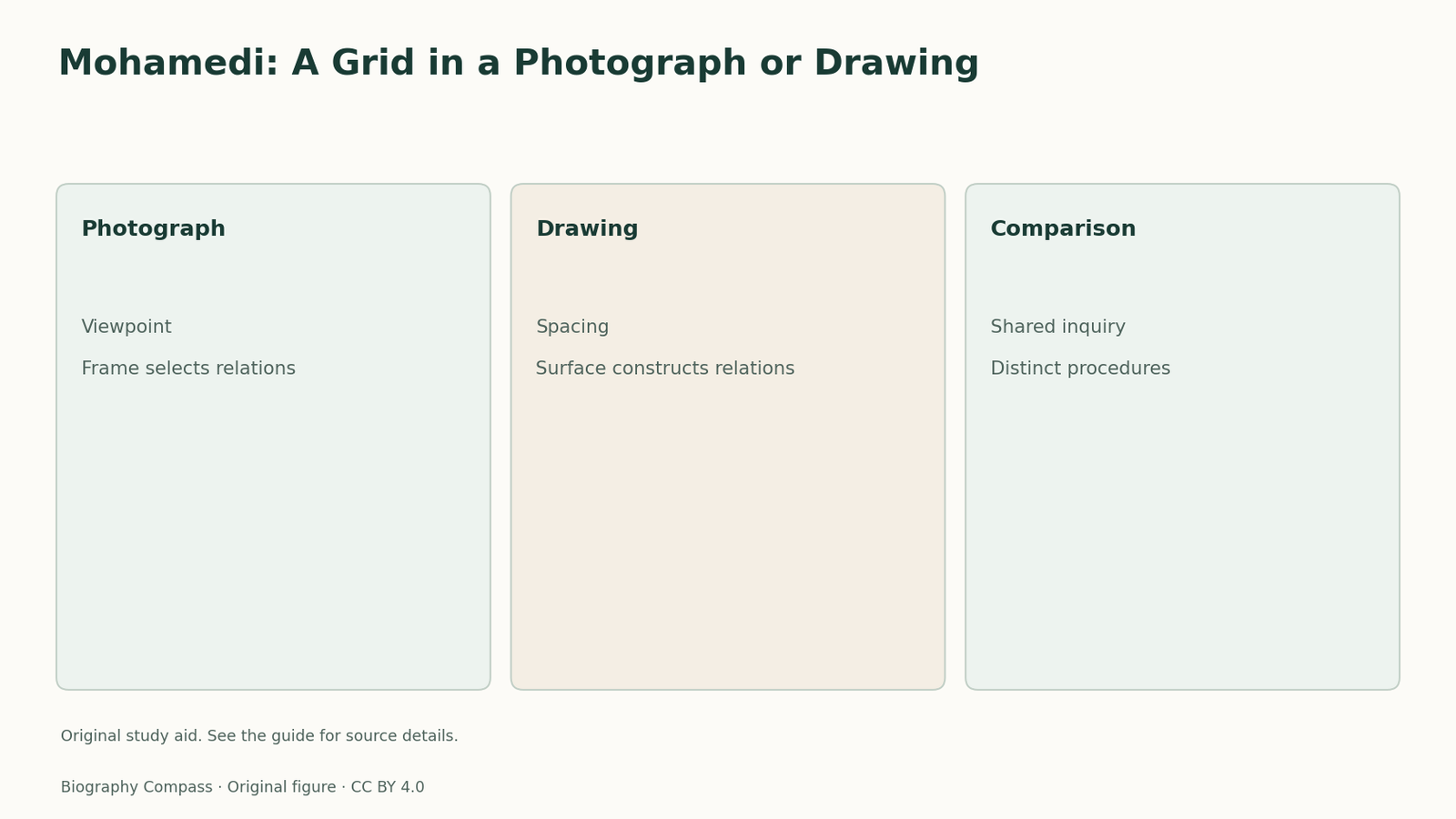
A photograph selects a visible relationship
The Met’s survey includes photographs alongside drawings and diaries. Its scholarship connects Mohamedi’s interest in photography with light and the structure of the visible world. A photograph can isolate a repeated interval or an architectural relationship by choosing a viewpoint and frame. The resulting organisation depends partly on something encountered outside the image. That does not make the photograph a neutral record. The selection of what enters the frame is itself an artistic decision.
A drawing constructs relationships directly
In the drawings, pencil and ink organise lines on paper. Spacing, direction and density are made rather than simply selected from a scene. A grid can establish an expectation of regularity, making a small change in angle or interval especially visible. The museum describes organic forms as well as delicate grids and hard-edged lines, so one geometric category should not stand for the whole practice. Comparing media is most useful when it explains how each produces a relationship rather than announcing a shared appearance.
An exercise in method and inference
Make a neutral grid, then change the spacing of one row. Describe the effect without assigning it a fixed spiritual meaning. Next imagine photographing a real repeated structure from two positions. A strong answer identifies construction in the first operation and viewpoint selection in the second. It may propose a connection between them, but should mark that connection as an interpretation. The sources establish that Mohamedi worked in both media. They do not establish a one-to-one preparatory relationship between every photograph and an individual untitled drawing.
Continue the chronology
Related history guides
Biography context
Explore India through connected lives
Connected biographies
Read the artist’s biography
1937–1990
Nasreen Mohamedi
Artist and teacherAn Indian artist whose pencil and ink work developed a sustained inquiry into line, light and abstraction.Read biographyQuick answers
Common questions
- Was every drawing copied from one of her photographs?
- The sources establish related interests across media, but do not document a one-to-one relationship for every drawing.
Primary and institutional sources
How this history was checked
The listed records support the facts. Observation exercises and arguments are Biography Compass editorial interpretations. This article was reviewed on 7 November 2026.