
The short answer
How does Aung Soe’s practice join diagram, text and painting?
Compare the records
What the sources allow us to say
Read the object record alongside the contextual account.
| Record | Evidence | Reading limit |
|---|---|---|
| Museum retrospective | Connects Manaw with drawing, signs and inward practice. | A visible sign does not have one automatic translation. |
| Artist research project | Documents the artist’s shifting visual language. | General ideas should not replace object-specific observation. |
The line has a history of learning
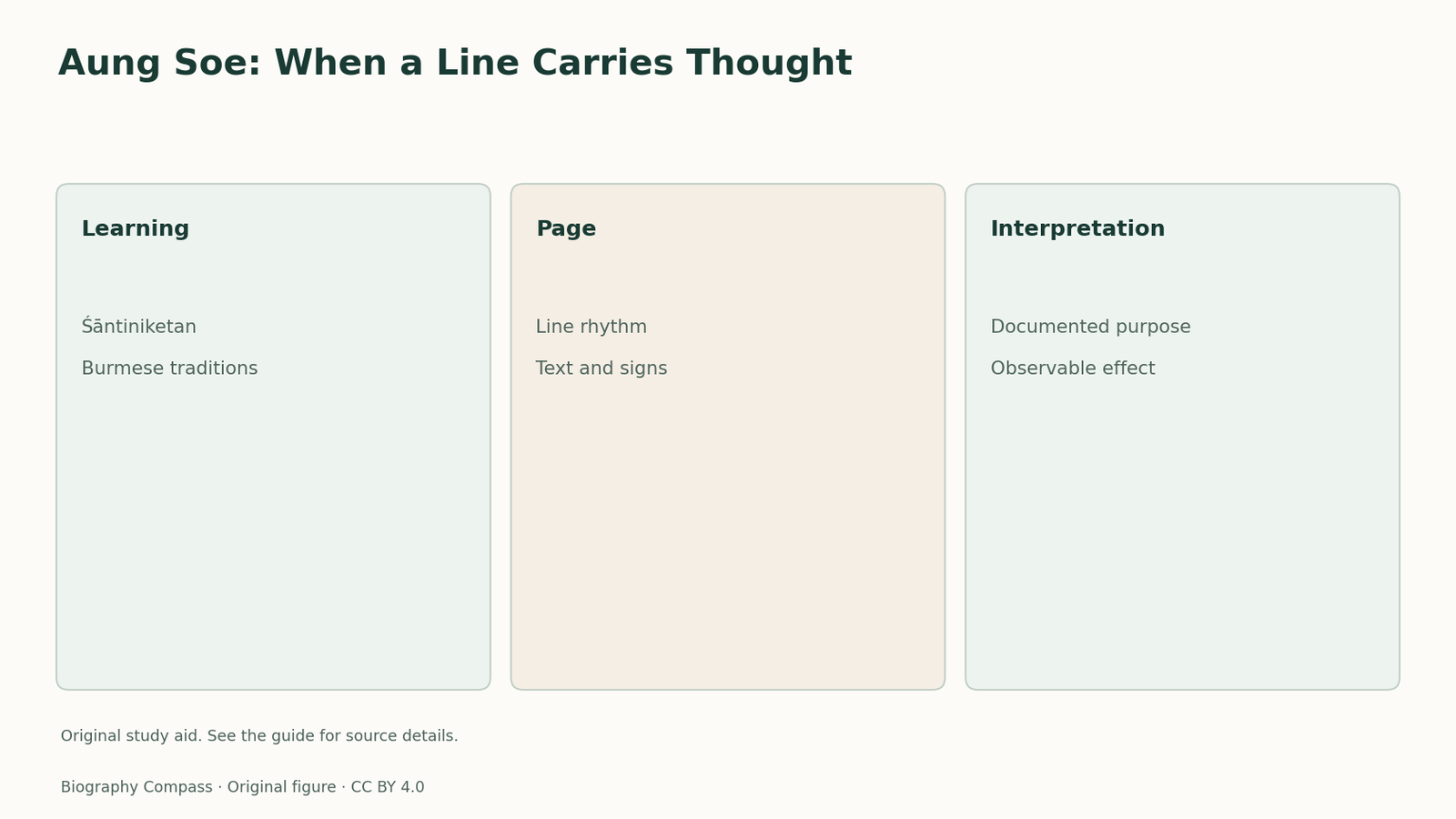
Asia Art Archive relates Aung Soe’s practice to his Śāntiniketan training and to the study of Burmese artistic traditions after his return. This context helps explain why a repeated line can be more than a convenient pattern. The later work sought a relationship between an image, movement and states of mind. The question is about what drawing could investigate, rather than whether the page follows one recognised national style or one imported modernist school.
Sources for this section: [2]
A diagram can point toward a practice
The archival account discusses mantra, numerical or written signs and closely spaced marks within manaw maheikdi dat painting. It connects line rhythm with the artist’s experience of breath and change. These are scholarly interpretations grounded in the practice and its records. Compare them with the Pompidou survey’s broader selection of oils, drawings, illustrations and manuscripts. The later spiritual inquiry belongs within that varied career and should not be made to explain every earlier illustration through a single formula.
A drawing exercise with a stated limit
Make two neutral groups of parallel lines, one evenly spaced and one changing in interval. Describe how the eye moves through each group. Then explain why that exercise cannot reproduce Aung Soe’s spiritual practice. A useful answer distinguishes an observable visual rhythm from the artist’s documented purpose and training. The small experiment can clarify how repetition directs attention. It cannot establish that a particular viewer has entered the same state of mind as the maker or that every sign on an original page has been correctly translated.
Continue the chronology
Related history guides
Biography context
Explore Myanmar through connected lives
Connected biographies
Read the artist’s biography
1923/24–1990
Bagyi Aung Soe
Painter and illustratorA Burmese painter and illustrator who connected modern experimentation with local traditions and spiritual inquiry.Read biographyQuick answers
Common questions
- Why is his birth year written 1923/24 here?
- The archival study retains that uncertainty, while the Pompidou exhibition uses 1923. The profile preserves the narrower unresolved detail.
Primary and institutional sources
How this history was checked
The listed records support the facts. Observation exercises and arguments are Biography Compass editorial interpretations. This article was reviewed on 7 November 2026.