
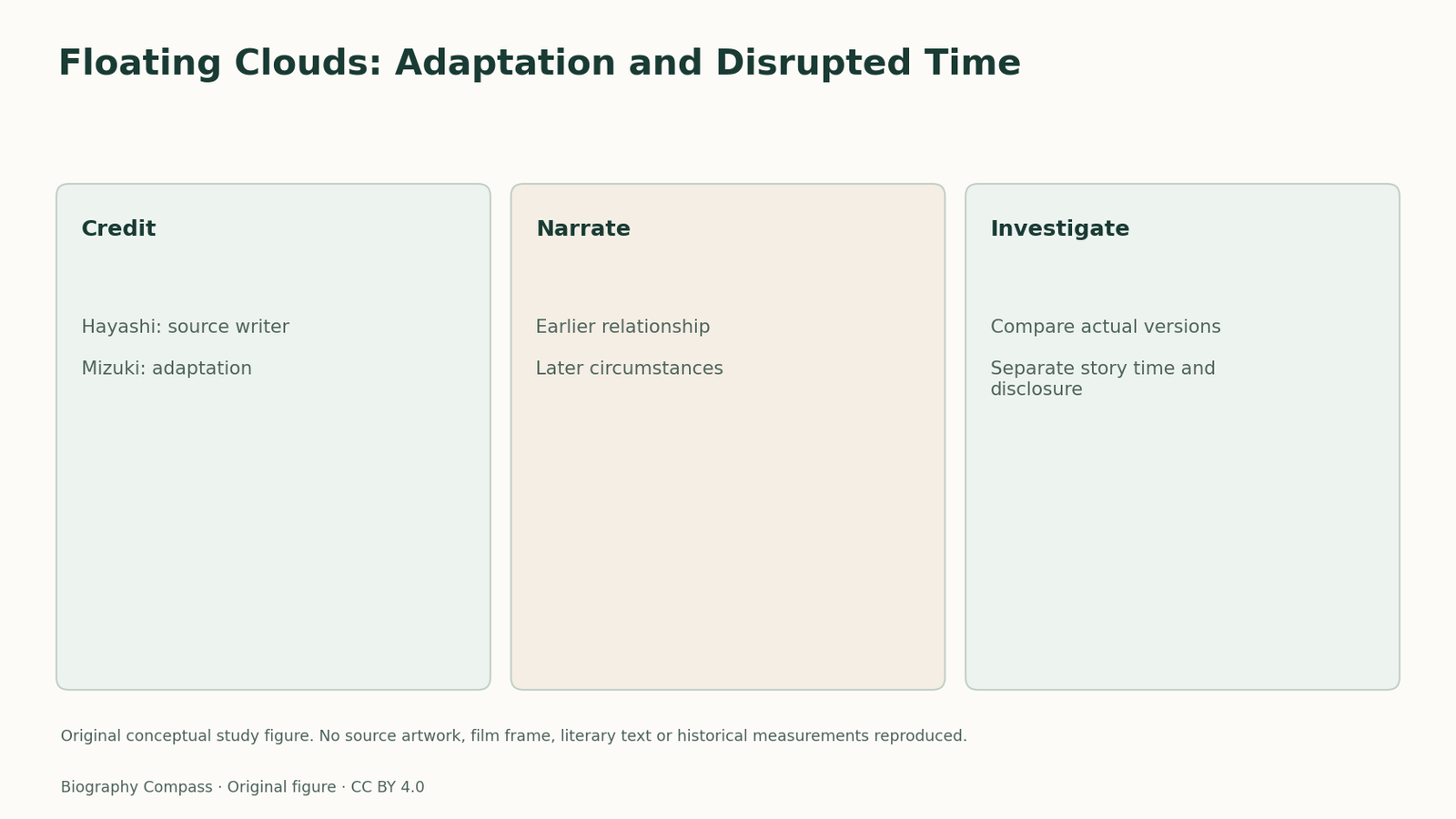
The short answer
How does a documented adaptation organise memory and a changing relationship without serving as a literal historical record?
Read the evidence
Sources, interpretation and production roles
The records answer different questions about this work. The final exercise is an original teaching model.
| Record or question | Supported reading | Boundary or contrast |
|---|---|---|
| Institutional filmography | Identifies Mizuki’s Floating Clouds adaptation credit. | Different films have different screenwriters. |
| BFI synopsis | States relationship and postwar setting. | A dramatic premise is not demographic evidence. |
| Researchabstract | Identifies a documentary study of adaptation. | Its mention of letters does not grant access to those letters. |
The novel, screenplay and film have separate credits
Floating Clouds is a 1955 film directed by Mikio Naruse and adapted from Fumiko Hayashi’s novel. UNIJAPAN identifies Yōko Mizuki as the relevant screenwriter; it separately associates Sumie Tanaka with Lightning. Keeping that pairing precise matters because both writers collaborated on Hayashi adaptations within Naruse’s wider career. The source writer, adapter and director are three distinct production roles. A film’s close association with Naruse does not make its screenplay an unwritten extension of his personal biography.
The relationship belongs to a changing historical setting
BFI’s synopsis describes a woman trying to survive in postwar Japan and a lover seeking a conventionally recognised social position. Its guide to Naruse identifies a relationship begun during the war in Vietnam that continues to shape the woman’s life. These are the supplied dramatic premises, not a complete record of ordinary experience in every postwar household. They invite a question about how earlier attachment affects later choices. A chronology of events and the order in which a film reveals them are analytical tools, not automatically the same thing.
Adaptation research asks how the work was made
Okubo’s research abstract identifies comparisons among the script, plot manuscripts and letters addressed to Mizuki. It also discusses the relationship between Mizuki and Hayashi, including their wartime travel. This is useful evidence of the study’s question and method. The abstract does not itself supply every document or establish every revision. The important distinction is between crediting Mizuki by name and investigating particular adaptation decisions through surviving records. Both improve a director-centred overview, but only the latter can support a claim about a specific change between drafts. The distinction makes an adaptation question specific enough to investigate rather than merely celebrate a credit.
Sources for this section: [5]
Original chronology exercise with a checked answer
Make two blank rows for a fictional adaptation: “events in story time” and “order presented on screen”. Place cards labelled earlier meeting, later reunion and remembered promise in the first row according to their stated time. Then try two possible presentation orders in the second row. Does changing the presentation order change when the meeting happened inside the story? No. It changes what information a viewer receives at a given point. Now add a third row headed “production record”, with cards for novel, screenplay draft and released film. Which row could establish that the adapter moved a scene? The production row, provided the actual versions were compared. The first two rows alone cannot allocate that decision to a named collaborator. This is an original analytic exercise, not a reconstruction of Mizuki’s private papers or an asserted shot-by-shot account of Floating Clouds. The reference answer separates story time, disclosure and adaptation evidence before proposing an interpretation. For a further test, mark each card with the kind of source that could verify it: a synopsis for the premise, an inspected edition for presentation order, and compared drafts for a revision claim. Those labels prevent the three questions from being confused.
Continue the chronology
Related history guides
Biography context
Explore Japan through connected lives
Connected biographies
People and related creative practices
1905–1969
Mikio Naruse
Film directorMikio Naruse developed a studio career from silent films to postwar dramas, working with literary adaptations, women screenwriters and recurring performers.Read biography1898–1956
Kenji Mizoguchi
Film directorA Japanese director whose moving camera and sustained scenes connected personal suffering with social settings.Read biography1903–1963
Yasujirō Ozu
Film director and screenwriterYasujirō Ozu moved from silent comedy to carefully organised family dramas, developing long collaborations and a visual style recognised beyond Japan.Read biographyQuick answers
Common questions
- Is the guide a transcription of Mizuki’s letters?
- No. Only the identified research abstract was read; the private letters themselves were not.
- Does changing presentation order necessarily change story chronology?
- No. The disclosure of events and their place in story time must be distinguished.
Primary and institutional sources
How this history was checked
Sources include production records, institutional collections and the specifically identified passages discussed here. Interpretations and teaching models are distinguished from credits and publication facts. This article was reviewed on 8 November 2026.
- National Diet Library of JapanNARUSE Mikio
- UNIJAPAN / National Film Archive of JapanNARUSE Mikio 1905–1969
- Hayley Scanlon / British Film InstituteWhere to begin with Mikio Naruse
- British Film Institute PlayerFloating Clouds
- Kiyoaki Okubo / RepresentationDramaturgy and Passion: Yoko Mizuki’s adaptation of Floating Clouds