
The short answer
A film can come back into view without returning in every detail. The archive’s account of Nang Baep Maha Phai explains why the recovery of its images and its soundtrack have separate histories.
Reading the evidence
What each record establishes
Read across the rows to keep the claims and evidence attached to the right record.
| Record | What it establishes | What needs separate evidence |
|---|---|---|
| Screening listing | A 1976 work and a 26 December 2025 screening. | The condition of the source elements. |
| Image rescan | A clearer image from surviving material. | Recovery of separate sound information. |
| Condition note | The final audio gap is documented. | Whether another copy will eventually be found. |
Identify the original date and the later screening
The Thai Film Archive gives the original release year of Nang Baep Maha Phai as 2519 in the Buddhist Era, corresponding to 1976. The archive explains that the film had not circulated as a commercial video release and that the preserved film was the only set it had found at the time.
The archive’s separate event listing schedules a screening at its Rong Chang Daeng theatre for 26 December 2025. It records the 1976 production year and the 2025 showing in different fields. The listing helps identify the event a viewer could cite, while the retrospective’s preservation account explains the condition of the surviving material.
Image improvement does not restore every track
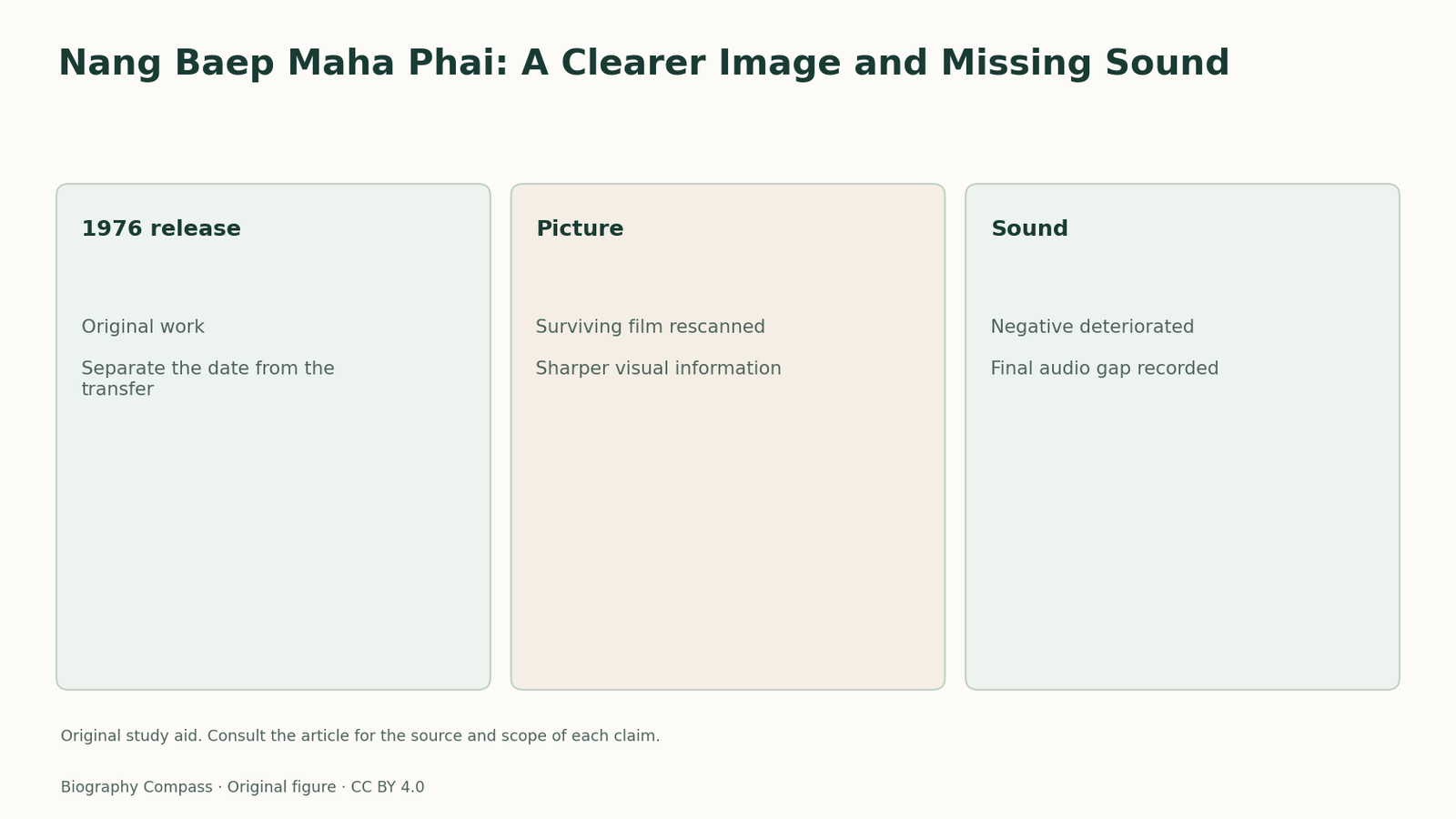
The archive explains that preservation film was scanned again for a clearer image. It separately reports incomplete audio, with the last ten minutes missing because the sound negative had deteriorated. The two statements can both be true. A clearer picture does not supply information that has been lost from a different element.
This is an archive’s description of its source material. It identifies the problem with the surviving sound. A listener or critic should still identify the viewing version before making a claim about whether silence was an original artistic decision.
Sources for this section: [1]
Write a condition note that travels with the film
Imagine an archive transfers a film whose image is legible throughout but whose dialogue disappears near the end. Record the work’s year, the later transfer and the damaged track on separate lines. Add the time range only if the archive has identified it. Readers can then discuss what survives without treating a preservation limit as part of the original style.
Continue the chronology
Related history guides
Biography context
Explore Thailand through connected lives
Connected biographies
Explore the people behind the records

born 1942
Chatrichalerm Yukol
Film director and screenwriterA Thai filmmaker whose career brought social subjects and historical spectacle to the screen.Read biographyQuick answers
Common questions
- Did rescanning recover the last ten minutes of sound?
- The Thai Film Archive reports that the sound in the final ten minutes was missing because the sound negative had deteriorated.
Primary and institutional sources
How this history was checked
Selected written and catalogue records. The article distinguishes documented production details from its editorial examples. This article was reviewed on 5 November 2026.