
The short answer
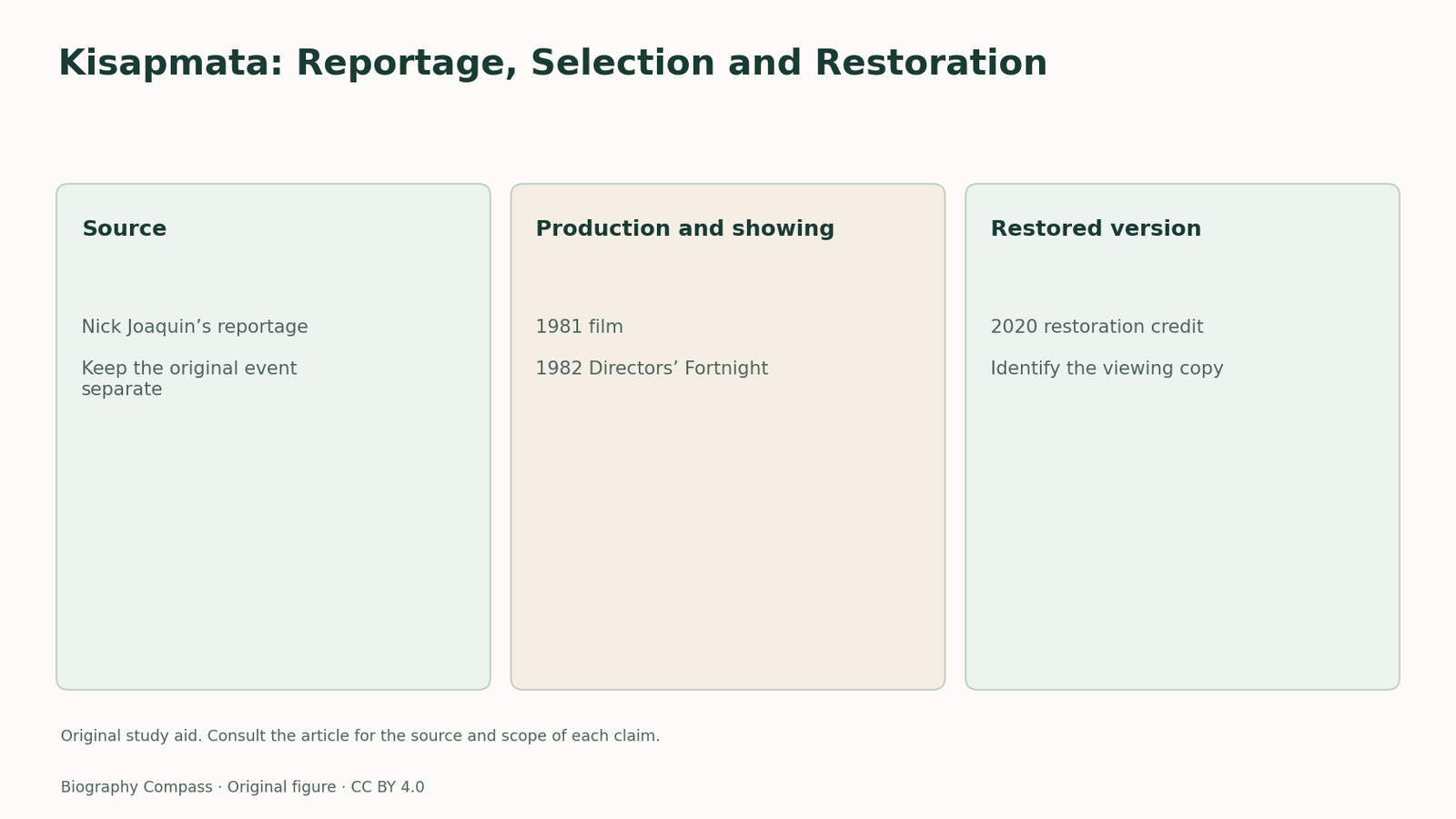
Kisapmata has a history that includes a report, a film, a festival selection and a later restoration. Keeping those records separate avoids putting a festival or preservation date into the wrong field.
Reading the evidence
What each record establishes
Read across the rows to keep the claims and evidence attached to the right record.
| Record | What it establishes | What needs separate evidence |
|---|---|---|
| Reportage | The source credited for the adaptation. | Whether any given scene is factual. |
| Selection | The 1982 parallel programme. | The first production date. |
| Restoration credit | The 2020 version, sources and restoration team. | Technical decisions not described by the distributor. |
Locate the source and the film separately
Kani Releasing identifies Nick Joaquin’s The House on Zapote Street as the reportage behind the adaptation. Vesoul lists Kisapmata as a 1981 film directed by Mike de Leon. In a later Cannes interview, de Leon describes how the story shared a mood with Itim despite a different premise.
These records support an adaptation credit and a way of comparing the director’s work. A scene in the drama remains a choice made for a film. Anyone making a factual claim about the real case would need the original report or other evidence about the event itself.
A festival selection creates its own record
The official Directors’ Fortnight archive lists Kisapmata for 1982. This establishes a showing in that particular programme. The same year’s selection includes Batch ’81. A reader looking up the director can now distinguish the year of production from the year two of his works appeared in the parallel programme.
A restoration draws on several surviving elements
The 2020 Bologna catalogue dates the 4K restoration and identifies its materials from the Asian Film Archive. The lab combined an incomplete 35 mm camera negative with a positive print and used the surviving optical sound negative. De Leon supervised colour grading and sound restoration at WildSound in Manila. The record separates what the archive preserved from the work required to prepare a new version.
Kani Releasing identifies L’Immagine Ritrovata in its release record, while Vesoul identifies its screening copy as restored. The word restored on a festival page points to a version. The technical entry lets a reader go further and distinguish the image elements from the sound element.
Build a four-line citation
For a film essay, give the report and its writer one line, the production and its director another, then add the selection and version as separate notes. Imagine citing a scene from a restored screening. Add the information that identifies the copy you saw. A future reader can check both the interpretation and the version without mistaking restoration for a new adaptation.
Continue the chronology
Related history guides
Biography context
Explore Philippines through connected lives
Connected biographies
Explore the people behind the records
1947–2025
Mike de Leon
Filmmaker and cinematographerA Filipino filmmaker whose work ranged from cinematography and psychological drama to the restoration of Philippine films.Read biography1917–2004
Nick Joaquin
Writer, journalist, playwright and cultural historianNick Joaquin worked across fiction, theatre, history, biography and magazine reporting. His English-language writing joined Philippine memories and social change to an unusually wide range of narrative forms.Read biographyQuick answers
Common questions
- Was Kisapmata made in 1982?
- Vesoul lists 1981 as the film year. The Directors’ Fortnight archive documents its 1982 selection.
Primary and institutional sources
How this history was checked
Selected written and catalogue records. The article distinguishes documented production details from its editorial examples. This article was reviewed on 5 November 2026.