
The short answer
A cold room has a temperature setting; a growing crystal occupies a particular place inside an apparatus. The central question is whether those two descriptions identify the same physical conditions. A local mixing calculation provides a limited way to explore the difference.
Compare the evidence
Settings, local observations and a toy balance
The distinction is between the question asked and the evidence needed to answer it.
| Question | Evidence or calculation | What remains open |
|---|---|---|
| Outer settings | Room and reservoir temperatures | Do not specify every point inside the apparatus |
| Historical comparison | Altered convection changes local temperature | Not a unique cloud-history reconstruction |
| Invented balance | Mass-weighted temperatures, equal heat capacities | No moisture or phase-change calculation |
Chronology
A timeline of the turning points
Artificial growth milestone
Laboratory control extends observation.
Apparatus comparison
Distinguish settings from local conditions.
What the apparatus comparison actually established
Nakaya, Toda and Maruyama varied convection in four apparatus designs. Their comparison showed that local growth-site air temperature could change while the cold-room and reservoir-water temperatures remained unchanged.
This separates a controlled setting from the local state experienced by the crystal. Changing a barrier or a flow path can change that state even when the outer settings look unchanged.
Sources for this section: [1]
A working hypothesis, not a unique cloud reconstruction
They treated unstable mixing as a working hypothesis and qualified reproducibility.
The apparatus therefore supports a question about local heat and vapour transport. It does not justify assigning a unique crystal form to one room-temperature number, or reconstructing a crystal’s entire cloud history from a classroom calculation.
Sources for this section: [1]
An original two-stream model
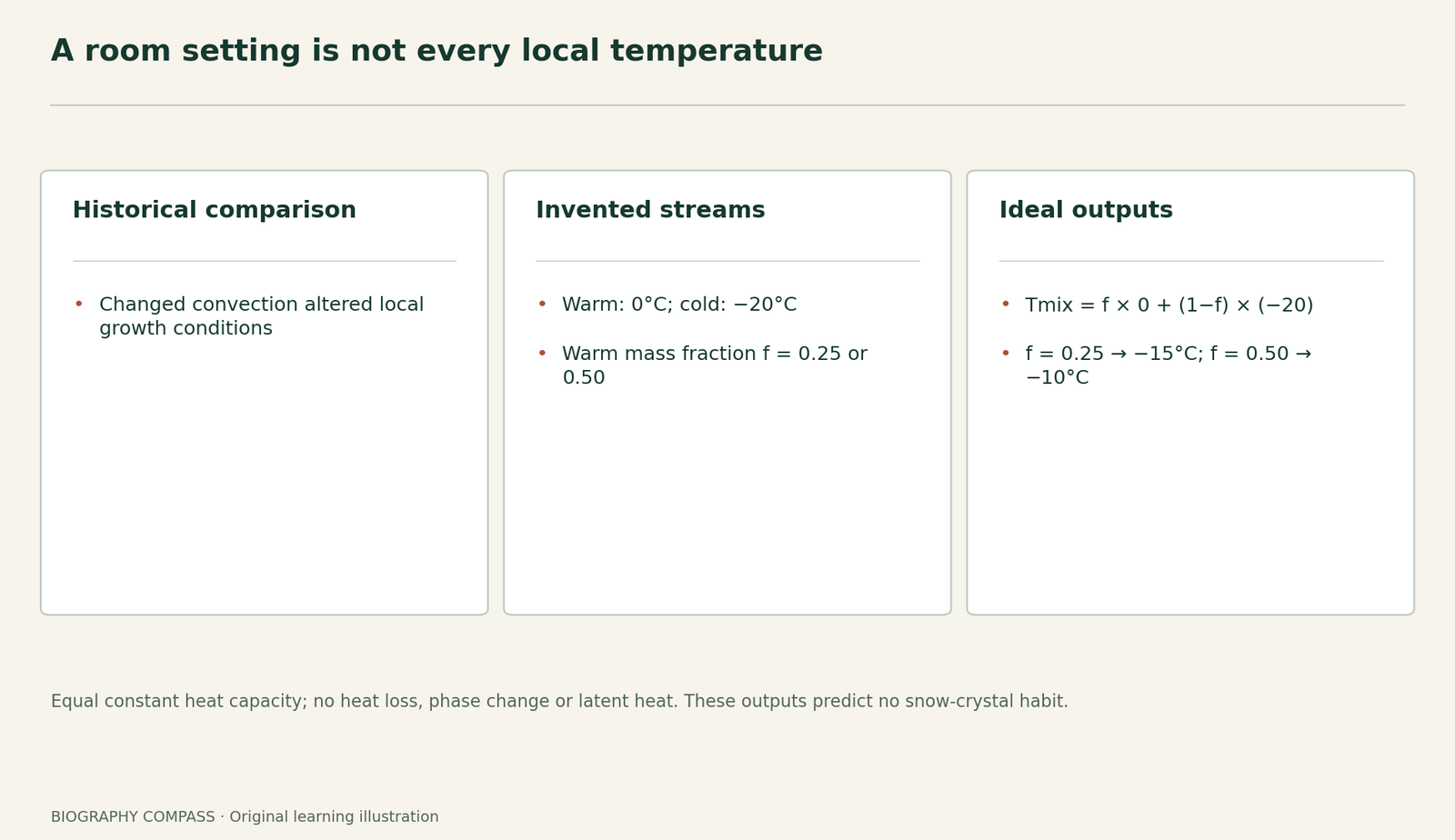
Invent two air streams at 0°C and −20°C. Let f be the warm stream’s mass fraction. Assume equal, constant heat capacity, complete mixing, no heat exchange with walls and no condensation, freezing or latent-heat release. Then Tmix = f × 0 + (1−f) × (−20), measured in °C.
Calculate Tmix for f = 0.25 and f = 0.50. Now hold the cold stream at −20°C and the warm stream at 0°C while changing only f. Explain why the same two source temperatures need not produce the same local mixed temperature. Do these results predict a plate, needle or dendrite?
Sources for this section: [1]
Reference answer and model boundary
For f = 0.25, Tmix = −15°C. For f = 0.50, Tmix = −10°C. More warm-stream mass raises the mixed temperature even though neither source temperature changes. The model illustrates a local-state distinction; it does not calculate the historical chamber’s measured temperatures.
It predicts no crystal habit. Water-vapour content, supersaturation, growth kinetics and actual heat transfer are absent from this fixture. The no-phase-change assumption deliberately removes a major physical complication. Neither these two results nor a room thermometer can replace measurements around a growing crystal.
Sources for this section: [1]
Continue the chronology
Related history guides
Hironaka: What Can One Blow-Up Chart Show?
Compare another research question with a bounded original worked example.
Read the timeline2002 lecture and an invented calculationTanaka: Soft Ionisation and Flight Time
Compare another research question with a bounded original worked example.
Read the timelineBiography context
Explore Worldwide through connected lives
Connected biographies
Researchers connected with these questions
1900–1962
Ukichiro Nakaya
Physicist and snow researcherUkichiro Nakaya investigated how snow crystals grow.Read biographyQuick answers
Common questions
- Are −15°C and −10°C Nakaya’s measured values?
- No. They are outputs of the invented two-stream model and are not assigned historical crystal shapes.
Primary and institutional sources
How this history was checked
Selected original passages and the stated reading scopes support the historical account. Every teaching fixture is explicitly invented. This article was reviewed on 30 October 2026.