
The short answer
A concert can be a landmark in cultural exchange while its surviving records answer only some of the questions a listener might ask. This guide begins with a contemporary statement, then separates event dates, musical authorship and the rights in later media.
Original source-reading aid
Separate the claim from the record
The same date or name can serve different purposes in different records.
| Country | Role of the record | Limit |
|---|---|---|
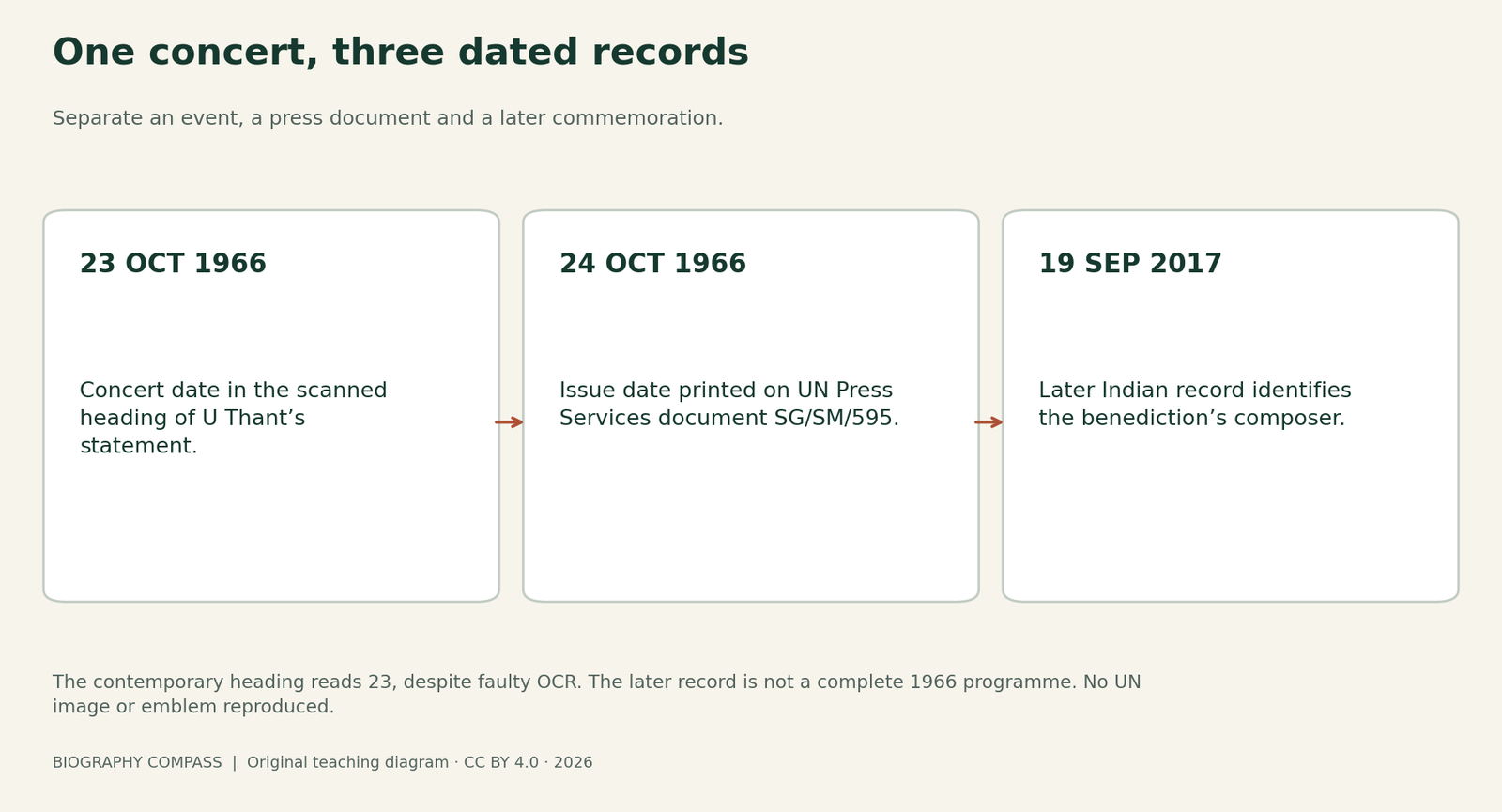
| 23 October 1966 | Concert date in the scanned heading. | Not the press document’s issue date. |
| 24 October 1966 | Issue date of SG/SM/595. | Not evidence the concert occurred that day. |
| 2017 government record | Composer attribution and later commemoration. | Not a full contemporary concert programme. |
| Online audiovisual item | Access to a particular recording, if identified. | Public display alone does not confer reproduction rights. |
Chronology
A timeline of the turning points
Read the scanned heading before trusting a date
United Nations Press Services document SG/SM/595 is dated 24 October 1966. Its subject heading identifies U Thant’s statement at the concert on 23 October. These dates describe a performance and the subsequent issue of a press document. The scan matters: machine-extracted text can misread the final digit in a typed date. Here the visible page, rather than a faulty text extraction, controls the transcription. The document’s own press-services wording also identifies its genre; it is not a General Assembly resolution.
Sources for this section: [1]
An invitation, a postponement and several participants
U Thant explains that an additional concert had been planned for the 1965 International Co-operation Year, postponed and invited again for the period immediately preceding United Nations Day. He thanks the accompanying artists, T. Sadasivam and the Government of India. This identifies several organisational roles without supplying a complete ensemble list or programme. The statement is strong evidence about the host’s welcome and acknowledgements. It is a narrower record than a full concert log, recording or set of production files.
Sources for this section: [1]
Place the performer’s career beside the occasion
The 1974 Ramon Magsaysay citation places Subbulakshmi’s international appearances within a career that also involved cinema, devotional singing and benefit concerts. The Music Academy’s roster adds another institutional marker: Sangita Kalanidhi in 1968. These sources explain why the invited performer had an established public and musical career. Neither source needs to be turned into a claim that the UN endorsed every aspect of her repertoire or granted a new musical qualification. An invitation, an award and an artistic practice have different meanings.
Keep the composer distinct from a famous rendition
A 19 September 2017 Indian government record describes Subbulakshmi’s great-granddaughters performing Maithreem Bhajatha and links it to her October 1966 UN appearance. It credits the Sanskrit benediction to Chandrasekharendra Saraswati. That later record supports composer attribution and the commemorative connection. It should not be silently promoted into a contemporary, complete running order for the earlier concert. The historical distinction is useful: a singer can make a work widely recognised without becoming its composer. No lyrics are reproduced here.
Sources for this section: [4]
Cultural diplomacy is an interpretation with a defined basis
Calling the concert an example of cultural diplomacy is an editorial interpretation of an international host, Indian government support and a performance offered to a cross-national audience. It does not mean the event negotiated a treaty, represented every Indian musical tradition or produced a measurable change in relations between states. A careful article makes the basis of its interpretation visible. It also keeps the musicians and organisers in the account, so that the UN setting does not replace the work performed on stage.
A worked source-comparison exercise
Exercise: a draft labels the concert “24 October 1966,” credits the singer as the composer of Maithreem Bhajatha and calls an online video public domain because it is on a UN website. Identify what each statement needs and choose the best available correction.
Suggested answer: the scanned heading gives 23 October for the concert, while 24 October belongs to the press document. Composer credit belongs to Chandrasekharendra Saraswati in the cited 2017 record. An online host does not determine reuse rights: the UN audiovisual guidelines require the relevant authorisation or licence. A complete programme or a specific footage licence would need additional evidence; neither can be reconstructed from a welcome statement alone.
A usable record without invented access
This guide examined the two-page statement and the named institutional records. It does not claim to have listened to a complete authenticated concert recording, inspected an original programme or independently identified every accompanist. Those are useful directions for further research. The illustration is an original evidence-reading diagram, rather than an unlicensed UN photograph or a simulated concert scene. Readers can follow the source links to check what is established now and what would require a different kind of record.
Connected biographies
People and institutions
1916–2004
M. S. Subbulakshmi
Carnatic vocalist and public-service fundraiserM. S. Subbulakshmi brought Carnatic singing to concert halls, cinema and international audiences. Her career joined rigorous musical training with public-service fundraising, while depending on teachers, accompanists, organisers and composers whose work deserves separate credit.Read biography
1909—1974
U Thant
Third secretary-general of the United NationsThe teacher and Burmese diplomat who became the first non-European UN secretary-general and led the organisation from 1961 through 1971.Read biography1904–1986
Rukmini Devi Arundale
Dancer, arts educator and animal-welfare organiserRukmini Devi Arundale built Kalakshetra into an institution for dance, music and craft. Her work changed teaching and stage presentation within an existing dance tradition, with hereditary teachers, composers, textile workers and students central to the story.Read biographyQuick answers
Common questions
Primary and institutional sources
How this history was checked
Original records are linked by section. The worked exercises are editorial teaching aids, not newly discovered historical evidence. This article was reviewed on 27 October 2026.
- United Nations Press ServicesSG/SM/595, issued 24 October: statement at concert on 23 October 1966
- Ramon Magsaysay Award Foundation1974 award citation and acceptance speech
- The Music Academy, MadrasSangita Kalanidhi roster
- Press Information Bureau2017 commemoration and composer attribution
- United Nations Audiovisual LibraryAudiovisual reuse guidelines