
The short answer
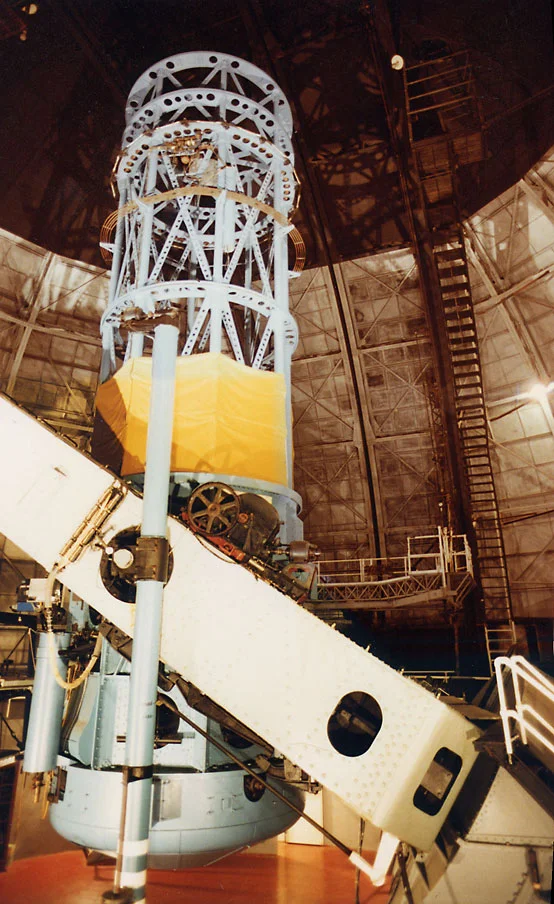
On the night of 5–6 October 1923 Edwin Hubble exposed plate H335H of Andromeda with Mount Wilson’s 100-inch telescope. The plate preserves a revised classification: a mark for a suspected nova was crossed out and replaced with a note that the star varied. Repeated plates supplied enough evidence to identify a Cepheid and estimate Andromeda’s distance.
From a marked plate to a distance
Three observations and inferences
A plate preserves a position and brightness at one point in time. A period requires a sequence.
| Record | What it shows | What more is needed |
|---|---|---|
| Plate H335H | The position and one brightness record for the object | Other dates to identify a repeated change. |
| Light curve | A brightness pattern with a period | A period–luminosity calibration to estimate intrinsic brightness. |
| Distance estimate | The implications of intrinsic and apparent brightness | Assessment of calibration and uncertainties. |
Chronology
A timeline of the turning points
100-inch Hooker telescope sees first light
Mount Wilson begins use of the large reflector.
Plate H335H exposes Andromeda
The archive retains the plate and its annotations.
Hubble sends the light curve to Shapley
The letter documents the period and an estimate of distance.
Results discussed publicly at an astronomy meeting
The public announcement follows the plate and private letter.
What the annotation shows
Carnegie Science identifies the night, the instrument and the plate number. The old nova mark and its replacement record a change in classification. The mark is evidence of how Hubble interpreted the findings, not a measurement of the time over which brightness changed.
The American Institute of Physics account connects the notebook and successive plates with Hubble’s light curve. Taken together, they let readers see why the revised designation represented a better match to the evidence.
Why a Cepheid gives more than a variable star
Henrietta Swan Leavitt’s work showed a relationship between a Cepheid’s pulsation period and its luminosity. With a calibration, that relationship supplied an estimate of how bright the object really was. Comparing that estimate with its observed brightness gave a distance.
Hubble’s February 1924 letter to Harlow Shapley included the light curve. His distance estimate put the object far beyond the Milky Way as it was then understood. The argument was about the scale of Andromeda, and the later relation between distance and recession was a separate result.
Which date belongs in the headline
The plate archive dates the exposure to October 1923. The letter and the astronomy meeting date communication of the result in 1924 and 1925. A history of the observing record therefore begins earlier than a history of its announcement.
The Hooker reflector gathered the light used in the exposures. Establishing a Cepheid period required the series, comparison and calibration that followed.
Continue the chronology
Related history guides
How Kodaikanal’s Spectra Revealed Sunspot Motion
Compare another photographic record whose pattern had to be interpreted.
Read the timeline1934–1949How Palomar’s 200-Inch Mirror Became a Telescope
Follow Hubble’s later work with a different large reflector.
Read the timeline1912Leavitt’s 1912 Table: Period and Brightness
Read the earlier relation that helped make a Cepheid a distance indicator.
Read the timelineConnected biographies
People connected to this history
Quick answers
Common questions
- When did Hubble expose the Andromeda plate?
- Carnegie Science dates plate H335H to the night of 5–6 October 1923.
- What did the revised annotation mean?
- Hubble had initially suspected a nova. The later annotation marked a variable star, identified as a Cepheid after comparison across observations.
Primary and institutional sources
How this history was checked
Dates, legal milestones and historical claims are checked against the official and institutional records below. This article was reviewed on 19 November 2026.