
The short answer
How do the novel’s classificatory chapters interact with the voyage narrative?
Read the evidence
Sources, interpretation and production roles
The records answer different questions about this work. The final exercise is an original teaching model.
| Record or question | Supported reading | Boundary or contrast |
|---|---|---|
| Cetology chapter | Ishmael organises whales through book-size categories. | The fictional system is not modern zoological advice. |
| Closing acknowledgement | The system is expressly left unfinished. | A useful order need not exhaust its subject. |
| Original exercise | A size classification answers some questions and leaves others open. | Its limits follow from the feature selected. |
Why stop an adventure to classify?
Moby-Dick, published in 1851, repeatedly interrupts the movement of a voyage with other forms of discourse. Chapter 32, Cetology, is a particularly useful example. Ishmael proposes a system for arranging whales. Instead of moving the ship toward an immediate encounter, the chapter asks how a large, difficult subject might be ordered in language. The interruption is part of the novel’s structure: a narrator who tells a story also wants to organise a world.
Sources for this section: [4]
A system made from books
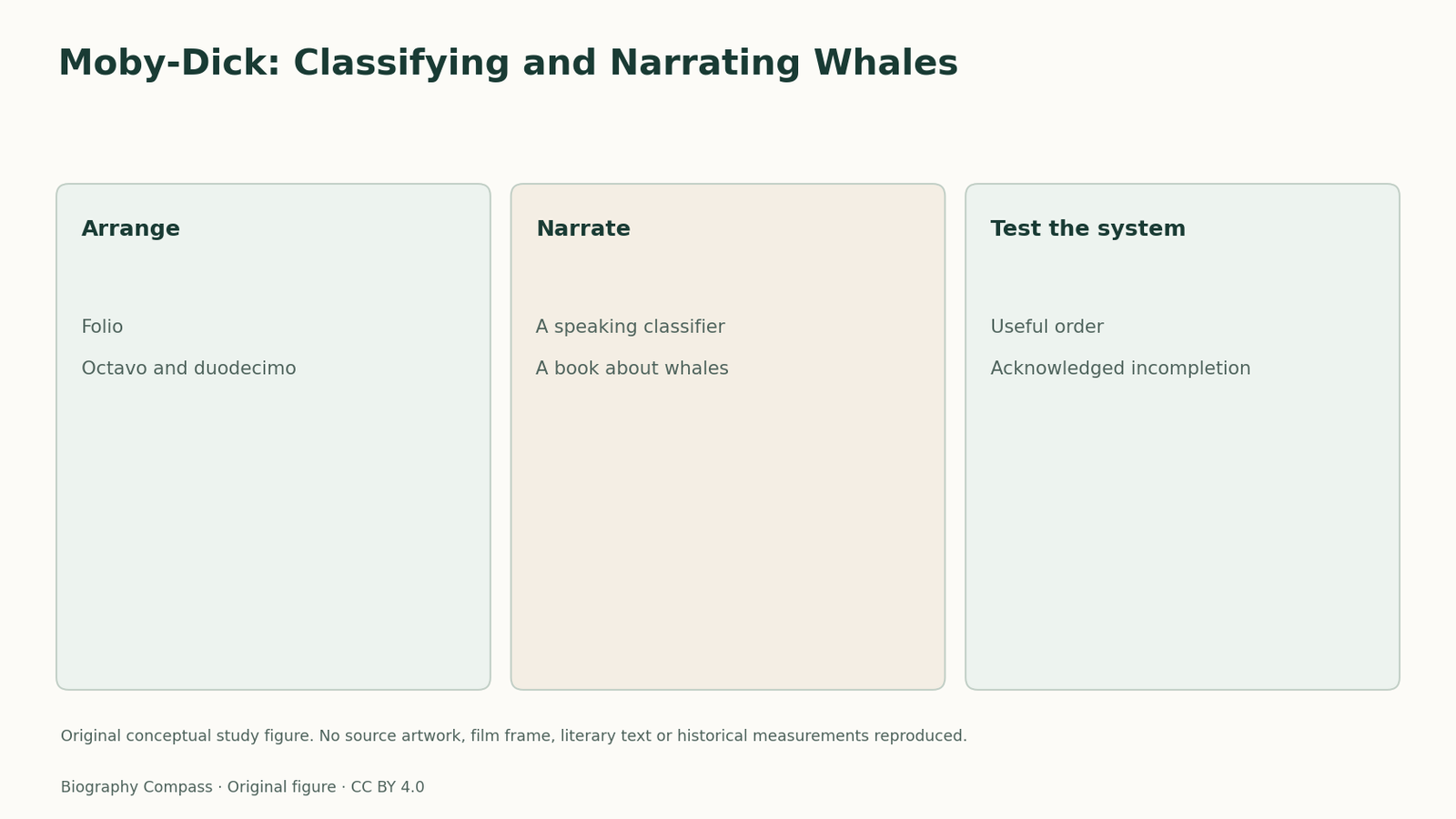
The selected chapter divides whales into categories named after book sizes: folio, octavo and duodecimo. Size becomes a bridge between animal bodies and printed volumes. That analogy gives the reader an order to follow, but it also calls attention to the medium in which the order appears. Whales are being made into a book about whales. This is a reading of Ishmael’s fictional classificatory language, not a modern zoological taxonomy or an instruction to repeat his scientific terminology as current fact.
Sources for this section: [4]
Incompletion is part of the design
The chapter ends by acknowledging that its system remains unfinished. The result is not simply a failed encyclopedia entry accidentally left inside a novel. The narrator gives incompletion a deliberate place in his presentation. A system can help readers organise a subject while failing to exhaust it. That tension connects the catalogue to the larger problem of narration: the work offers many descriptions and viewpoints without making any single list equivalent to the whole object being pursued.
Sources for this section: [4]
An original classification exercise
Suppose a class sorts three imaginary creatures only by size: small, medium and large. It then asks which creature is most dangerous or where each lives. A supported answer is that the original classification does not answer those questions. It was organised around one feature. Now apply the lesson to Ishmael’s book-size analogy. What becomes easy to arrange, and what remains outside the arrangement? This exercise does not supply new information about whale biology. It makes the choice of a classificatory principle available for discussion.
Sources for this section: [4]
Connecting knowledge with narrative voice
Finally, mark the sentences in which Ishmael introduces or limits his own system. Those moments remind the reader that someone is doing the arranging. The categories are not floating free of a speaker. Melville’s maritime biography can explain why whaling knowledge was available as material, while the literary question concerns what his narrator does with that material. Reading the chapter in this way gives it a purpose beyond either a detachable science lesson or an obstacle to the plot: it dramatises the desire to make knowledge complete.
Continue the chronology
Related history guides
Biography context
Explore United States through connected lives
Connected biographies
People and related creative practices
1819–1891
Herman Melville
Novelist, short-story writer and poetHerman Melville transformed sea voyages and a varied working life into fiction whose narrators mix adventure, argument and experiments in knowledge.Read biography
1835–1910
Mark Twain
Writer, humorist and lecturerWriting as Mark Twain, Samuel Langhorne Clemens turned experiences of printing, river work, travel and journalism into fiction, humor and searching criticism of American society.Read biography1804–1864
Nathaniel Hawthorne
Novelist and short-story writerNathaniel Hawthorne combined a career in public employment with fiction about judgement, secrecy and the stories a community tells about its past.Read biographyQuick answers
Common questions
- Are the categories modern scientific taxonomy?
- No. The guide reads the chapter as Ishmael’s literary system and keeps its terminology attributed to him.
- Why does the unfinished ending matter?
- It makes the limits of classification part of the narrator’s presentation.
Primary and institutional sources
How this history was checked
Sources include production records, institutional collections and the specifically identified passages discussed here. Interpretations and teaching models are distinguished from credits and publication facts. This article was reviewed on 7 November 2026.