
The short answer
One intervention can produce several kinds of record before historians agree about its significance. Reading them in sequence preserves what a participant could know at the time and what a later account adds.
Compare the records
Read the record at its own scale
Preserve speaker, date, medium and the strength of the inference.
| Evidence | What to identify | What remains to establish |
|---|---|---|
| Conference transcript | A participant’s public explanation and uncertainty. | Every private exchange or later result. |
| Broadcast catalogue | A dated description of a programme. | A personally viewed recording. |
| April statement | Retrospective attribution across participants. | A single-cause history of the settlement. |
Chronology
A timeline of the turning points
Visit and public account
The transcript preserves an unresolved response.
Broadcast catalogue
A report is described as covering subsequent support.
Retrospective statement
Credit is assigned across the negotiations.
The statement was made before the outcome was settled
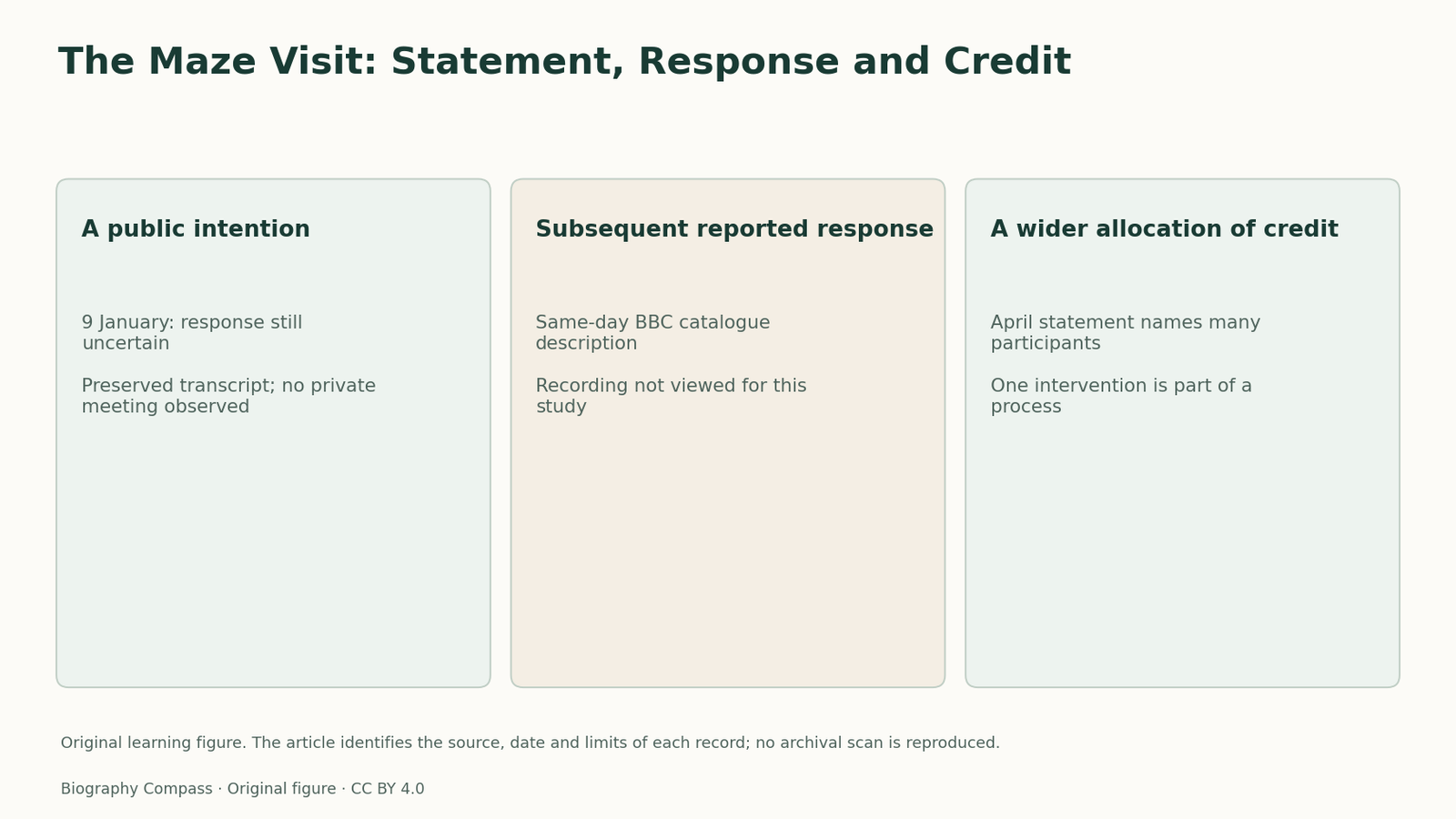
A preserved 9 January 1998 press-conference transcript has Mowlam explaining her Maze visit as an attempt to sustain political talks. She acknowledges objections from victims’ families and presents prisoners’ concerns as issues for an overall settlement through political representatives.
When asked whether she had succeeded, she says she does not yet know. The answer matters: an intention, an assessment of a useful meeting and knowledge of a subsequent decision are different claims. The archival transcript records her public account, not everything said privately to prisoners.
Sources for this section: [1]
A later account from the same day
The Heathwood catalogue describes a BBC NI report dated 9 January as covering the UFF decision to support continued talks, along with commentary and objections. Its description is later information than the uncertainty preserved in the conference answer.
This study inspected the catalogue entry, not the programme itself. A catalogue can establish how a recording is described and dated; it cannot substitute for checking its complete footage, exact words or editing. Nor does a reported change of position alone measure every cause behind it.
Sources for this section: [2]
Credit widened in the April account
In the April statement reproduced by The National Archives, Mowlam gives major credit to the party leaders, independent chairs and British and Irish heads of government. The retrospective allocation differs from a headline focused on one minister’s dramatic visit.
Both scales are useful. The January record examines an intervention at a difficult moment; the April account describes a negotiated outcome with many participants. Keeping them together avoids treating personal courage as sufficient proof of solitary authorship.
Sources for this section: [3]
Original evidence task and reference answer
Arrange three original claim cards: A says a minister hoped to retain participation; B says a later report described support continuing; C says that minister alone caused the entire settlement. Which records support A and B? What new evidence would C need?
Reference answer: the selected conference supports A and the dated catalogue description supports B within its stated access limit. Neither establishes C. Investigating that causal claim would require other participants’ records and the wider negotiations. The April statement itself distributes credit. The exercise distinguishes the strength of claims; it does not reconstruct an unrecorded conversation.
Continue the chronology
Related history guides
Biography context
Explore United Kingdom through connected lives
Connected biographies
A connected working life
1949–2005
Mo Mowlam
Politician and Northern Ireland SecretaryMowlam brought academic and constituency experience to a difficult negotiating office.Read biographyQuick answers
Common questions
- Does a reported change of position prove a sole cause?
- No. It supplies evidence of the reported response; the wider causal claim requires additional participants and records.
Primary and institutional sources
How this history was checked
Selected records, their dates and access limits are distinguished below; invented cases are explicitly labelled. This article was reviewed on 31 October 2026.