
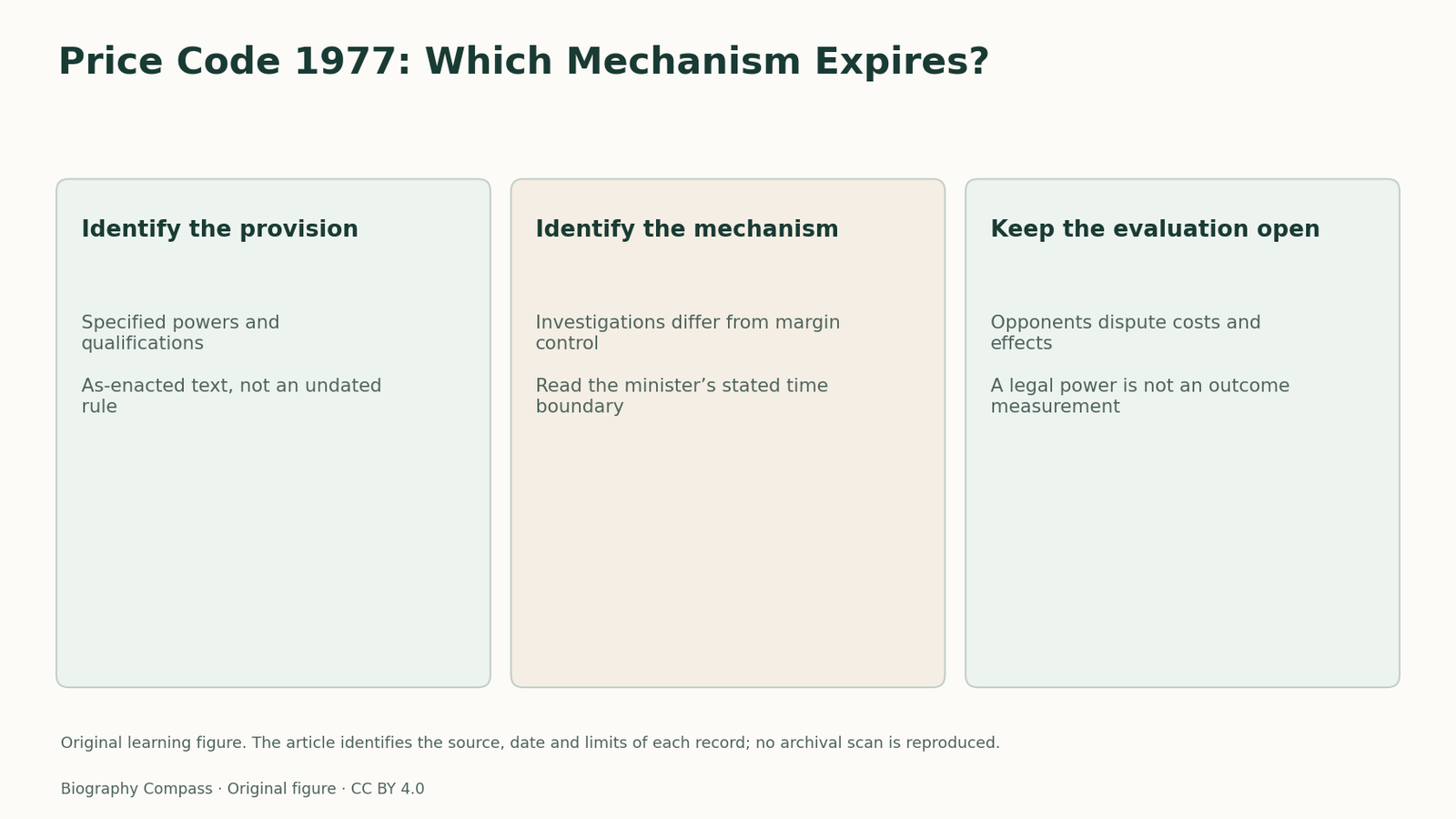
The short answer
A debate can describe some powers as lasting while seeking a short extension for another mechanism. Before treating that as a contradiction, identify exactly what each speaker says is being continued.
Compare the records
Separate duration, intention and outcome
The records establish different propositions even when they discuss one policy.
| Evidence | What to identify | What remains to establish |
|---|---|---|
| Enacted provision | The named power and its qualifications. | Every later application or economic result. |
| Minister’s explanation | The distinction the minister argued. | Independent verification of effectiveness. |
| Opposition reply | A competing account of costs and incentives. | A complete empirical evaluation. |
Chronology
A timeline of the turning points
Act
The original statute is dated.
Debate
The minister and opponents discuss the Code.
Stated limit
The minister identifies the temporary mechanism’s limit.
What Hattersley was asking the House to approve
On 21 November 1977 Hattersley distinguished continuing price-investigation and sector-examination functions from temporary margin controls. He told the House that extending the latter beyond 31 July 1978 would require a new Act.
The argument concerns different mechanisms. A power to investigate a proposed increase is not the same proposition as a general formula constraining margins. Calling both price control without preserving their objects makes the minister’s explanation harder to assess.
Sources for this section: [1]
The enacted record is a separate kind of evidence
The original Price Commission Act, dated 22 July 1977, separates investigations, examinations and amendments to earlier legislation. Section 14 gives specified 1973 provisions permanent effect, expressly subject to section 17(3).
That limited wording matters. It does not say that every provision of an earlier statute, every feature of the Code or every future regulatory decision has been made permanent. This study uses selected as-enacted text and the historical debate, rather than presenting the repealed or amended scheme as current business instructions.
Sources for this section: [2]
Opposition arguments ask another question
Sally Oppenheim challenged the extension in the same debate, connecting controls with profitability, investment and administrative burdens. She also acknowledged some relaxation compared with the preceding Code. Those are arguments to test, not an economic result established merely by their appearance in Hansard.
To evaluate effectiveness, a researcher would need dated evidence about prices, firms and competing explanations. The legal existence of a power, a minister’s intended mechanism and its measured consequences are three different objects of inquiry. A faithful debate summary retains disagreement without pretending that both sides supplied the missing evaluation.
Sources for this section: [1]
Original annotation task and reference answer
Annotate three supplied claims: A says a named provision continues; B says a minister intends a mechanism to restrain prices; C says the mechanism caused a measured fall. For each, name the kind of evidence required. Which claim could a debate alone establish most directly?
Reference answer: an enacted text and its qualifications address A; an attributed speech establishes that its speaker advanced B. C requires observations and a defensible causal comparison, beyond either document alone. The task classifies evidence, not the actual size or success of a price intervention. Keep the historical date and the mechanism’s name attached to every conclusion.
Continue the chronology
Related history guides
Biography context
Explore United Kingdom through connected lives
Connected biographies
A connected working life

1932–2026
Roy Hattersley
Politician, author and Labour deputy leaderHattersley combined ministerial and opposition work with a long writing career.Read biographyQuick answers
Common questions
- Does a lasting investigative power imply every control has the same duration?
- No. Identify the mechanism and the provision’s stated qualifications before comparing time limits.
Primary and institutional sources
How this history was checked
Selected records, their dates and access limits are distinguished below; invented cases are explicitly labelled. This article was reviewed on 31 October 2026.