
The short answer
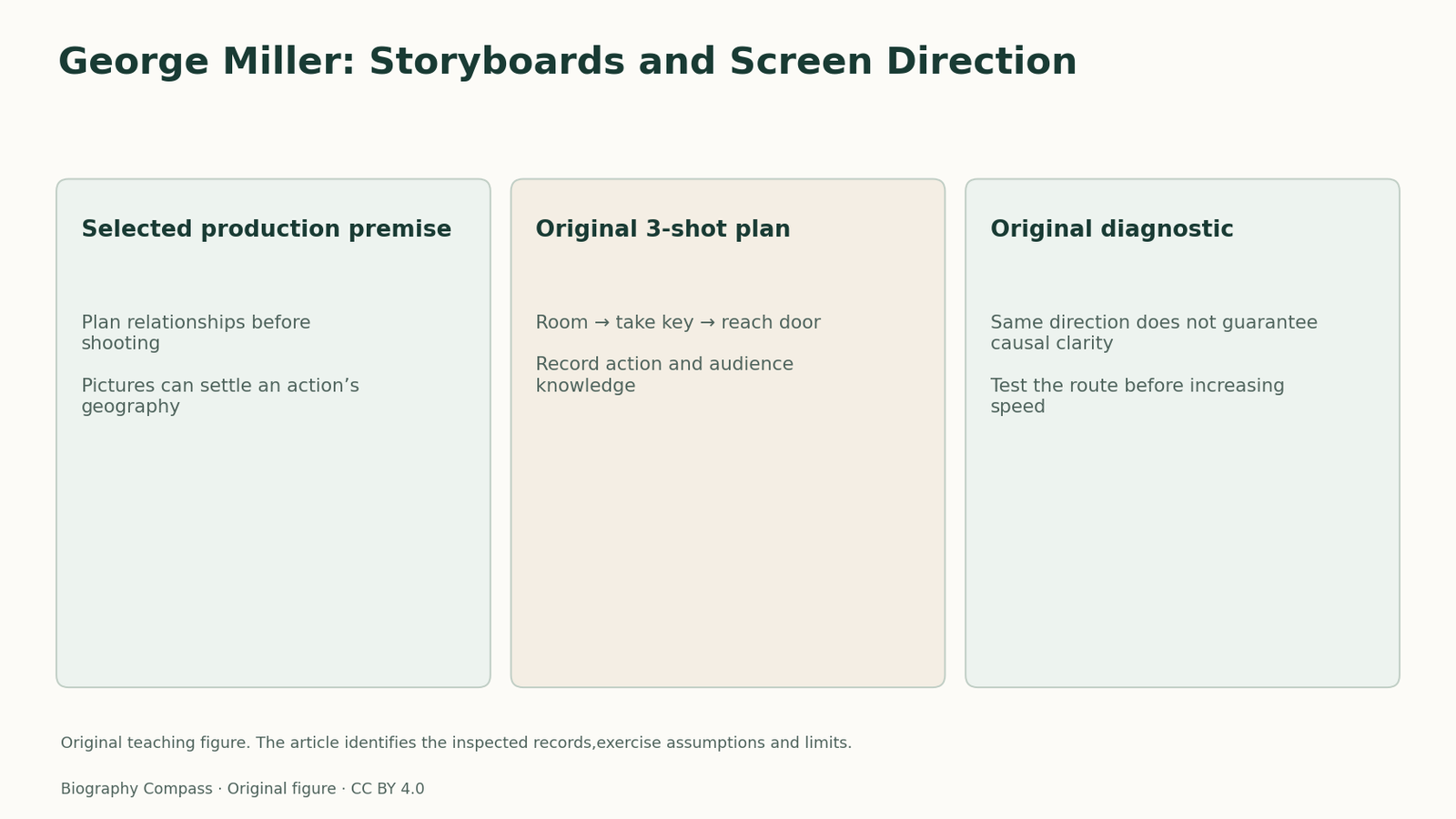
A chase can be hard to explain in prose because the important event is also a changing arrangement of bodies, objects and viewpoints. Miller’s account gives us a production question: what must a drawing settle before a crew can turn it into shots?
Source comparison and original decisions
Compare the evidence with the new plan
The source statements and the invented planning choices have different jobs.
| Question | Selected record | Original decision |
|---|---|---|
| Position | Drawings specify relationships in action. | Establish desk, key and door before changing view. |
| Transfer | A report describes planning, not every cut. | Show how possession changes. |
| Test | No complete historical panel sequence supplied. | Ask a partner to reconstruct the route. |
Chronology
A timeline of the turning points
Production Q&A
Storyboard-first explanation.
AFI account
Later written production discussion.
An account of making, not a substitute for the film
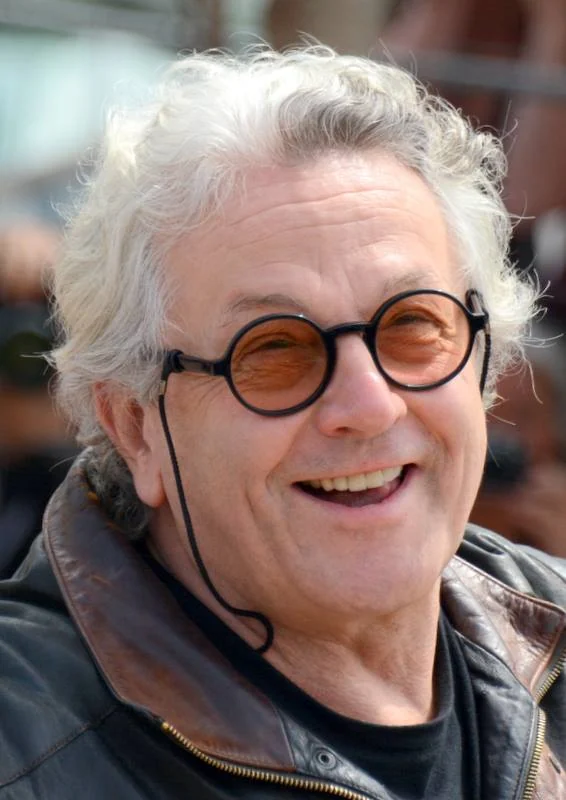
In the 2014 Q&A, Miller says he chose pictures before screenplay prose for Fury Road. Drawings specified where vehicles, an object and an explosion would be in relation to each other.
AFI’s later article again connects extensive storyboarding with an extended chase. Its written report does not supply a complete panel-to-finished-shot concordance.
Separate two kinds of continuity
Spatial continuity concerns where things appear and which way an action travels. Causal continuity concerns what an action enables. A sequence can preserve left-to-right movement while still failing to show how a character obtained the object needed in the next shot.
A production drawing can therefore carry more than an attractive composition. Annotate the object’s location, the actor’s destination and the change that must survive the cut. These are proposed planning uses, not a reconstruction of any particular historical storyboard.
Sources for this section: [1]
Original task: courier, key and door
Use these invented facts: a courier enters from screen left; a key rests on a central desk; a locked door is at screen right. The courier must take the key and reach the door. Plan three shots without dialogue. Each shot note must state both a visible action and what the audience learns. Then diagnose a version that cuts directly from the entrance to a close-up of the key already turning in the lock.
Sources for this section: [1]
Reference plan and a practical test
Shot 1: a wide view establishes courier, desk/key and right-hand door. Shot 2: a closer view shows the courier’s hand taking the key; keep a desk feature visible so the location is intelligible. Shot 3: a wider view follows arrival at the door before the lock action. The plan supplies access, possession and arrival in that order.
The abrupt version may be a deliberate ellipsis, but it omits the transfer of possession and travel. Ask a partner to sketch the route from the notes alone. If the resulting plan puts the desk beyond the door, repair geography before adding faster cuts. This test diagnoses the written plan; it does not prove how every viewer would read a filmed edit.
Sources for this section: [1]
Continue the chronology
Related history guides
Biography context
Explore United States through connected lives
Connected biographies
The related working life
Quick answers
Common questions
- Are these three shots from Fury Road?
- No. The courier, key, room and shot notes are original.
Primary and institutional sources
How this history was checked
Read the selected records and their stated publication contexts. This article was reviewed on 31 October 2026.