
The short answer
How did a subscription become money available to government?
A worked comparison
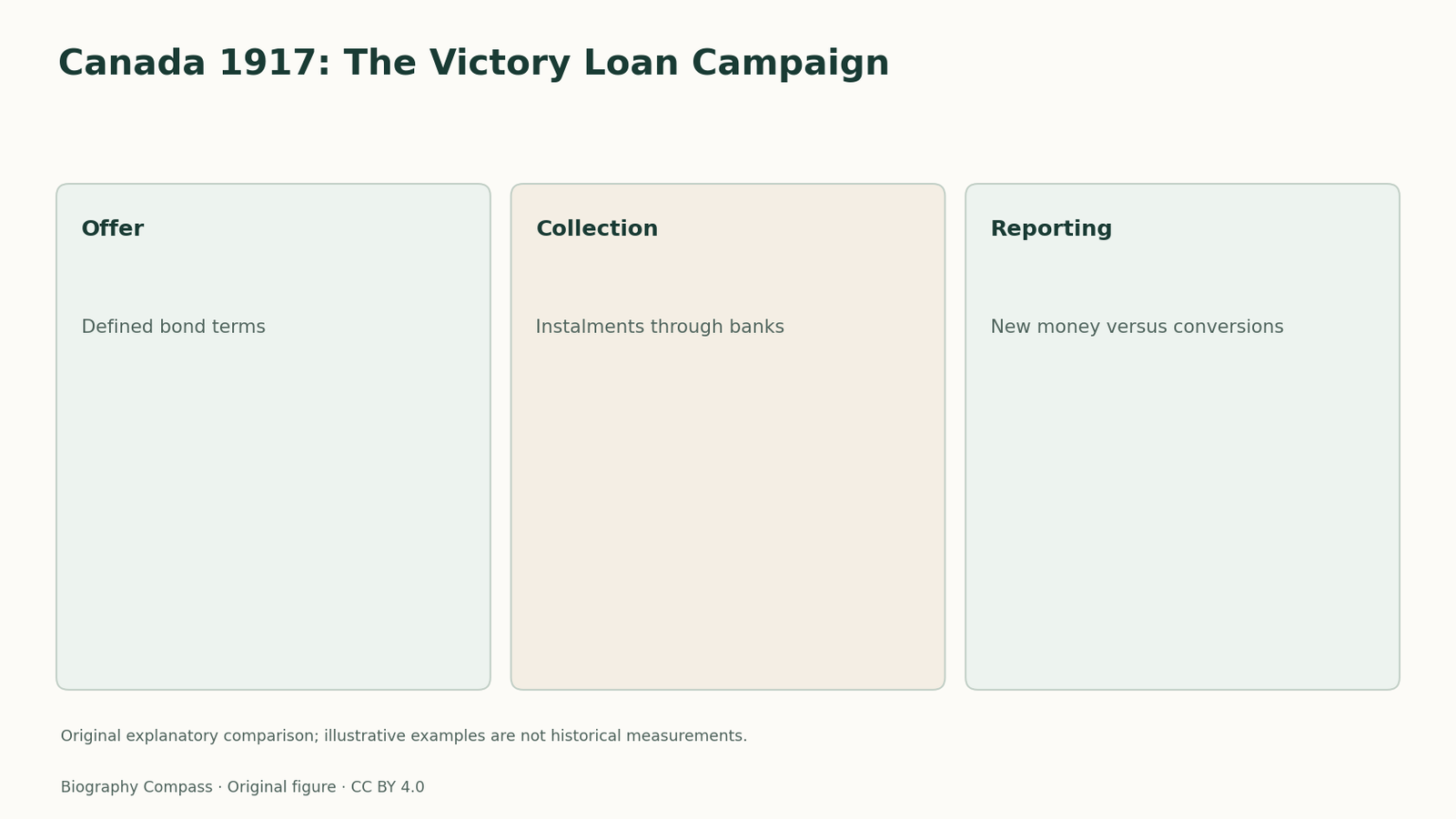
What each part contributes
Use the specific distinctions developed in the study.
| Part or record | What it establishes | Why the distinction matters |
|---|---|---|
| Subscription | A commitment to buy | Not always cash already received |
| Conversion | Exchange of an earlier holding | Different from new money |
| Bank administration | Receipts, instalments and bonds | Continues beyond the appeal |
How did a subscription become money available to government?
Canada’s November 1917 Victory Loan combined public persuasion with a practical collection system. Its terms invited smaller subscriptions and allowed payment by instalments, broadening the number of people who could participate. Those features also meant that an announced subscription was not necessarily cash already in the Treasury. The useful question is how the campaign’s promises moved through banks, temporary receipts and final bonds. White’s April 1918 budget statement supplies concrete evidence of that administrative work, allowing the campaign to be studied as a financial process rather than only as patriotic advertising.
The announced terms defined a specific offer
Contemporary reporting gives the opening of subscription books as 12 November 1917 and describes five-, ten- and twenty-year bonds bearing five-and-a-half-percent interest. The smallest denomination was fifty dollars, and purchasers could spread payments over several months. These are features of the historical offer, not investment advice for present readers. The denominations concern how much could be subscribed; maturity concerns when principal was due; interest concerns the promised periodic return. Keeping those terms separate helps explain how the government translated a broad appeal into a defined financial instrument.
Sources for this section: [4]
Banks performed several stages of the transaction
In his 1918 statement White described banks taking subscriptions, issuing temporary receipts, receiving instalments, transmitting money to the Finance Department and exchanging scrip for bonds. He also identified continuing work in paying coupons and interest checks. The bank was therefore more than a place that displayed an appeal. It linked the subscriber’s local transaction with central public finance and later servicing. The statement records the minister’s explanation of remuneration for that work, making it possible to identify actual tasks rather than assume that all campaign participation was an unpaid volunteer activity.
Sources for this section: [3]
Subscriptions, allotment and cash receipts require different labels
The same budget statement distinguishes the amount allotted as new money from conversions of earlier war-loan holdings. A conversion changed the form of an existing investment; it was not necessarily an equal amount of fresh cash reaching the government. A later historical statistical summary also places the November issue after earlier domestic war loans. These distinctions matter when comparing campaign totals. A subscription headline, an accepted allotment, a conversion and receipts in a particular fiscal period can all be correct while referring to different accounting stages or categories.
Transaction exercise and checked answer
Suppose a fictional subscriber agrees to buy a one-hundred-unit bond, pays twenty units immediately and the balance later. Another exchanges an existing one-hundred-unit security for the new issue. How much new cash has arrived immediately from these two transactions? Only twenty units, assuming no other payment. The second transaction is a conversion, and the first still has an unpaid balance. This example does not reconstruct a Canadian loan account. It clarifies why a campaign’s full face-value total cannot automatically be read as cash received on its opening day, and why later reports must state which stage they measure.
Sources for this section: [3]
Continue the chronology
Related history guides
Biography context
Explore Canada through connected lives
Connected biographies
People and wider context
1866–1955
William Thomas White
financier and Canadian finance ministerWilliam Thomas White was a financier and Canadian finance minister, known for wartime borrowing and Canada’s 1917 Victory Loan campaign.Read biographyQuick answers
Common questions
- Was the 1917 Victory Loan Canada’s first domestic war loan?
- No. It was the first called Victory Loan, following earlier domestic war-loan issues.
Primary and institutional sources
How this history was checked
The source notes distinguish original records, institutional descriptions and later historical interpretation. Exercises and comparisons are original editorial analysis. This article was reviewed on 8 November 2026.
- A Cyclopædia of Canadian Biography, historical editionWilliam Thomas White, contemporary biography
- Public Archives of CanadaSir William Thomas White fonds, finding aid 540
- Canadian House of Commons, Thomas WhiteBudget statement, 30 April 1918
- Commercial West, FRASERCanada’s New Victory Loan, 10 November 1917
- Dominion Bureau of StatisticsCanada Year Book 1931, public finance, page 852