
The short answer
Selecting representatives and becoming a representative are different powers. A close reading should also ask which institution a voting date describes.
Document and inference
Separate what each record establishes
The comparison preserves the limits of each input.
| Input | What it supplies | What remains open |
|---|---|---|
| Supplied motion | Identify the two requested powers. | Do not replace a request with an enacted outcome. |
| Voting date | Name the institution to which the date refers. | It does not establish the date of a woman taking a seat. |
| Original matrix | V and S are separate permissions. | No actual electoral counts are supplied. |
Chronology
A timeline of the turning points
Motion
Two political powers requested.
Identify the supplied text
The modern republication supplies Māori text and an English translation of the 18 May 1893 speech. Reasons one to four concern women’s land and capacity to manage it; the fifth turns to unsuccessful male petitions and women’s representation.
We read that supplied text, not an inspected autograph. Its numbered reasons allow a claim to be checked against a particular part rather than against a familiar slogan.
Sources for this section: [1]
An original two-rights matrix
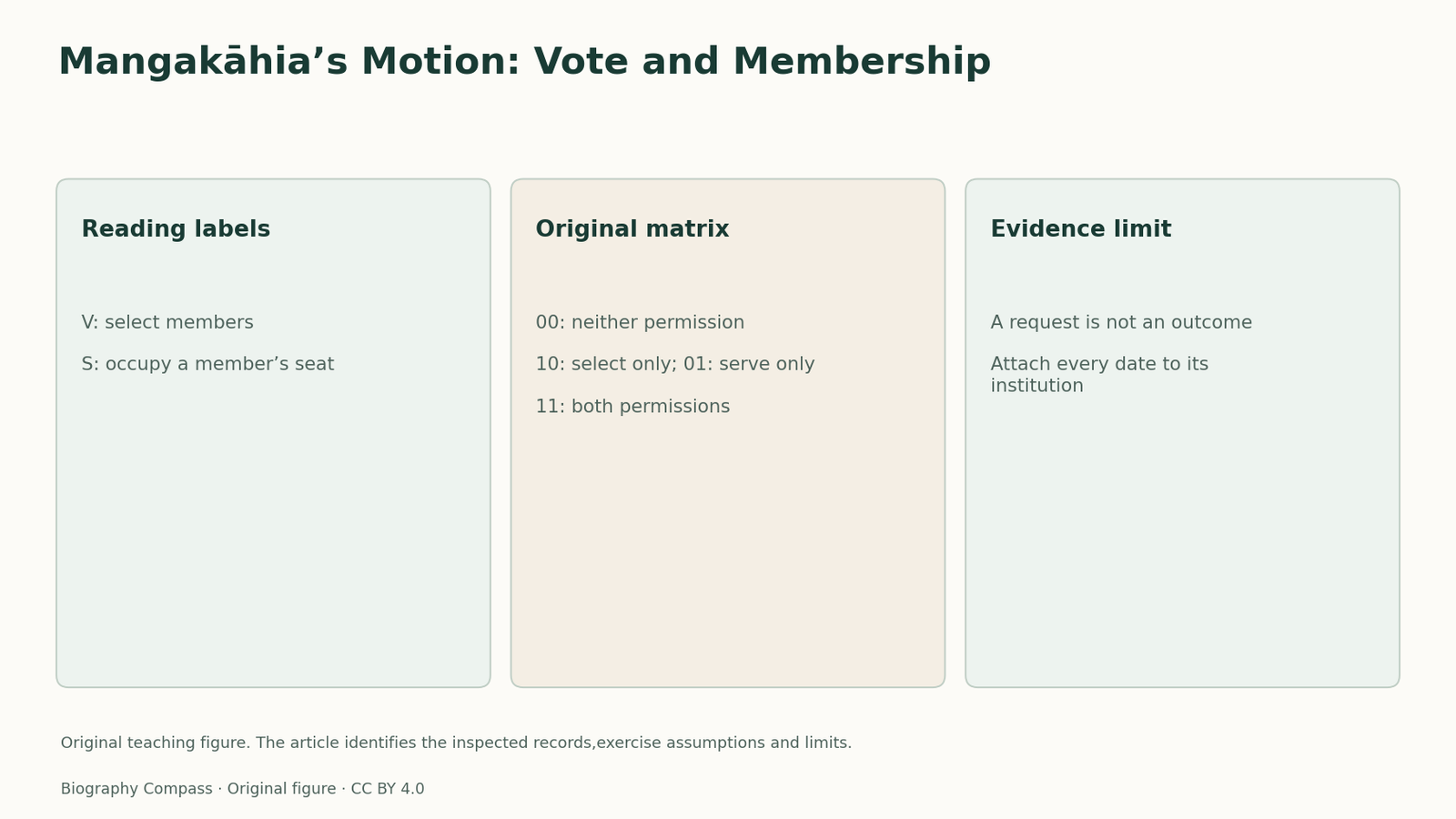
Let V mean a person may take part in selecting members, and S mean the person may occupy a member’s seat. These are our reading labels, not symbols in the speech. Compare arrangements (V, S)=(0,0),(1,0),(0,1),(1,1). Which would satisfy both requests?
Now classify three invented claims: a person can cast a ballot; a person can serve after being selected; a motion requests both powers. State which right each claim addresses and whether it reports an achieved outcome.
Sources for this section: [1]
Reference answer and close reading
Only (1,1) contains both permissions. The first claim concerns V, the second S, and the third requests both without establishing either outcome. Do not fill a missing column by assuming every institution must share the rules of a present-day parliament.
The speech’s appeal to the Queen is an argument for trying a different representative route. It is not evidence that the Queen granted the request.
For the four land-related reasons, mark the premise and the political conclusion separately. Ownership or expertise is offered as a reason for representation; the text does not provide a population count or prove that every woman owned land.
Sources for this section: [1]
Keep two institutional timelines
NZHistory distinguishes the national voting change of 1893 from women’s participation in Kotahitanga elections in 1897.
A date with no institution attached is an incomplete answer. Nor does either voting date, by itself, establish the first woman actually seated in that body. A further membership record would be needed for that different question.
Sources for this section: [2]
Continue the chronology
Related history guides
Jessie Street: Hearing and NGO Status
Compare hearing, referral and recommendations in a separate institutional reading task.
Read the timeline1930 supplied textMaxeke’s Address: Housing and Work
Test how one eligibility condition can differ from the result a household actually obtains.
Read the timelineBiography context
Explore New Zealand through connected lives
Connected biographies
The related public career
Quick answers
Common questions
- Is the matrix a reconstruction of actual seat counts?
- No. It is an original classification task with explicit labels.
Primary and institutional sources
How this history was checked
Actual selected text and original teaching examples are distinguished below. A supplied extract is not the complete original proceedings. This article was reviewed on 31 October 2026.