
The short answer
A speech can diagnose an institutional barrier without measuring every household affected by it. This study separates the speaker’s account, its causal argument and an original rule test.
Document and inference
Separate what each record establishes
The comparison preserves the limits of each input.
| Input | What it supplies | What remains open |
|---|---|---|
| Speaker’s account | A described accommodation barrier. | It is not a population estimate. |
| Causal explanation | A proposed route from restriction to insecurity. | Magnitude and alternative causes remain unmeasured. |
| Original rule test | A transparent change to one stipulated condition. | Eligibility does not guarantee an actual dwelling. |
Chronology
A timeline of the turning points
Supplied text
Archive’s dating.
Read the argument in its supplied form
The archive labels its text an extract of Maxeke’s 1930 address. It describes a woman seeking urban accommodation who is told she cannot rent without a husband, links that restriction to insecurity, and proposes safer accommodation and cooperation.
The text also uses moral and religious language and assigns different responsibilities to men and women. Reading its institutional criticism does not require adopting all those assumptions. It is a historical public argument, not a present-day policy instruction.
Sources for this section: [1]
An original household rule test
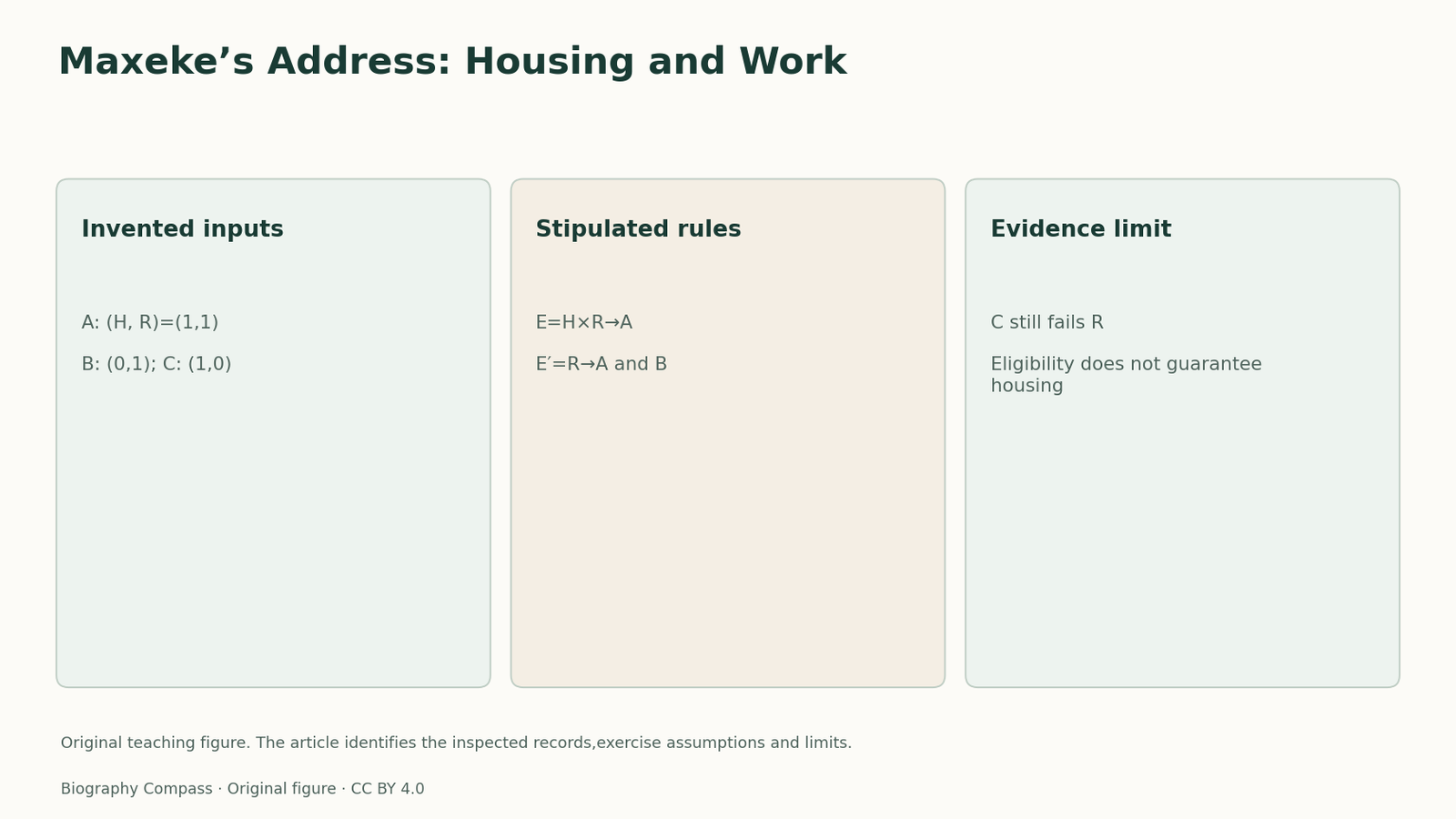
For this invented exercise only, suppose eligibility E requires both H=1 (a husband condition is met) and R=1 (other stated rental requirements are met). Define E=H×R. Three fictional households have (H, R): A=(1,1), B=(0,1), C=(1,0). Find the eligible set.
Now remove only the H condition, leaving E′=R. Which household changes eligibility? Does that change prove that accommodation exists, that it is affordable, or that the household actually obtains it? These numbers are not recovered housing data.
Sources for this section: [1]
Reference answer
Initially only A is eligible. After the rule change A and B are eligible; C still fails the other condition. The example isolates a gate. It does not establish a vacant room, an affordable rent, a landlord’s compliance or an actual move.
Changing formal eligibility can be relevant while leaving other obstacles unresolved. A useful reading should neither dismiss the gate because it is not the only barrier nor treat its removal as a complete account of an outcome.
Sources for this section: [1]
Separate testimony, interpretation and remedy
In the supplied extract, the accommodation refusal is the reported obstacle; the connection with vulnerability is the speaker’s causal explanation; hostels, clubrooms and cooperation are proposed remedies.
To estimate the prevalence of the rule or its effects, further administrative records, legal text and household evidence would be needed. We have not inspected the full conference proceedings, the original speech manuscript or a controlling housing ordinance.
The archive’s 1930 dating identifies the supplied extract. It should not settle a delivery-versus-publication dispute without the original proceedings.
Sources for this section: [1]
Continue the chronology
Related history guides
Biography context
Explore South Africa through connected lives
Connected biographies
The related public career
Birth date disputed–1939
Charlotte Maxeke
OrganiserOrganiser linking education, church networks and women’s public work.Read biographyQuick answers
Common questions
- Are A, B and C historical households?
- No. They are invented cases used to test the stated rule.
Primary and institutional sources
How this history was checked
Actual selected text and original teaching examples are distinguished below. A supplied extract is not the complete original proceedings. This article was reviewed on 31 October 2026.