
The short answer
Providing a meal, getting a child into a classroom and improving what that child learns are connected possibilities, but they are different results. Keeping the measures separate makes a programme easier to assess fairly.
Purposes and evidence
Three different results
Each measure answers a different question about the supplied activity.
| Instrument or measure | What follows | What does not follow |
|---|---|---|
| Meals supplied | A delivery count. | A child’s attendance or learning result. |
| Attendance rate | Participation under a defined denominator. | A demonstrated change in attainment. |
| Comparison of changes | A specified descriptive calculation. | Causality without further design assumptions. |
Chronology
A timeline of the turning points
Statutory design
The law specifies several purposes.
Oversight review
GAO examines monitoring weaknesses.
What the original law set out to support
Section 3107 of the 2002 act authorised agricultural commodities and financial and technical assistance for school food programmes, alongside maternal and young-child nutrition. Its educational purposes included literacy and primary education, particularly for girls.
This is a design question as well as a funding question. If a programme names several purposes, choosing one easily counted activity cannot automatically demonstrate progress against all the others.
Sources for this section: [1]
The audit’s concern was measurement, not proof of failure
GAO’s 2011 review found weaknesses in monitoring. Agreements tracked participation and school progression, but did not require indicators directly measuring learning; some also lacked direct nutrition measures.
That finding does not establish that nobody benefited. It identifies a gap between the outcomes sought and the information collected. Nor should findings about a dated set of agreements be presented as an unchanged description of every later project.
Sources for this section: [2]
Original exercise: three reports from two schools
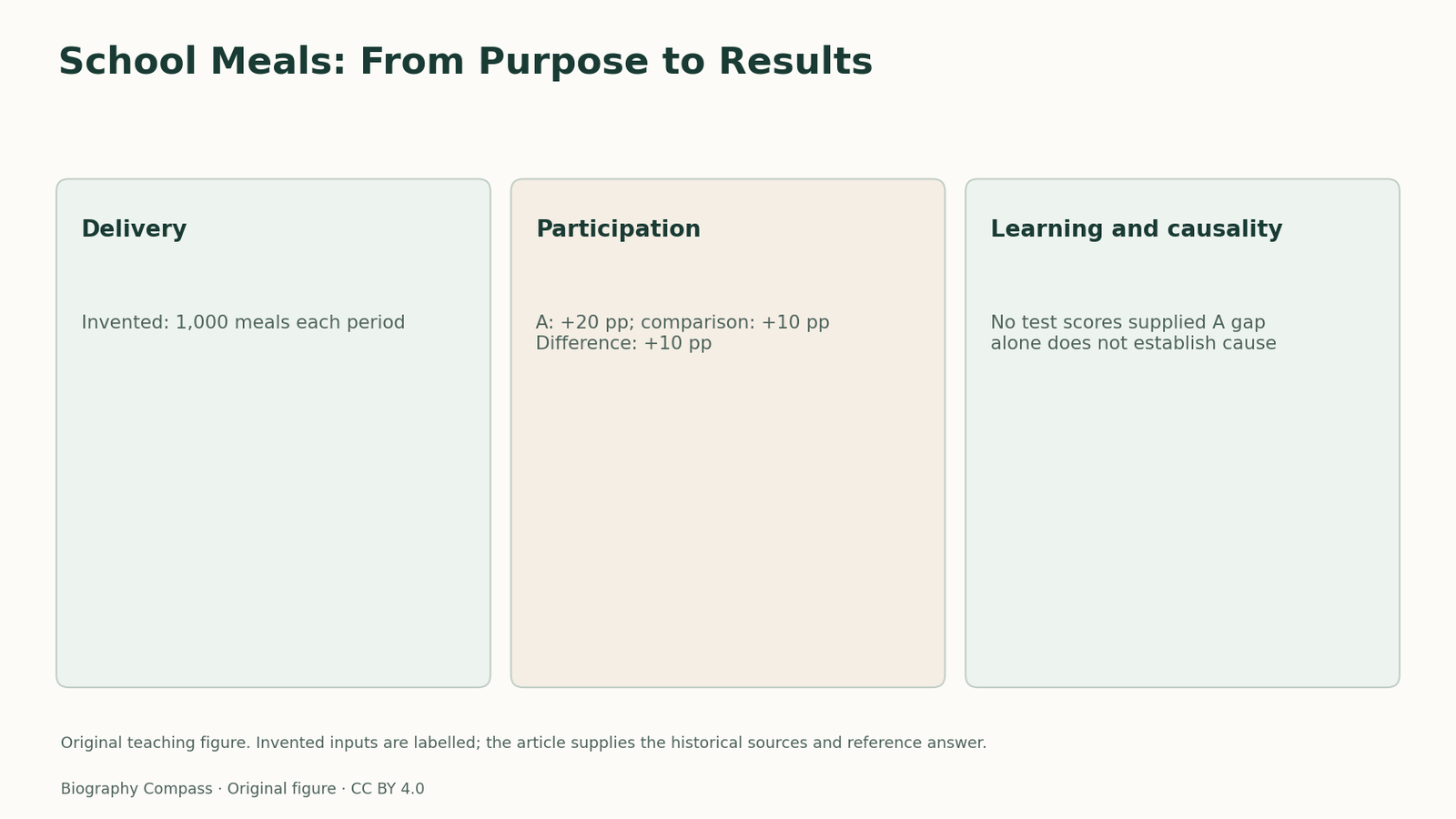
Invented records: School A supplies 1,000 meals during each of two equal periods. Its attendance rate rises from 60% to 80%. A comparison school supplies no programme meals and rises from 65% to 75%. Test scores are not recorded. Assume the rates use comparable attendance definitions and stable enrolment counts.
Identify one delivery result, the attendance change at each school, and the difference between those changes. Can the table establish improved learning? Would the difference alone identify the causal effect of the meals?
Sources for this section: [2]
Reference answer and an improved evidence plan
The delivery count is 1,000 meals per period; A’s attendance rises 20 percentage points and the comparison school’s 10 points. The difference between changes is 10 points. That arithmetic does not make the comparison group a valid counterfactual: selection, other interventions or changing circumstances could still explain a gap.
No learning change can be calculated without a learning measure. A stronger plan would specify comparable observations before collection, preserve denominators and document relevant differences between schools. The invented figures establish these arithmetic distinctions only; they are not historical programme results or a nutrition recommendation.
Sources for this section: [2]
Continue the chronology
Related history guides
Biography context
Explore United States through connected lives
Connected biographies
The connected working life

1922–2012
George McGovern
Senator and hunger-policy advocateA senator whose electoral defeat was followed by decades of work against hunger.Read biographyQuick answers
Common questions
- Do the invented attendance figures prove improved learning?
- No. The exercise supplies no learning measure, so that result cannot be calculated from its table.
Primary and institutional sources
How this history was checked
The article uses the selected passages identified below. Original exercise inputs are supplied here, rather than presented as a historical dataset or a ruling on a present dispute. This article was reviewed on 31 October 2026.