
The short answer
How do visible manipulators change the relation between dramatic action and control?
Read the evidence
Sources, interpretation and production roles
The records answer different questions about this work. The final exercise is an original teaching model.
| Record or question | Supported reading | Boundary or contrast |
|---|---|---|
| Handlers | Prepare puppets and remain visible | Not an accidental production intrusion |
| Double role | Iwashita as Koharu and Osan | Comparison does not make them one person |
| Credits | Writing, design, photography and music | Distinct collaborative tasks |
Puppets introduce a film with living actors
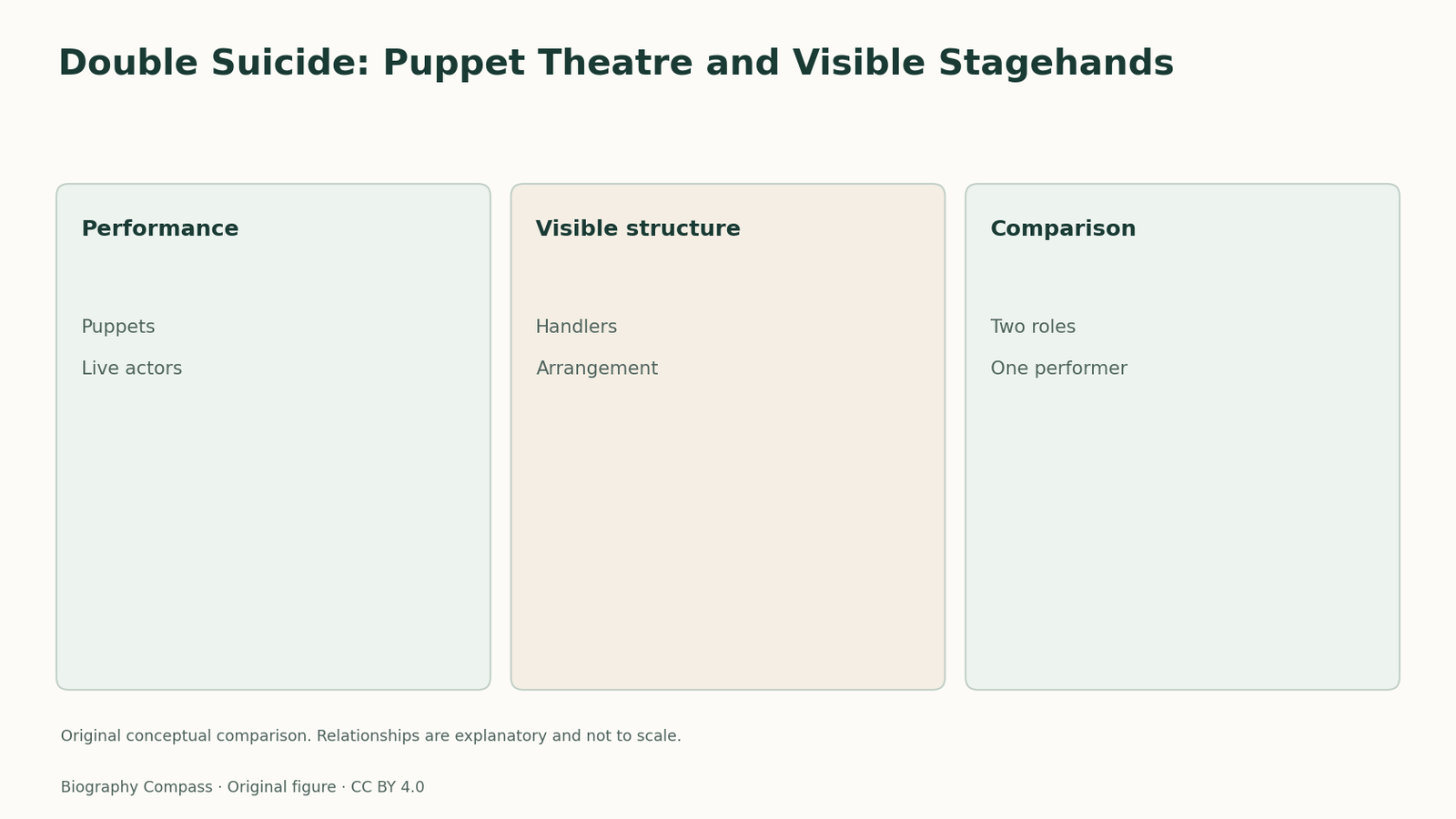
Masahiro Shinoda’s Double Suicide is a 1969 adaptation of Chikamatsu’s theatrical material. Claire Johnston’s essay describes an opening in which black-clad handlers prepare puppets before the film moves into a drama performed by live actors. The handlers remain visible within that drama. This is the specific formal question pursued here: what changes when a film keeps the people who normally manage a performance within the audience’s view? Johnston’s account places puppets, handlers and live performers in a deliberate relationship. The transition changes the bodies on screen while retaining a deliberately visible system of theatrical presentation around them.
Visible handling complicates individual action
Johnston reads the handlers as both agents within the presentation and figures of helpless observation. Our interpretation builds on that tension: a character can appear to act while the work simultaneously reveals forces that arrange the action. The resulting question concerns agency, not simply the discovery that a film is artificial. A visible handler does not have to cancel emotion. It can direct attention to how an action is made possible or constrained, while leaving the person’s experience consequential. This distinction makes the device more useful to discuss than a broad claim that traditional theatre and modern cinema have been mixed together.
Sources for this section: [5]
One performer and several creative responsibilities
Criterion credits Shima Iwashita with both Koharu and Osan, while Kichiemon Nakamura plays Jihei. Johnston considers the doubled casting part of the film’s relationship between desire and obligation. That is an attributed critical interpretation, not a statement that the two fictional people are literally one person. The credits also assign screenplay work to Taeko Tomioka, Shinoda and Takemitsu, with Kiyoshi Awazu responsible for art direction and Toichiro Narushima for cinematography. Our analytical point is that the film’s theatrical references become cinema through distinct collaborative decisions. No single credit can be assumed to account for every aspect of the visible staging or its meaning.
Exercise: conceal and reveal the arrangement
Imagine a performer crossing a room to hand over a letter. In version A, a change of lighting appears without visible assistance. In version B, a black-clad helper moves a screen and openly redirects the light before the crossing. A possible answer says the second version makes the organization of the action available for attention, even if the performer’s intention remains the same. Now cast one actor in two contrasting roles and list what an audience might compare: gesture, costume, speech and obligations. Explain why this is an interpretation created by presentation rather than proof that the characters are identical. The original model helps relate visible handling and doubled casting without copying Shinoda’s scenes or determining one compulsory response.
Continue the chronology
Related history guides
Biography context
Explore Japan through connected lives
Connected biographies
People and related creative practices
1931–2025
Masahiro Shinoda
Film director, screenwriter and authorMasahiro Shinoda moved from Shochiku’s youth-oriented filmmaking towards historical, theatrical and independent work, sustaining collaborations across film and music.Read biography1903–1963
Yasujirō Ozu
Film director and screenwriterYasujirō Ozu moved from silent comedy to carefully organised family dramas, developing long collaborations and a visual style recognised beyond Japan.Read biography
1912–1998
Keisuke Kinoshita
Film director and screenwriterKeisuke Kinoshita worked across comedy, melodrama, historical fiction and television, repeatedly changing the formal means through which ordinary lives reached an audience.Read biographyQuick answers
Common questions
- Who plays Koharu and Osan?
- Criterion’s cast record credits Shima Iwashita with both roles.
- Are the visible handlers a mistake?
- The critical account describes them as a deliberate part of the film’s theatrical presentation.
Primary and institutional sources
How this history was checked
The staging discussion follows Claire Johnston’s essay and the production credits; neither a full film viewing nor a full reading of the source play is claimed. The reading exercises and comparisons are original analytical models. This article was reviewed on 8 November 2026.