
The short answer
How does theatrical presentation change a film’s relationship to a village story?
Read the evidence
Sources, interpretation and production roles
The records answer different questions about this work. The final exercise is an original teaching model.
| Record or question | Supported reading | Boundary or contrast |
|---|---|---|
| 1958 | Kinoshita’s theatrical presentation | Different from Imamura’s 1983 film |
| Curtain | The act of showing is announced | Not accidental exposure of a set |
| Collaboration | Design, camera, editing and music | Theatre reference remains cinema |
Start with the right Narayama
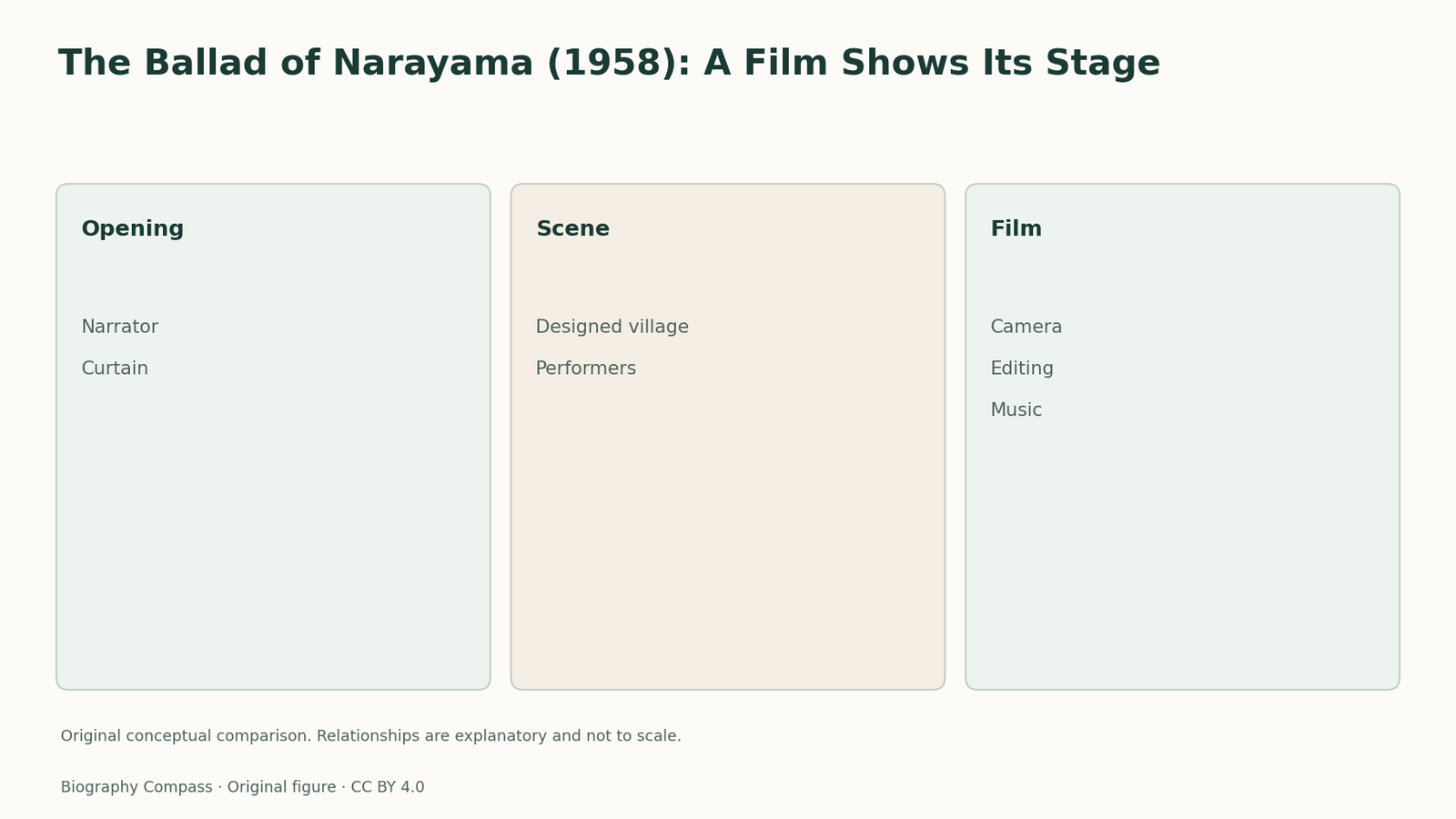
Keisuke Kinoshita’s The Ballad of Narayama is the 1958 film, distinct from Shohei Imamura’s 1983 treatment of the same source material. This study concerns the earlier film’s decision to display a theatrical mode of presentation. Criterion identifies it as an adaptation of Shichiro Fukazawa, with Kinuyo Tanaka as Orin. Philip Kemp’s essay describes a narrator and a curtain that openly introduce a stylized village. The starting question is what this declared artifice permits a camera to do. The visible stage is a cinematic choice: the curtain establishes a boundary that the narrator opens for a viewer, making entry into the fictional world an event in itself.
An opening curtain announces a contract
Kemp describes the narrator drawing aside a striped curtain after the credits to reveal the village setting. Our interpretation is that the gesture makes presentation part of the story’s beginning. A viewer is asked to accept a deliberately constructed world, not discover later that an apparently natural landscape is a studio arrangement. The narrator’s presence also separates the events from a voice that can comment on them. Those layers need not compete for credibility: action and commentary can perform different functions. Their visible separation gives a reader of the film’s design a more precise question than whether the setting is simply realistic or unrealistic.
Sources for this section: [5]
Theatricality still depends on film workers
The credits identify Kusuda’s cinematography, Ito and Umeda’s production design, Yoshi Sugihara’s editing and separate musical responsibilities for Rokuzaemon Kineya and Matsunosuke Nozawa. These roles show why theatrical reference does not eliminate cinematic construction. Sets have to be designed, performers and space photographed, and filmed material assembled. Kemp notes lighting changes that mark transitions within the studio world. Our reading is that the camera can work with an acknowledged stage instead of disguising it. This distinguishes the 1958 work’s production question from the later Imamura topic already on the site, which concerns another film and its different treatment of the material.
Exercise: announce or conceal a change of world
Plan an original scene in which a storyteller introduces a room. In version A, the room is shown immediately without an introduction. In version B, the storyteller opens a plain curtain and then begins commenting while two performers act. A possible answer says version B makes the act of showing visible and establishes two levels of address: the scene and the commentary. Assign separate tasks to designer, camera operator, editor and musicians. Explain why choosing a theatrical convention does not make those film roles redundant. Return to the documented opening and identify the curtain as an intentional announcement of form, rather than a mistake that prevents the audience from believing the characters’ experience.
Continue the chronology
Related history guides
Harakiri: An Official Story Meets a Counter-Account
Explore Harakiri’s clash between clan authority and a family’s suffering, its collaborative credits and the significance of a restored emblem.
Read the timeline1983The Ballad of Narayama: Fiction, Work and Survival
Read Imamura’s 1983 Ballad of Narayama through literary adaptation, work and survival, distinguishing festival interpretation from historical proof.
Read the timelineBiography context
Explore Japan through connected lives
Connected biographies
People and related creative practices
1912–1998
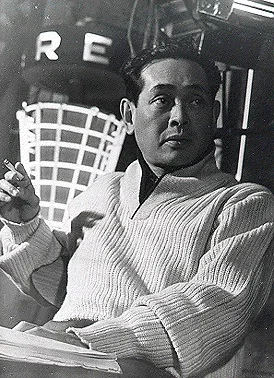
Keisuke Kinoshita
Film director and screenwriterKeisuke Kinoshita worked across comedy, melodrama, historical fiction and television, repeatedly changing the formal means through which ordinary lives reached an audience.Read biography1926–2006
Shōhei Imamura
Film director, screenwriter and film educatorShōhei Imamura developed a film career around marginal lives and social contradictions, moving through studio apprenticeships, independent work and film education.Read biography1916–1996
Masaki Kobayashi
Film director and screenwriterMasaki Kobayashi made films that placed individuals against hierarchical power, moving between contemporary drama, period cinema, ghost stories and documentary.Read biographyQuick answers
Common questions
- Is this the 1983 Narayama film?
- No. This is Kinoshita’s 1958 version; Imamura directed the later 1983 film.
- Who supplied the source story?
- The credits identify Shichiro Fukazawa as the source novelist, with Kinoshita writing and directing the adaptation.
Primary and institutional sources
How this history was checked
The opening and staging discussion follows Philip Kemp’s essay and the 1958 film’s credits; the complete film was not viewed for this guide. The reading exercises and comparisons are original analytical models. This article was reviewed on 8 November 2026.
- ShochikuKeisuke Kinoshita 100 Project
- Musashino Art University Image LibraryKeisuke Kinoshita
- Arsenal Institute for Film and Video ArtKeisuke Kinoshita retrospective
- Criterion CollectionThe Ballad of Narayama
- Philip Kemp / CriterionThe Ballad of Narayama: Abandonment
- Japan Foundation Touring Film ProgrammeA Japanese Tragedy