
The short answer
How did Terrell distinguish work already done from the programme she wanted to expand?
Evidence comparison
Read the records together
The records were created for different purposes and support different kinds of claims.
| Record | What it establishes | Question to keep open |
|---|---|---|
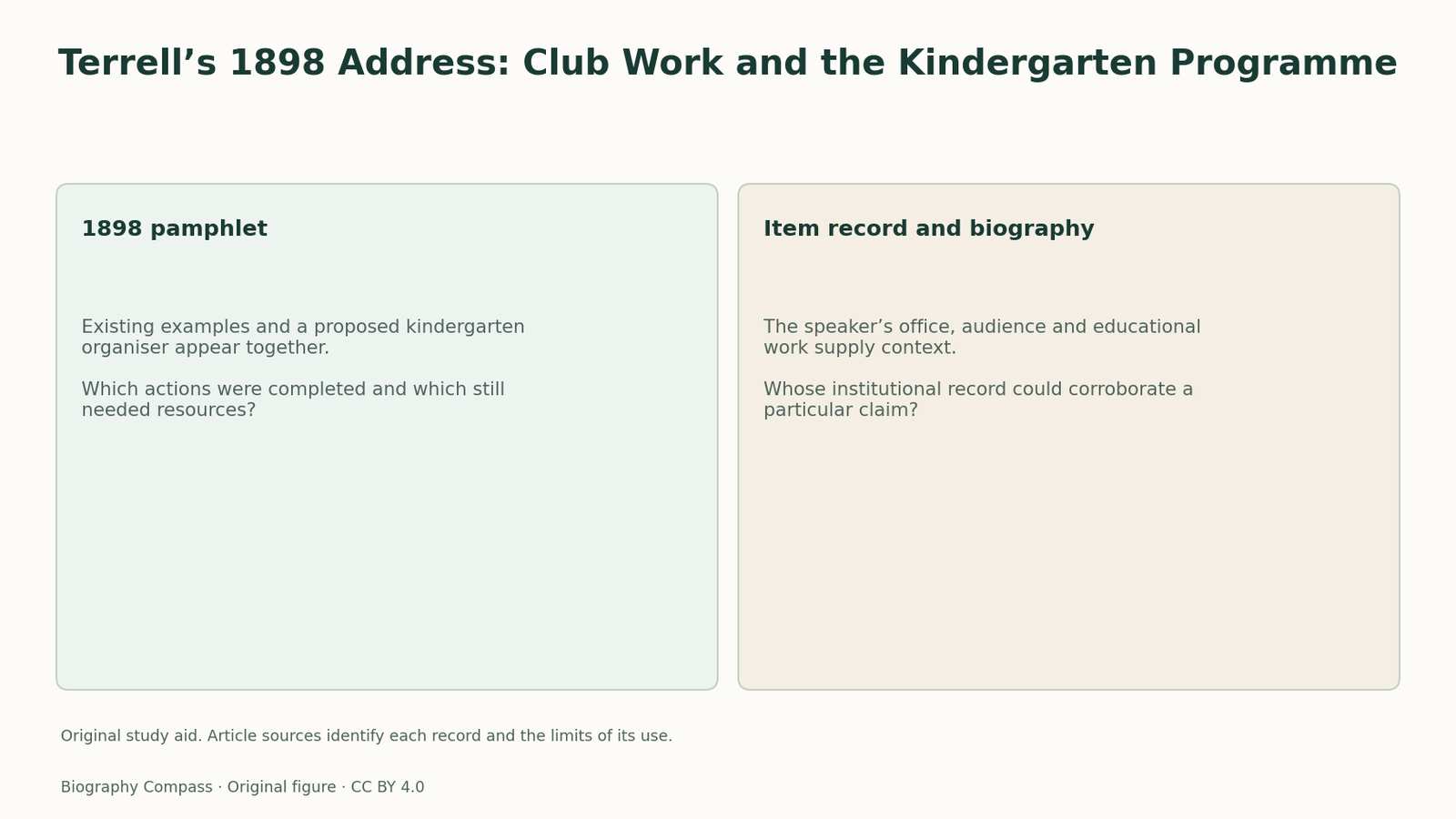
| 1898 pamphlet | Existing examples and a proposed kindergarten organiser appear together. | Which actions were completed and which still needed resources? |
| Item record and biography | The speaker’s office, audience and educational work supply context. | Whose institutional record could corroborate a particular claim? |
Chronology
A timeline of the turning points
Washington teaching
Terrell joins the city’s educational world.
Association address
She presents achievements and a future kindergarten programme.
Identify the speaker and the audience
Terrell spoke as president of the National Association of Colored Women before the National American Woman Suffrage Association. The organisations should not be merged simply because both appear on the title page. Her position allowed her to describe Black women’s collective work to an audience whose support and understanding she sought. That setting helps explain why the address combines a record of achievements with an argument about equal opportunity and responsibility.
Separate examples from a national total
The pamphlet names missions, clubs, educational work and a New Orleans care institution. These examples show the range of activity Terrell wanted recognised. They do not automatically supply a complete national inventory or independently audited results for each organisation. A careful reading keeps her attribution visible and asks what institutional records could corroborate a particular example before converting an illustrative list into a measured total for the country.
Sources for this section: [2]
Locate the future programme
Terrell called for free kindergartens and described efforts to secure an organiser who could encourage and establish them where resources were available. The request identifies work still to be done. Her language also reflects the moral and social assumptions of her period, which should be examined rather than adopted uncritically. The biography gives context for her commitment to education, while the speech makes the resource-dependent character of the proposed expansion explicit.
Make an achievement-and-plan ledger
Create rows for an institution named as operating, an outcome claimed by the speaker and a proposed organiser. Add columns for document type and corroborating evidence. A useful answer puts the organiser under future programme, not completed appointment. It also distinguishes the association Terrell represented from the audience she addressed. The ledger makes the speech readable as an intervention joining recognition, persuasion and practical plans, rather than as a flat list of accomplished facts.
Continue the chronology
Related history guides
Biography context
Explore United States through connected lives
Connected biographies
People behind the records
1863–1954
Mary Church Terrell
Educator and civil rights organiserTerrell connected education, Black women’s organisations and civil rights campaigning, continuing to challenge segregation into her final years.Read biographyQuick answers
Common questions
- Does calling for an organiser prove the appointment occurred?
- No. The address identifies an effort to obtain resources and support; later records are needed to establish an appointment.
Primary and institutional sources
How this history was checked
Sources support the chronology and the record comparison. The reading exercise is original. This article was reviewed on 7 November 2026.