
The short answer
A factory can divide production into repeated operations while preserving information for an individual customer. The important question is where the order’s identity survives each handoff.
The records answer different questions
Keep the measures separate
The question changes when the object, unit or reporting period changes.
| Record or measure | What it establishes | What it does not establish |
|---|---|---|
| Shop order | Customer specification and deposit | A completed delivery |
| Sectioned production | Division of operations | Loss of individual order identity |
| Ready-to-wear offer | A different sales format | The format of every garment shown |
Chronology
A timeline of the turning points
Contracted service
Personal orders precede own manufacture.
Own workshop
Production organisation changes.
Personal orders did not exclude factories
Burton contracted for made-to-measure supply before operating his own workshop.
The shops took measurements, cloth choices and deposits; factories then produced the suits.
This route sits between two misleading extremes: every suit taken from ready stock, or every suit made entirely by one craftsperson in the shop. The commercial system depended on linking local customer contact with production elsewhere.
What the selected booklet actually describes
Sartorial Service describes coat, vest and trouser sections, inspection, separate pieces sorted by branch, and consignments travelling by lorry or rail. Elsewhere it advertises ready-to-wear overcoats as well as made-to-measure suits.
The same publication therefore contains more than one selling format. The production description should not be applied automatically to every pictured garment. It is also company publicity: its organisation claims do not independently measure fitting quality, delivery reliability or worker experience.
The selected workshop account starts with cloth received, checked for flaws and measured before reaching cutters. Later operations include machining, pressing and finishing, with examiners checking separate garments before branch despatch. This sequence identifies several handoffs where the relationship between a specification and its pieces could matter.
Sources for this section: [3]
An original order-tracing task
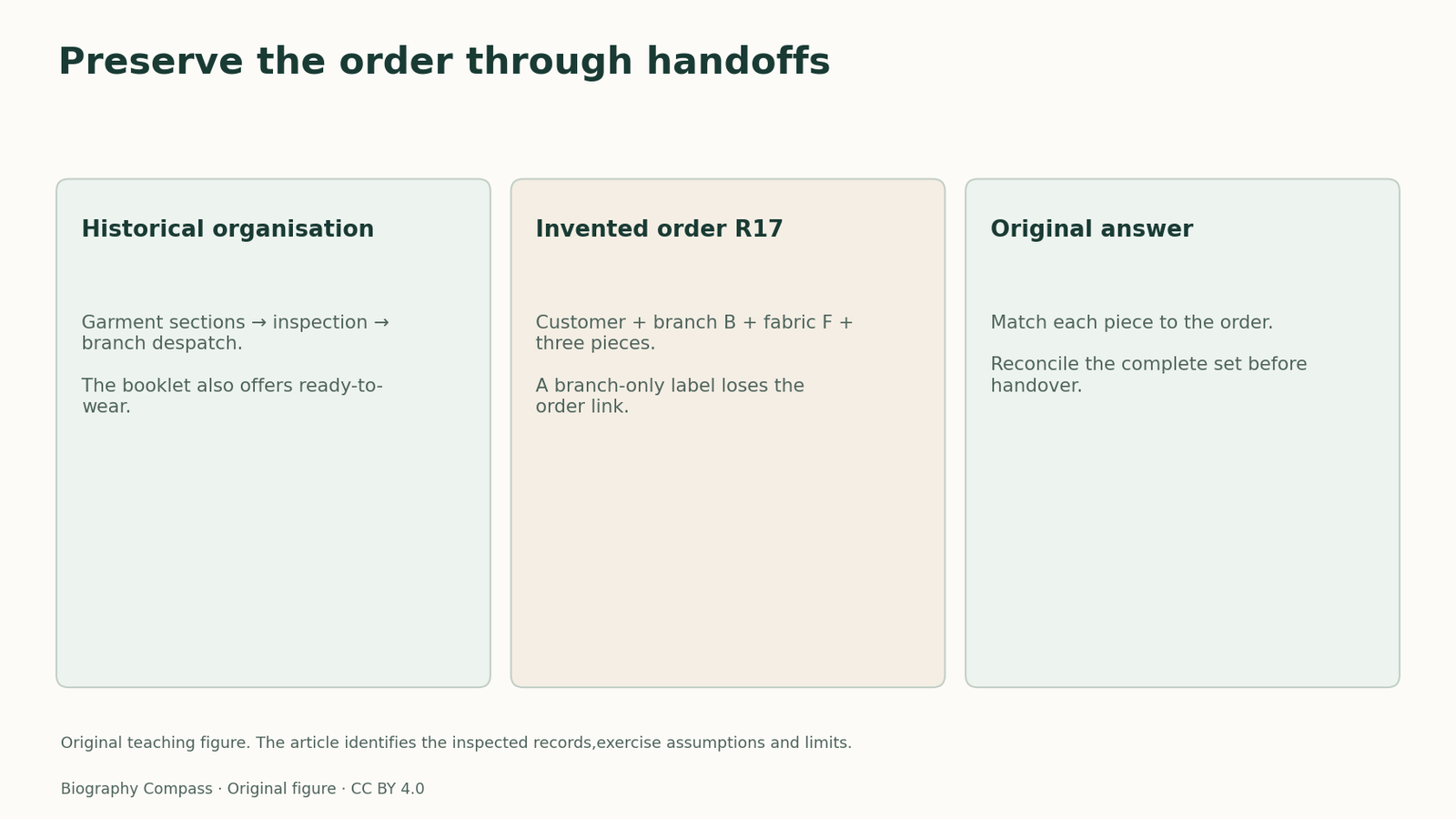
Invented order R17 specifies one customer, branch B, fabric F and three garment pieces. The cutting ticket retains those fields. A despatch label retains only “branch B”. Identify the missing link before concluding that the correct complete suit reached the correct person. Then propose a minimal record that could close it.
Reference answer: a branch destination alone does not match each piece back to R17 or confirm the set is complete. Retain the order identifier on each piece or its traceable container, then reconcile coat, vest and trousers against the order before handover. This is an original information-flow proposal, not a claim that the historic firm used that exact identifier or procedure.
A precise interpretation of industrial tailoring
The records make industrial organisation visible without requiring that “factory-made” mean “impersonal stock”. They also leave genuine questions open: the customer’s final fitting and the employee’s daily conditions need evidence beyond the staged production account. Keeping those questions separate allows the manufacturing mechanism to be explained rather than replaced by either praise or nostalgia.
Continue the chronology
Related history guides
Biography context
Explore United Kingdom through connected lives
Connected biographies
The connected careers
Quick answers
Common questions
- Does factory production necessarily mean stock sizing?
- No. The learning task distinguishes repeatable operations from the information that identifies a particular customer order.
Primary and institutional sources
How this history was checked
Read these dated records together; the original task states its own assumptions and separates them from reported facts. This article was reviewed on 31 October 2026.
- Jayne Shrimpton / Discover Your Ancestors, issue 115, November 2022The tailor of taste
- Kathryn A. Morrison, Building Our Past, 28 January 2017The Story of Montague Burton – the Tailor of Taste
- Montague Burton Ltd; retained museum scan hosted by Andrews and PygottSartorial Service, Leeds Museums catalogue LMG/LEEDM.S.1991.19.3
- West Yorkshire Archive Service / Hidden TreasuresMontague Burton’s sunroom