
The short answer
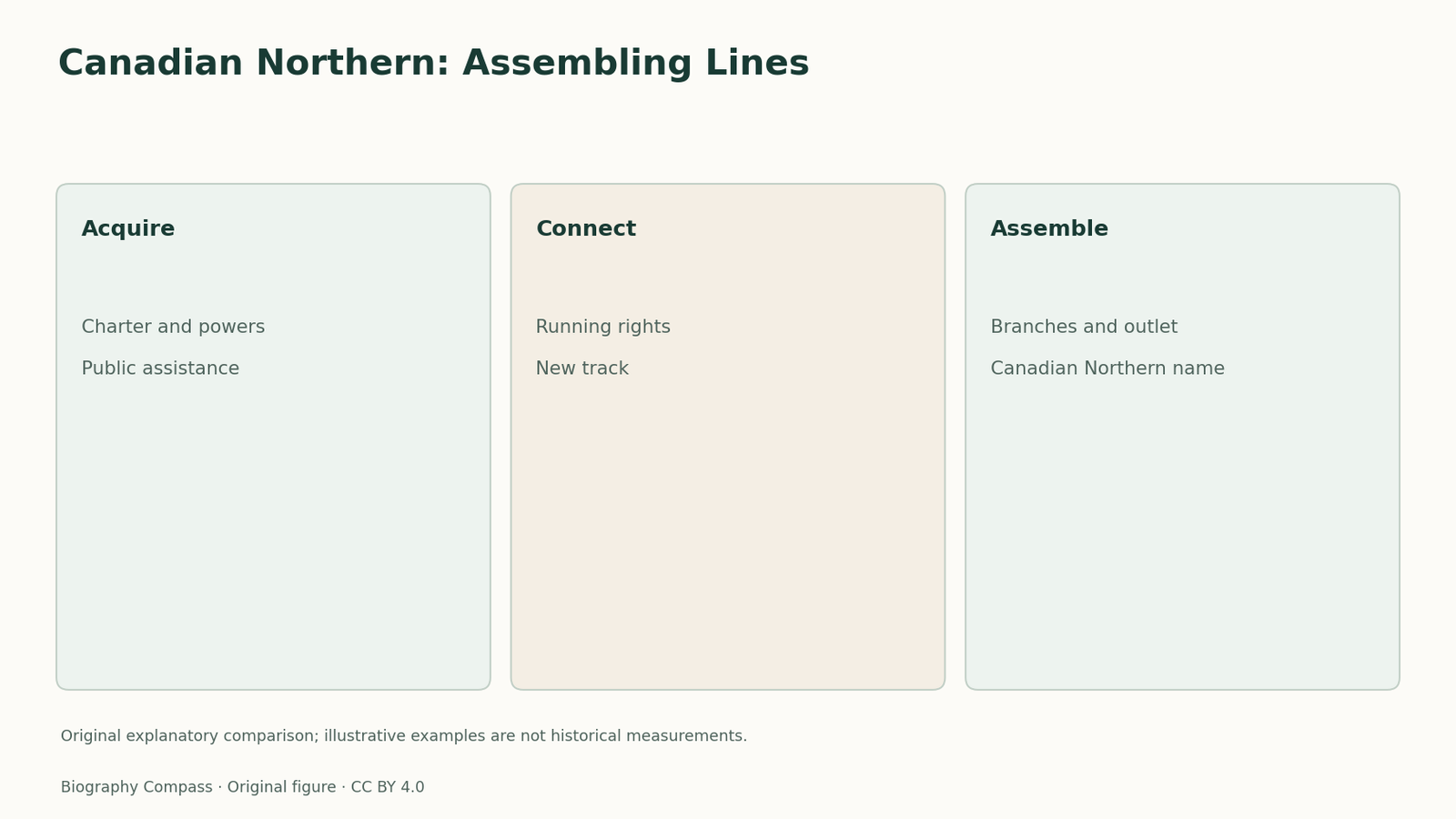
The early Canadian Northern story demonstrates three different routes to a connected system: purchasing corporate powers, negotiating access over another company’s line, and building new track. Oscar Skelton’s 1916 account supplies a specific example from 1895–1901. Donald Mann and William Mackenzie did not begin by owning a completed transcontinental railway. They assembled a western network from smaller opportunities. The independent question here is how legal and operating connections translated into a usable route, rather than how the later system was valued or nationalised.
A worked comparison
What each part contributes
Use the specific distinctions developed in the study.
| Part or record | What it establishes | Why the distinction matters |
|---|---|---|
| Charter | Power to undertake a railway | Not completed track |
| Running rights | Access over another line | Operation without owning that section |
| New construction | Additional physical railway | Still needs connected access |
A railway could grow without owning every rail
The early Canadian Northern story demonstrates three different routes to a connected system: purchasing corporate powers, negotiating access over another company’s line, and building new track. Oscar Skelton’s 1916 account supplies a specific example from 1895–1901. Donald Mann and William Mackenzie did not begin by owning a completed transcontinental railway. They assembled a western network from smaller opportunities. The independent question here is how legal and operating connections translated into a usable route, rather than how the later system was valued or nationalised.
Sources for this section: [2]
A charter was a starting right
The Lake Manitoba Railroad and Canal Company’s charter provided a vehicle through which the partners could build. Skelton describes a Dominion land subsidy and Manitoba assistance through a bond guarantee and tax exemption. Those instruments did different jobs: land assistance, credit support and relief from taxes should not be added as though all were cash already deposited in a construction account. A charter also did not supply the labour, rails, equipment and operating organisation required to turn a projected line into an actual service.
Sources for this section: [2]
Running rights closed a gap
In 1896 the partners obtained running rights over the Manitoba and Northwestern between Portage and Gladstone. Their own construction pushed northwest from Gladstone toward Dauphin, reaching Lake Winnipegosis the next year. The use of someone else’s track is the key mechanism in this stage. A map showing a continuous railway service can therefore hide a difference in ownership. Running rights made movement possible across a missing link without requiring the partners to construct a duplicate line along the whole approach.
Sources for this section: [2]
An outlet toward Lake Superior
The partners then sought an eastern outlet from Winnipeg toward Lake Superior. Construction began from both the Winnipeg and Port Arthur ends in 1898, using powers obtained in more than one jurisdiction. Skelton dates completion to three years later. Meanwhile western branches expanded, and the 1899 combination with the Winnipeg Great Northern brought the Canadian Northern name. These overlapping actions explain why incorporation, a renamed system and the opening of a particular route should have separate dates. A corporate label alone does not identify when each connection became usable.
Sources for this section: [2]
An original route-assembly exercise
Imagine a route with three sections: twenty miles owned by Company A, thirty miles newly built by Company B, and ten miles operated by B under running rights over Company A. Company B can offer a forty-mile continuous service while owning only thirty of those miles. The answer follows from separating operation from ownership. This invented example is not Canadian Northern mileage. It illustrates the precise distinction visible in the 1896 arrangement and suggests a useful map key: colour owned track, access rights and projected extensions differently rather than assigning the entire network one undifferentiated colour.
Sources for this section: [2]
Continue the chronology
Related history guides
Canadian Northern: The 1917 Appraisal
Study Swain’s 1917 Canadian Northern appraisal through measured quantities, unit prices and local conditions, separating physical value from shareholder claims.
Read the timeline1905–1914ROM: Collecting, Establishment and Opening
Trace ROM’s collecting, construction,1912 establishment and 1914 opening, identifying Walker, curators, donors, the university and the province.
Read the timelineBiography context
Explore Canada through connected lives
Connected biographies
People and wider context
1853–1934
Donald Mann
railway contractor and promoterDonald Mann was a railway contractor and promoter, known for Canadian Northern Railway partnership with William Mackenzie.Read biographyQuick answers
Common questions
- Did running rights mean Mann’s company owned the other railway’s track?
- No. They allowed operation over an agreed section. Ownership, access rights and newly constructed track are different elements of the network.
Primary and institutional sources
How this history was checked
Read the cited original records, institutional accounts and later interpretations. The comparison and exercise explain the specific evidence used in this study. This article was reviewed on 8 November 2026.