
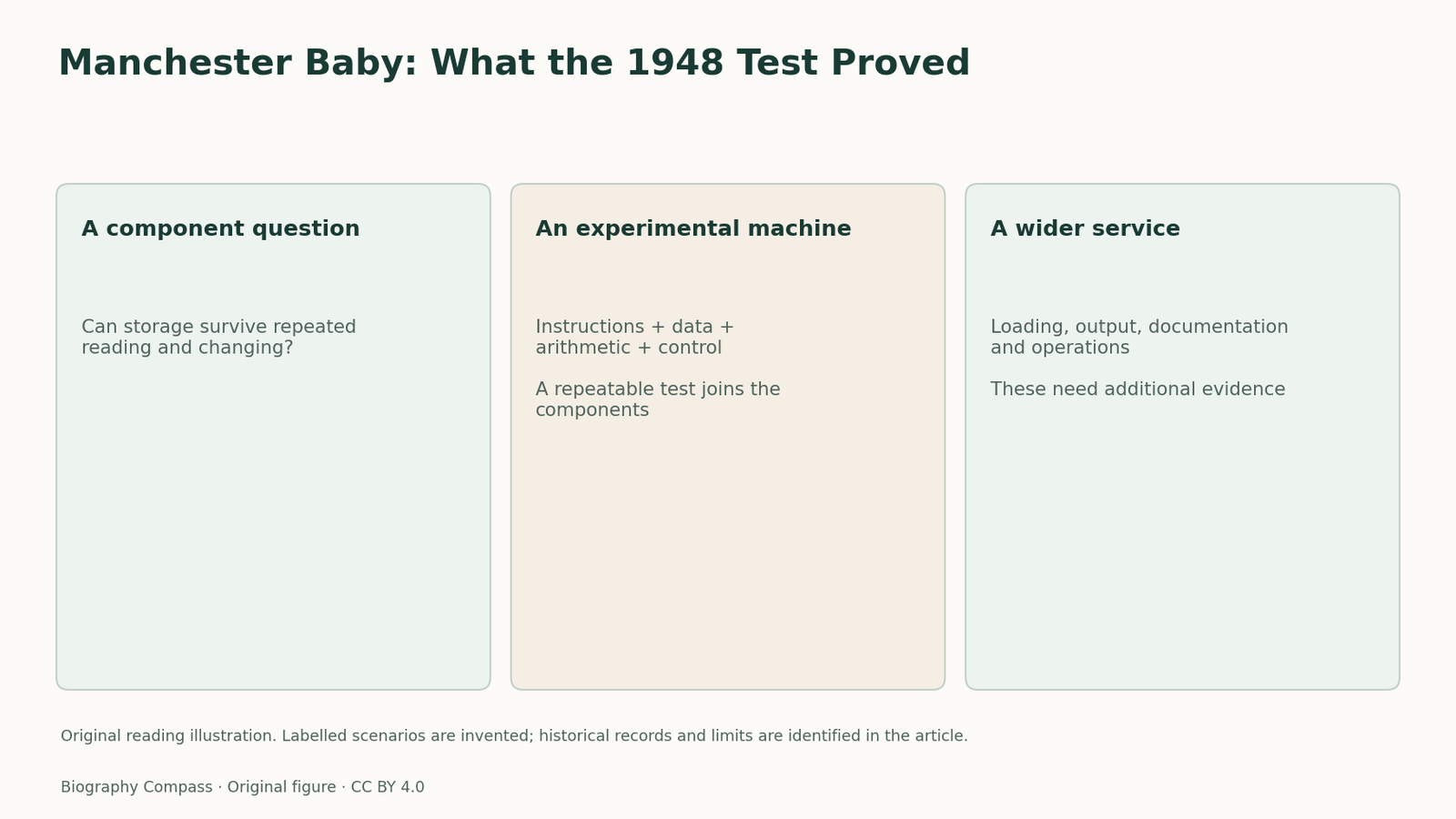
The short answer
A successful demonstration can settle one question while leaving several others open. The Baby is a useful case for separating an engineering test from an entire computing service.
Compare the representations
What did the Manchester Baby demonstrate, and what was still left to build?
Keep the stated evidence separate from the conclusions it permits.
| Distinction | Representation or action | What follows — and what does not |
|---|---|---|
| Stored pattern | A memory retains information. | This alone does not demonstrate an entire computer. |
| Programmed experiment | Stored instructions direct operations. | A successful test can validate a mechanism at small scale. |
| Computing service | Users can prepare and recover useful jobs. | Additional engineering, software and operating procedures require evidence. |
Chronology
A timeline of the turning points
Selected historical record
The cited record supplies the historical starting point; the labelled examples below are original.
Two records with different dates
Williams and Kilburn’s September 1948 Nature letter describes a small experimental machine built primarily to test its storage principle. It says that a program could be changed without altering mechanical or electromechanical circuits. This is a contemporary account, not a later claim about a commercial product.
The fuller paper by Williams, Kilburn and Tootill, published in 1951, explains the experimental purpose and identifies completion of the machine in June 1948. Publication date and machine-completion date are therefore different facts.
Three questions to ask of a demonstration
First ask whether information survives the operations needed by a computation. A display that can show a pattern once is weaker evidence than storage that can be read and changed while calculation proceeds. Second ask whether changing the stored instructions changes the sequence of operations without rebuilding the machine. Third ask whether ordinary users can prepare, submit and recover useful work.
Those questions are connected but do not entail one another. Imagine a museum demonstrator that reliably runs two short sequences. It may establish changeable stored control while offering no printer, scheduling system, documentation or means of loading a large user calculation. The absence of those facilities does not invalidate the experiment; it limits the conclusion.
How a minimal test can be powerful
A deliberately small machine can expose repeated interactions between storage, arithmetic and control. If a proposed memory fails after certain reads or writes, the designer needs that failure before constructing a much larger installation. The test’s value lies in exercising the mechanism under relevant conditions, not in solving the largest possible mathematical problem.
For an invented demonstration log, record the initial stored pattern, the requested operations, the final pattern and whether the run can be repeated. Then distinguish a wrong program from a storage failure. A correct final answer alone may not tell you which mechanism produced it; a trace or independent check can be more informative. This is a suggested reading protocol, not a recovered 1948 laboratory notebook.
From Baby to a computing service
The 1951 paper explains the machine as a basis for understanding larger systems, while noting the trivial scale of its calculations. Its modest scale is part of the evidence rather than an embarrassment to be edited away.
A careful caption can therefore say “demonstrated an operating stored-program machine” without implying that an office could immediately order the same system and run its business. Experimental success, a larger operational machine and a manufacturer’s product need separate dates and records. That distinction remains useful whenever an invention is described through a single dramatic first.
Sources for this section: [2]
Continue the chronology
Related history guides
Biography context
Explore United Kingdom through connected lives
Connected biographies
A working life behind the record
Quick answers
Common questions
- Why is a 1951 paper relevant to a machine completed in 1948?
- It is a later technical account of that earlier experimental machine. The article keeps those dates distinct and also uses the contemporary 1948 letter.
Primary and institutional sources
How this history was checked
The account identifies the selected portions actually consulted. Original scenarios and reference answers explain the distinction without reproducing the source’s diagrams or implying that historical software was run. This article was reviewed on 5 November 2026.