
The short answer
Two machines can be intended to accept the same code while differing substantially in their construction. The important question is exactly what the promised compatibility covers.
Compare the representations
What could a shared code preserve when moving from a relay machine to an electronic one?
Keep the stated evidence separate from the conclusions it permits.
| Distinction | Representation or action | What follows — and what does not |
|---|---|---|
| Shared operations | The same named operations have the same agreed meanings. | This supports transfer of methods expressed through them. |
| Shared representation | Word size, addresses and encodings also match. | This requires more evidence than matching operation names. |
| Shared environment | Input, output, storage and timing assumptions are compatible. | A program may depend on these even when its arithmetic transfers. |
Chronology
A timeline of the turning points
Selected historical record
The cited record supplies the historical starting point; the labelled examples below are original.
Read the preface as a proposal
The 1947 Booth–Britten coding preface proposes the same code for ARC and a planned electronic machine. Experience on the relay computer could inform revisions to the later design.
Only the preface and introduction were inspected. They state an intention, not the result of a completed migration.
Sources for this section: [1]
An original migration checklist
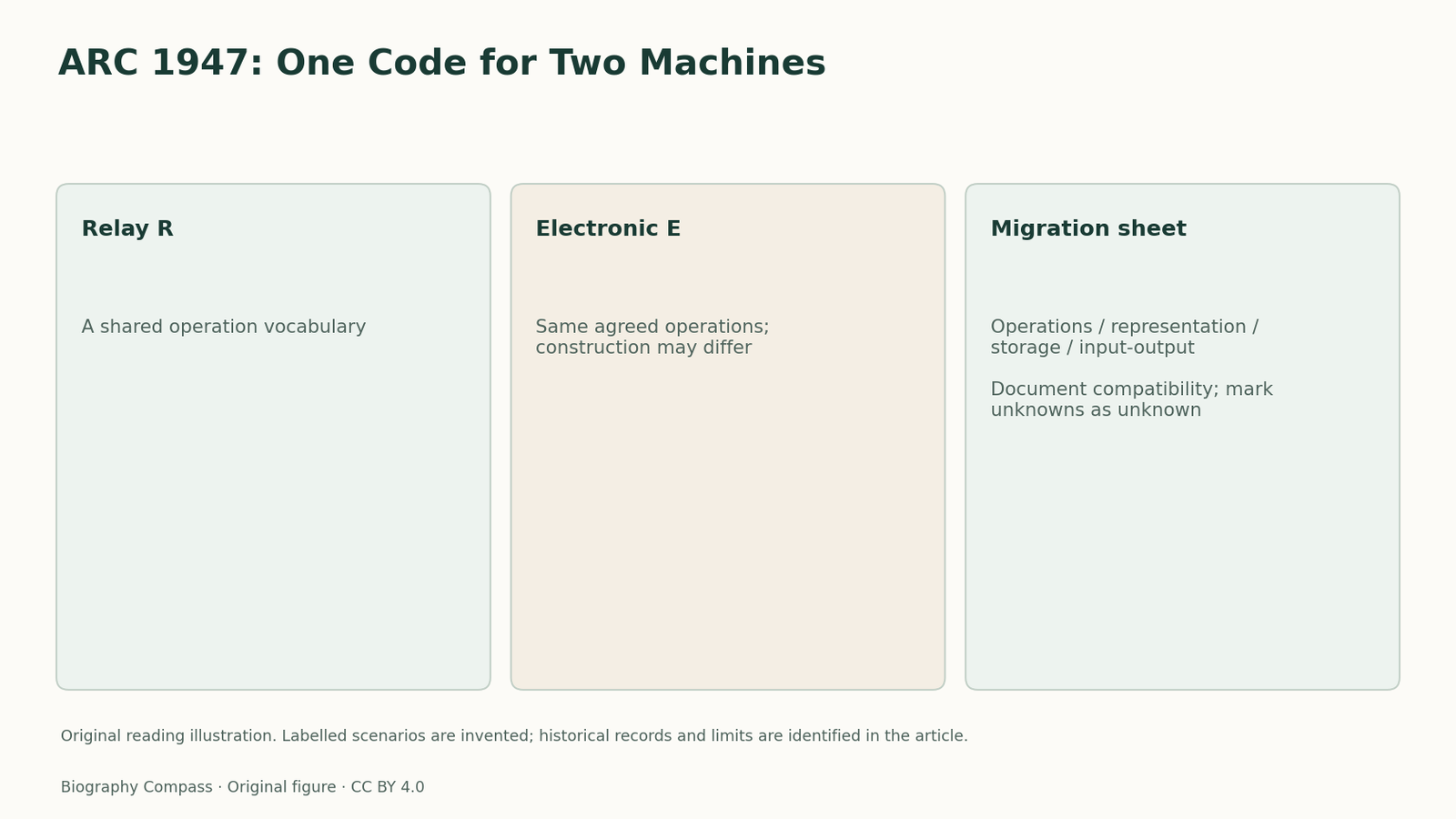
Imagine two invented machines, Relay R and Electronic E. Both promise ADD, SUBTRACT and a conditional transfer, using the same meanings and address conventions. A written sequence using those operations has a plausible basis for transfer. But the shared vocabulary does not settle how numbers are represented, how many storage locations exist or how an input record reaches memory.
Make a migration sheet with four rows: operation meanings, numerical representation, storage assumptions and external input/output. Mark each row “documented compatible,” “documented different” or “not yet established.” Do not replace the last category with a guess. A program can use only documented common operations and still fail if it assumes more storage than the second machine provides.
Faster hardware is not the same as a new program
Suppose E executes the same agreed steps faster than R. A mathematical routine that depends only on the agreed arithmetic may transfer without a new method. A routine that waits a fixed number of steps for an external device has an additional timing assumption. The latter needs separate checking even if all the arithmetic instructions mean the same thing.
This is an original diagnostic example, not a claim that the ARC report contains that particular timing bug. It shows why an apparently simple portability statement must be read at the level at which it is made. Shared instruction meanings, identical binary encodings and compatible operating environments are different claims.
Why the early experiment could inform the later code
The authors describe experience with the simpler machine as a way to discover desirable modifications. Their proposal therefore leaves room for revision, rather than promising a frozen interface before practical use.
A productive reading asks what evidence would justify each migration-sheet entry. A code description may establish operation meanings; a storage specification may establish capacity; a successful run may establish one test case. None automatically proves every other row. This makes the report useful as a case study in compatibility without turning a short extract into an unsupported universal invention claim.
Sources for this section: [1]
Continue the chronology
Related history guides
Biography context
Explore United Kingdom through connected lives
Connected biographies
A working life behind the record
Quick answers
Common questions
- Does the inspected preface prove that a complete modern assembler existed?
- No. The selected text describes a compatibility plan, not a verified assembler implementation.
Primary and institutional sources
How this history was checked
The account identifies the selected portions actually consulted. Original scenarios and reference answers explain the distinction without reproducing the source’s diagrams or implying that historical software was run. This article was reviewed on 5 November 2026.