
The short answer
How did an early seminar relate to the later announcement of a national advisory council?
Evidence comparison
Read the records together
The records were created for different purposes and support different kinds of claims.
| Record | What it establishes | Question to keep open |
|---|---|---|
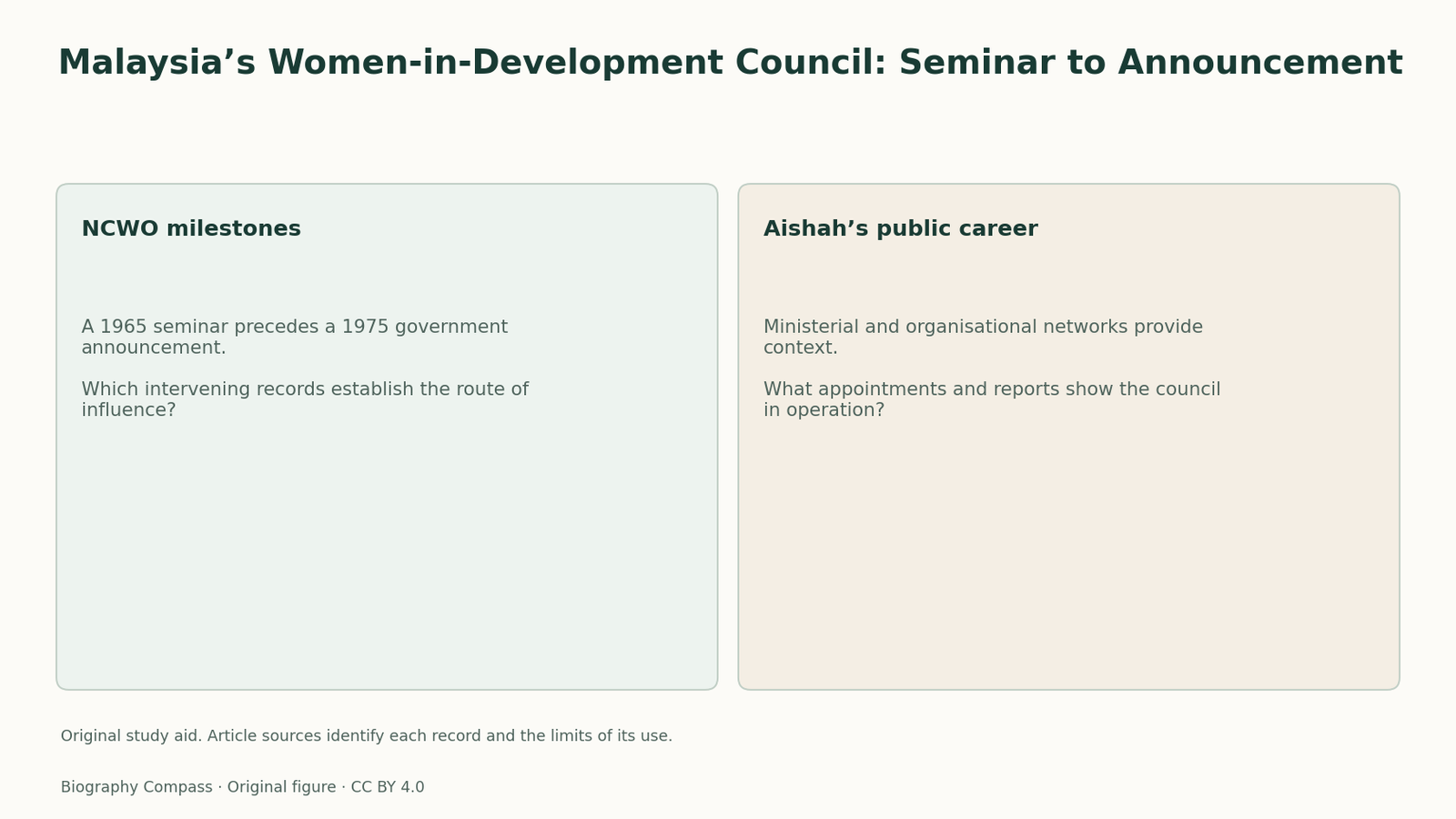
| NCWO milestones | A 1965 seminar precedes a 1975 government announcement. | Which intervening records establish the route of influence? |
| Aishah’s public career | Ministerial and organisational networks provide context. | What appointments and reports show the council in operation? |
Chronology
A timeline of the turning points
Bureau studied
NCWO holds a seminar on an institutional response.
Council announced
A national women-in-development structure enters the public programme.
Start with what the seminar considered
NCWO’s milestones identify a 1965 seminar studying the establishment of a women’s bureau. A seminar can frame a problem, build support and recommend an institutional response. It does not itself establish every later government body associated with the same concern. The reader should record the proposal in its original form before using hindsight to name it after a council announced a decade later.
Sources for this section: [3]
Locate the government announcement
The council’s account places the announcement of the National Advisory Council for the Integration of Women in Development during International Women’s Year in 1975. This is a different stage and a different actor: a prime minister announces a national structure in a public political setting. The institutional history connects advocacy and government response, but the interval remains important. A chronological relationship is a starting point for examining influence rather than a complete account of every decision in between.
Sources for this section: [3]
Place contemporary leaders without inventing authorship
Aishah Ghani’s welfare ministry began in 1973, while Fatimah Hashim continued NCWO leadership. These overlapping careers explain the surrounding network of women’s public work. They do not establish that either person alone designed every part of the new advisory arrangement. A careful account identifies their documented offices and uses the council’s own record for the seminar and announcement, leaving specific authorship or Cabinet decisions to the relevant additional documents.
Add the missing operational questions
Draw stages for seminar, proposal, government announcement and operation. Fill the two dated events supported here, then list evidence needed for the last stage: appointments, terms of reference, meetings or reports. A useful answer can recognise a sustained advocacy route without declaring an advisory institution fully effective on the day of announcement. The exercise shows how to investigate whether a commitment to include women in development became a continuing administrative practice.
Continue the chronology
Related history guides
Biography context
Explore Malaysia through connected lives
Connected biographies
People behind the records
1923–2013
Aishah Ghani
Journalist, women’s leader and welfare ministerAishah moved from journalism and nationalist organising to women’s party leadership, parliamentary service and eleven years in the welfare ministry.Read biographyQuick answers
Common questions
- Did the 1965 seminar itself create the council announced in 1975?
- The records identify different stages. A fuller institutional history needs the intervening decisions and operational documents.
Primary and institutional sources
How this history was checked
Sources support the chronology and the record comparison. The reading exercise is original. This article was reviewed on 7 November 2026.