
The short answer
How do financial safeguards and a judge’s public conduct address different risks?
Evidence comparison
Read the records together
The records were created for different purposes and support different kinds of claims.
| Record | What it establishes | Question to keep open |
|---|---|---|
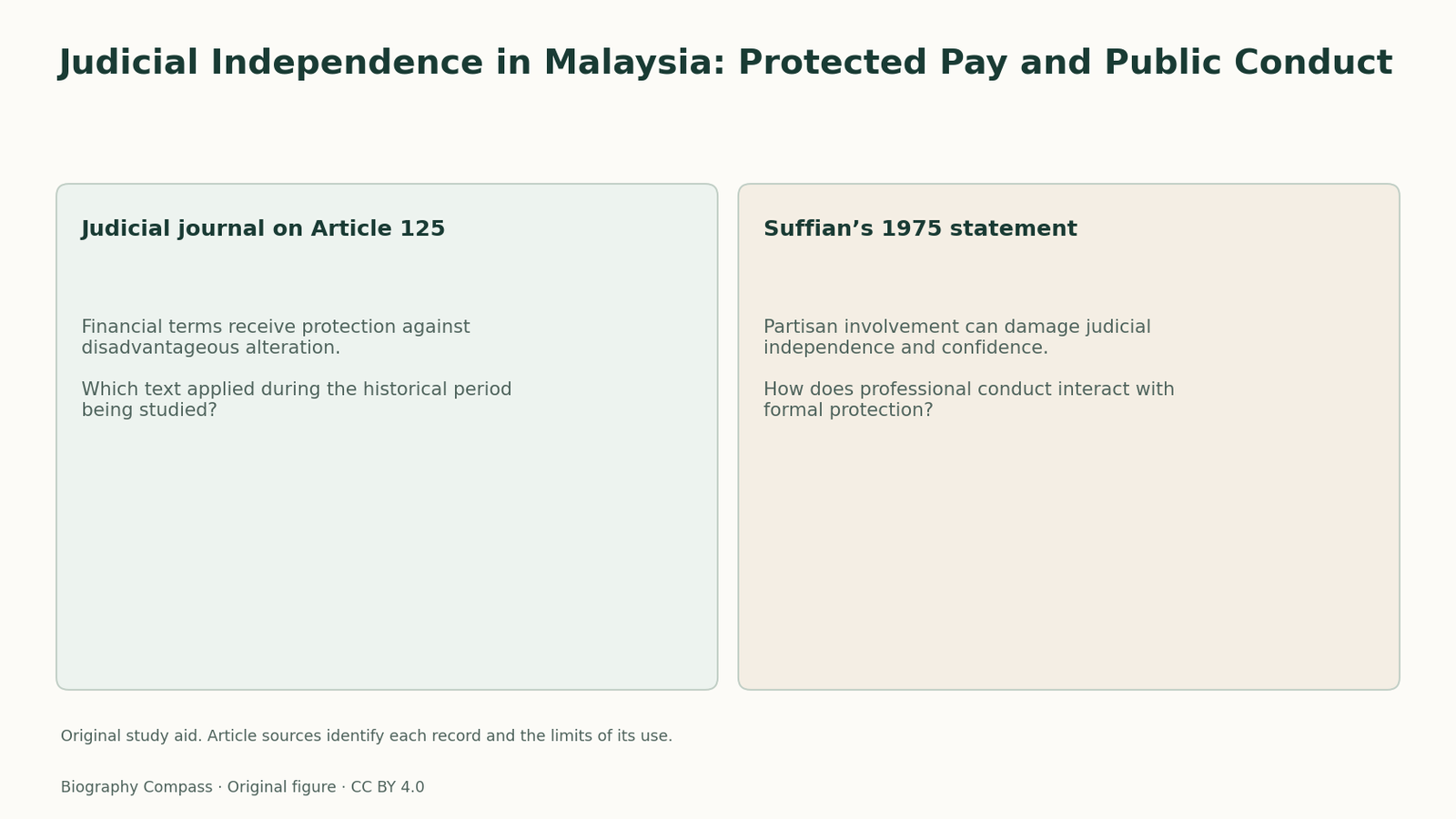
| Judicial journal on Article 125 | Financial terms receive protection against disadvantageous alteration. | Which text applied during the historical period being studied? |
| Suffian’s 1975 statement | Partisan involvement can damage judicial independence and confidence. | How does professional conduct interact with formal protection? |
Chronology
A timeline of the turning points
Lord President
Suffian begins national judicial leadership.
Award statement
He explains concerns about partisan involvement.
Read the financial safeguard precisely
The judiciary’s journal explains that Article 125 protects a judge’s remuneration and other terms, including pension rights, against disadvantageous alteration after appointment. The protection concerns the conditions attached to office. It addresses a risk that control over pay could be used to pressure an officeholder. It does not by itself describe how the judge approaches a particular dispute, handles a conflict of interest or explains a decision to the parties.
Sources for this section: [3]
Read the separate professional commitment
In the 1975 award material Suffian explains his reluctance to accept assignments carrying political overtones. His concern is the damage caused when judges are involved, or appear involved, in partisan activity. This is a statement about conduct and public confidence. It should be placed beside the formal safeguard rather than substituted for it. Personal restraint cannot supply a missing legal protection, while protected terms cannot automatically establish impartial conduct in every case.
Sources for this section: [2]
Keep the documents in their periods
The award statement belongs to Suffian’s period in judicial leadership. The later journal explains the constitutional framework as discussed in 2023. Their different dates should remain visible, particularly when a reader investigates amendments or the precise terms applicable in an earlier case. The comparison is about two dimensions of independence, not an assertion that every contemporary provision was drafted by Suffian or operated in identical form throughout his career.
Diagnose two hypothetical pressures
Consider a threatened reduction in terms after appointment and an invitation to serve as a partisan campaign adviser. Put each beside the record that addresses the risk most directly. A sound answer places the first within the financial safeguard and the second within the conduct concern. It then asks what procedural or ethical evidence a real case would require. This makes judicial independence concrete without pretending that one guarantee can answer every institutional problem.
Continue the chronology
Related history guides
Biography context
Explore Malaysia through connected lives
Connected biographies
People behind the records
1917–2000
Mohamed Suffian Mohamed Hashim
Jurist and Lord PresidentSuffian moved from wartime broadcasting and legal service into judicial leadership, combining constitutional writing with a strong concern for independence.Read biographyQuick answers
Common questions
- Does protected remuneration alone establish impartial judging?
- It is one institutional safeguard. Conduct, procedure and the handling of individual cases require separate evidence.
Primary and institutional sources
How this history was checked
Sources support the chronology and the record comparison. The reading exercise is original. This article was reviewed on 7 November 2026.