
The short answer
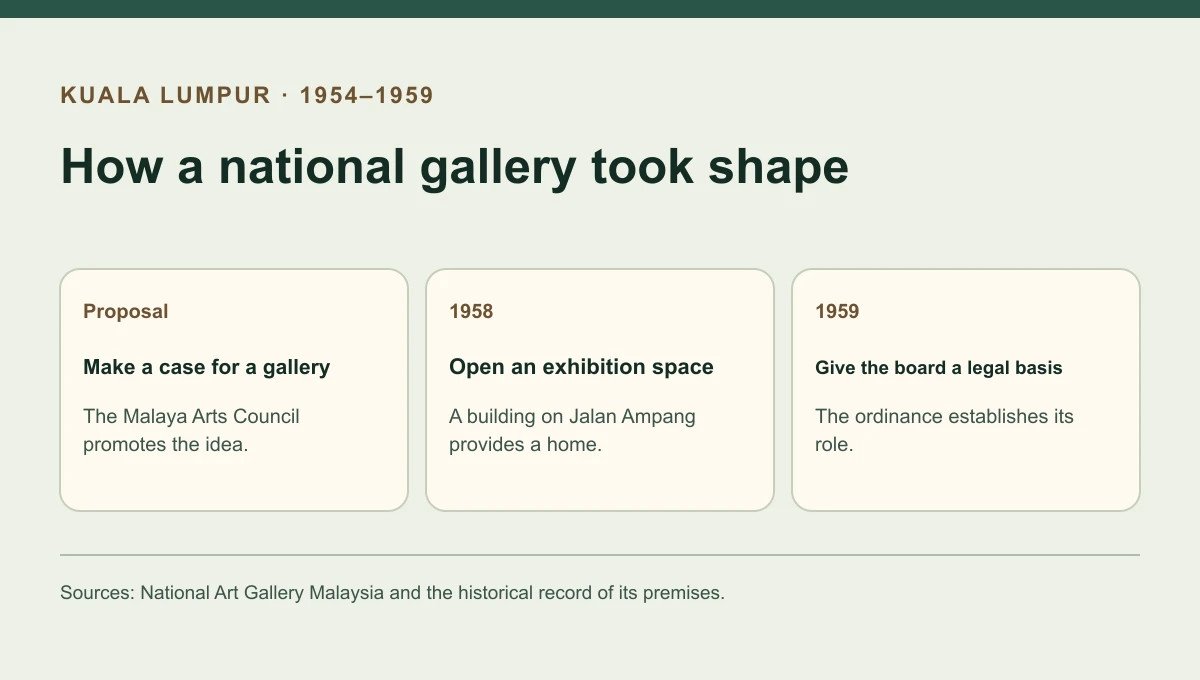
Malaysia’s National Art Gallery had a working committee, premises and an inaugural exhibition before its founding ordinance took effect. The gallery’s chronology separates the campaigning for a public art institution from the practical task of opening a gallery and the later legal foundation for its board.
Compare the records
A gallery needs more than an opening date
The proposal, exhibition and board are recorded separately.
| Stage | People or institutions | What the record shows |
|---|---|---|
| Advocacy | Malaya Arts Council | Mubin Sheppard and Frank Sullivan help develop the proposal. |
| Public opening | Gallery organisers and Tunku Abdul Rahman | Premises and the inaugural exhibition put the idea into public use. |
| Legal foundation | The 1959 ordinance | A statutory arrangement makes the board’s role durable. |
Chronology
A timeline of the turning points
The proposal takes shape
The Malaya Arts Council campaigns for a public art institution.
The gallery gets a home and presents an exhibition
A building at Jalan Ampang makes a public opening possible.
The board gets its legal foundation
The ordinance establishes the institution’s governance on a statutory footing.
How the idea became a place
The gallery traces the initiative to the Malaya Arts Council between 1954 and 1956 and names Mubin Sheppard and Frank Sullivan in that work. In August 1958 the government allocated a two-storey building at 109 Jalan Ampang. That made a proposed gallery into a place people could visit. It gave organisers room to exhibit work rather than relying only on a committee and a case for founding an institution.
The first exhibition made the case visible
The institutional history credits Prime Minister Tunku Abdul Rahman with opening the gallery and describes an inaugural exhibition at Dewan Tunku Abdul Rahman. Artists’ participation was a separate contribution from the decision to allocate a building. Exhibition history can be followed by asking who took part, what space they used and how the work met an audience, even where a legal chronology simply gives a founding year.
Why the statute belongs to 1959
The gallery’s chronology identifies the founding governance ordinance with 1959. It also records Frank Sullivan as the first administrator and secretary to the board. Reading these details alongside the allocation of premises explains why a gallery can begin public activity before the legal and administrative history reaches its next milestone. Later moves to different buildings change the venue record without replacing that first exhibition or the institution’s original mandate.
Continue the chronology
Related history guides
How Dewan Bahasa dan Pustaka Became a Statutory Body
Compare the sequence by which Malaysia put another cultural institution on a statutory footing.
Read the timeline1945–1963How Muzium Negara Rose on the Former Selangor Museum Site
Read how a separate national museum acquired a purpose-built home.
Read the timelineConnected biographies
People connected to this history
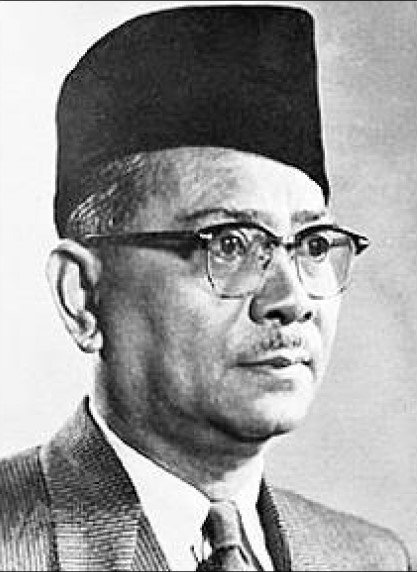
1903—1990
Tunku Abdul Rahman
First Prime Minister of MalaysiaThe independence leader who became Malaya’s first prime minister and helped define the federation that would become modern Malaysia.Read biographyQuick answers
Common questions
- Where was Malaysia’s first National Art Gallery?
- The government allocated a building at 109 Jalan Ampang in Kuala Lumpur.
- Did the inaugural exhibition and the ordinance occur in the same year?
- The gallery began public activity in 1958. Its founding ordinance is dated 1959.
Primary and institutional sources
How this history was checked
Dates, legal milestones and historical claims are checked against the official and institutional records below. This article was reviewed on 19 November 2026.