
The short answer
A new recording can preserve an existing musical work while changing the performers, production and recorded sound. The National Heritage Board’s account explicitly says that the 2019 anthem recording retained Zubir Said’s words and Phoon Yew Tien’s arrangement. Its separate credit blocks identify the people responsible for different stages. A library record for an earlier album adds another useful distinction: the date attached to a recorded object need not be the date when its music was first written.
Compare the records
What does each record establish?
Keep the work, the people involved and the documentary route visible when drawing a conclusion.
| Record | Evidence supplied | Useful distinction |
|---|---|---|
| Heritage Board history | 1958 composition, 1959 adaptation and the 2001 launch. | A later recording date does not replace the earlier work history. |
| Heritage Board credits | Separate composition, arranging, performing and production responsibilities. | Name a person’s credited role before describing their contribution. |
| Earlier NLB album record | Three versions recorded in 1989; catalogue year 1994. | A recorded object and its description have their own dates and access limits. |
Chronology
A timeline of the turning points
City Council song
Zubir composed the work for a civic commission.
Anthem presentation
An adapted version was presented as the anthem.
Re-arrangement launched
Phoon Yew Tien’s re-arrangement is separately credited.
New recording
The SSO recorded at Esplanade Concert Hall with Joshua Tan conducting.
The song’s beginning and its adaptation are separate events
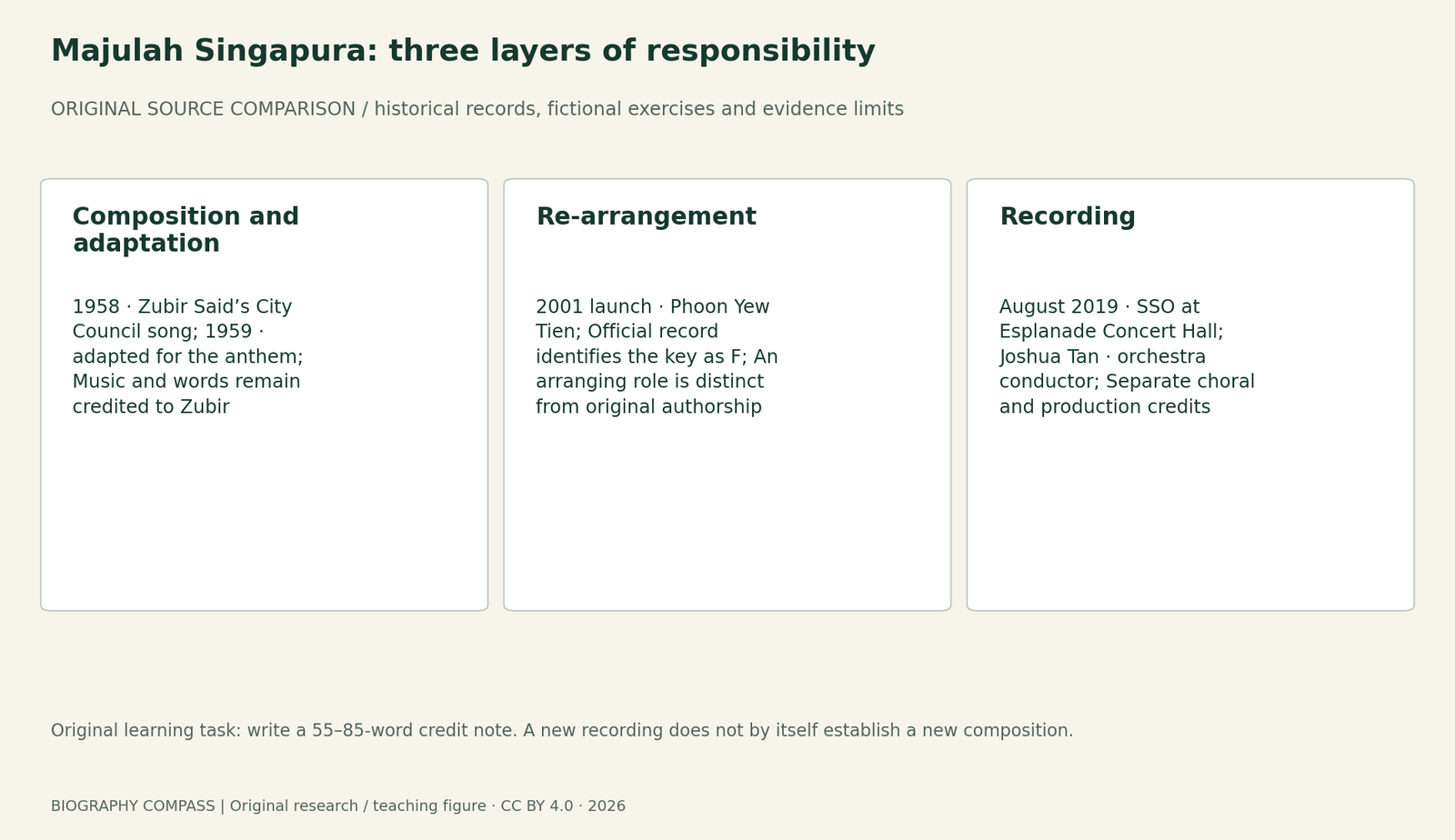
Zubir Said composed Majulah Singapura in 1958 for Singapore’s City Council. The Heritage Board describes changes requested by Toh Chin Chye in 1959: Zubir shortened the words and adjusted the melody for use as an anthem. It was presented on 3 December that year. These details locate a compositional and editorial history before the later orchestral recordings. They also prevent a familiar but incorrect shortcut in which the music is assumed to have been newly written at independence in 1965.
An arrangement is another layer of musical work
On 19 January 2001 a re-orchestrated version was launched. The Heritage Board credits Phoon Yew Tien for the re-arrangement and identifies its key as F. It separately retains Zubir’s music-and-words credit. The distinction matters because arranging an existing work is a real creative contribution without automatically transferring the original authorship. A short caption can preserve both names and roles. It should also avoid making a claim about every audible detail merely because a documentary page identifies a key or arrangement.
Sources for this section: [1]
The 2019 record identifies a new performance and production
The Heritage Board says the 2019 recording retained that arrangement. Its credits identify Joshua Tan as orchestra conductor and the Singapore Symphony Orchestra, with separate choral leadership and choirs. The recording took place at Esplanade Concert Hall in August 2019. Producer and engineer credits provide further roles beyond composition and performance. Comparison with the separate 2001 credit block therefore shows continuity in the attributed work alongside a new recording team. It does not, by itself, measure differences in tempo, balance or instrumental sound.
Sources for this section: [1]
A catalogue describes an object rather than every earlier event
NLB’s record for Majulah Singapura: national anthem of the Republic of Singapore identifies an album containing three versions recorded in 1989, with a catalogue year of 1994. Those are compatible fields describing different events or aspects of the object. They should not replace 1958 as the composition year. Nor does the catalogue’s existence establish that the audio or accompanying score has been examined. It supplies a route to an earlier recorded release whose description can be compared with the Heritage Board’s later production history.
Exercise: repair a credit note
An invented display note says: Joshua Tan composed the national anthem in 2019, replacing Phoon Yew Tien’s 2001 song. Write a replacement of 55–85 words using the documentary records. Identify original authorship, the re-arrangement and the 2019 conductor without treating them as interchangeable roles. Then name one question the records alone cannot answer about the sound. The task is to make a concise public statement that remains accurate across the layers of a familiar work, rather than to review a performance that has not been heard.
Reference answer and an appropriate next step
One possible note reads: Majulah Singapura began as Zubir Said’s City Council song in 1958 and was adapted for use as the anthem in 1959. Phoon Yew Tien later supplied the re-arrangement launched in 2001. The 2019 Singapore Symphony Orchestra recording retained the words and arrangement, with Joshua Tan conducting the orchestra and a separately credited choral and production team. A question about the exact tempo difference between the recordings requires comparable audio and a stated measurement method. The credits establish responsibility and continuity, not that measurement.
Continue the chronology
Related history guides
How can The Celestial Web name a poem, a concert work and a sculpture?
Follow The Celestial Web through notebook, exhibition and programme records, then distinguish the poet, composer, performers and dates in a worked example.
Read the timeline1970s · later recollectionsHow did Little Ironies move from a drawer to publication?
Compare Catherine Lim’s account with Robert Yeo’s memoir, trace the publishing network and test what their different story counts can actually establish.
Read the timelineBiography context
Explore Singapore through connected lives
Zubir Said biography
Read the wider working life behind this focused comparison.
Explore the biographiesLeong Yoon PinLeong Yoon Pin biography
Read the wider working life behind this focused comparison.
Explore the biographiesRelated learning guideHow can The Celestial Web name a poem, a concert work and a sculpture?
Follow The Celestial Web through notebook, exhibition and programme records, then distinguish the poet, composer, performers and dates in a worked example.
Explore the biographiesRelated learning guideHow did Little Ironies move from a drawer to publication?
Compare Catherine Lim’s account with Robert Yeo’s memoir, trace the publishing network and test what their different story counts can actually establish.
Explore the biographiesConnected biographies
People behind the records
1907–1987
Zubir Said
Composer, recording supervisor and music teacherZubir Said built a musical career across travelling performance, recording and Malay film production before composing Singapore’s national anthem. His work also included teaching younger musicians after leaving the film studio.Read biography1931–2011
Leong Yoon Pin
Composer, conductor and music educatorLeong Yoon Pin combined composition, conducting and education across a long Singapore career. His music drew on the region’s languages and sounds, while his choirs and teaching created opportunities for others to perform and compose.Read biographyQuick answers
Common questions
- Does a new conductor become the composer?
- No. The Heritage Board credits original music and words, re-arrangement and the recording’s conductor separately.
- Does this guide advise on permission to perform or reuse the anthem?
- No. It examines historical records and credit roles, rather than making a permissions determination.
Primary and institutional sources
How this history was checked
Compare the historical accounts, catalogue fields and credited roles, then use the worked exercise to state a conclusion with the right scope. This article was reviewed on 28 October 2026.