
The short answer
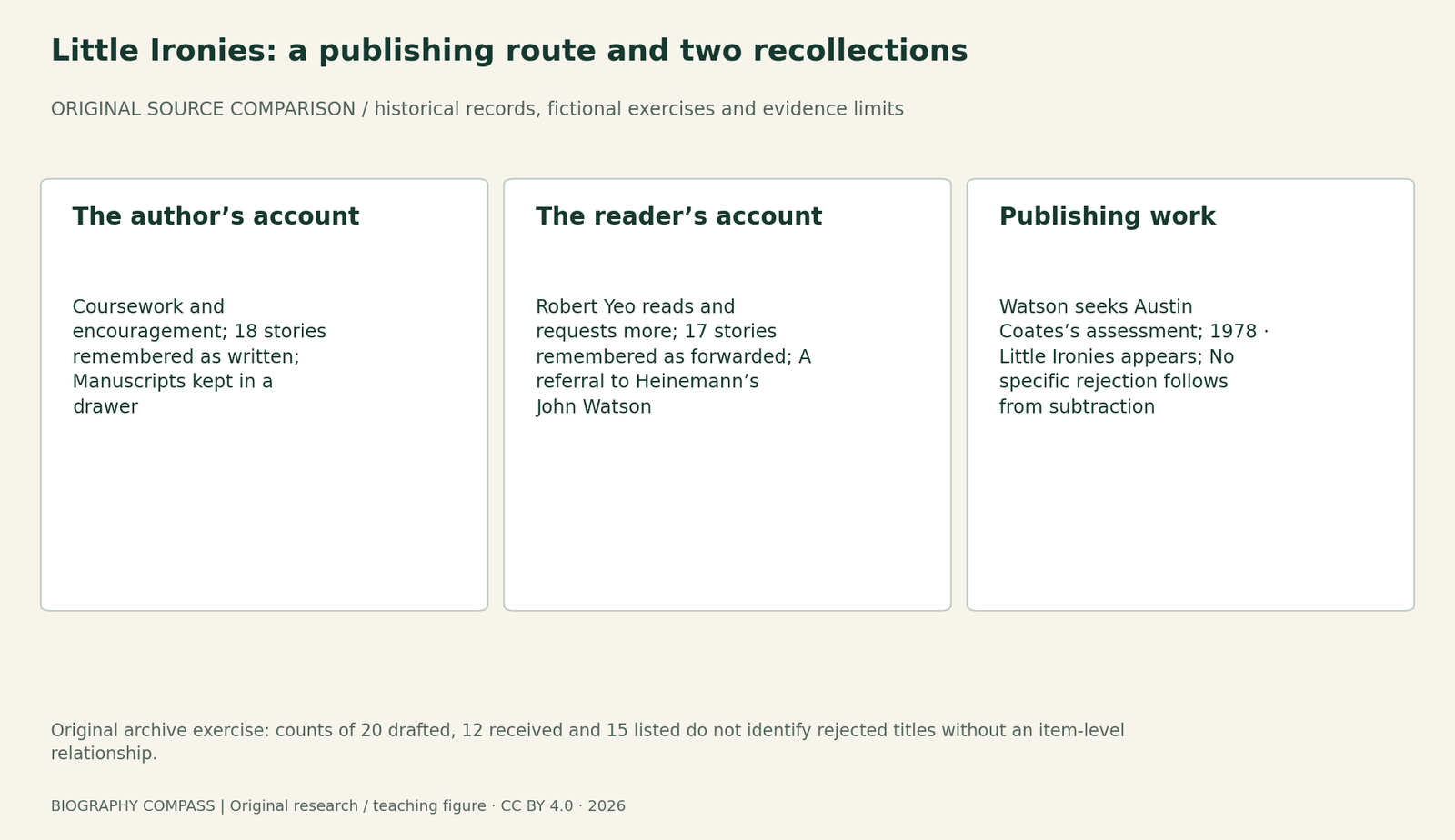
Catherine Lim remembered an unexpected opportunity to publish stories kept in a drawer. Robert Yeo later described a more detailed route through his own reading, Heinemann manager John Watson and an outside assessment. These participant accounts illuminate different parts of the same publishing history. Their differing counts also require care: eighteen stories remembered as written and seventeen remembered as forwarded are not enough, by subtraction alone, to identify an editorial rejection.
Compare the records
What does each record establish?
Keep the work, the people involved and the documentary route visible when drawing a conclusion.
| Record | Evidence supplied | Useful distinction |
|---|---|---|
| Lim’s participant account | Coursework, encouragement, eighteen stories and an unexpected publishing opening. | The author describes her experience of the process, not every later publishing decision. |
| Yeo’s memoir excerpt | Initial reading, seventeen forwarded stories, Watson and Coates. | A referral and assessment contribute to publication without reallocating authorship. |
| Published-collection description | A 1978 collection described as containing seventeen stories. | Matching counts alone do not identify every manuscript or prove a rejection. |
Chronology
A timeline of the turning points
Writing and storage
Lim recalls coursework, encouragement and manuscripts kept in a drawer.
Reading and referral
Yeo recalls requesting stories and forwarding a group to Heinemann.
Little Ironies
The collection appeared through the Writing in Asia publishing context.
A participant memoir
Yeo’s published recollection supplied a later account of the route to publication.
The author remembers a beginning in education
In her What’s Up account, Lim places some early stories within teacher-training coursework. A supervisor encouraged further writing, and she recalls producing eighteen stories and keeping them for four years. The eventual publication felt accidental because a casually mentioned manuscript led a friend to help. This is a participant’s retrospective explanation of how an opportunity arrived. It supplies valuable detail about encouragement and delay, while its language of accident need not imply that no other person later performed deliberate editorial or publishing work.
Sources for this section: [1]
The intermediary remembers selection and a professional route
In his 2018 BiblioAsia memoir excerpt, Yeo recalls encountering Lim’s stories while assembling an anthology. After reading an initial group, he requested more and forwarded seventeen to John Watson at Heinemann. He then describes Watson obtaining an assessment from Austin Coates in the context of the Writing in Asia series. Those steps identify a network through which privately held writing could become a proposed book. Yeo’s account does not turn him or the publisher into the author; it makes their different contributions to circulation visible.
Sources for this section: [2]
Different vantage points need not produce incompatible histories
Lim emphasises coursework, the drawer and an opening she had not planned. Yeo emphasises recognising material, requesting a fuller group and approaching a publishing professional. These are accounts of different stretches of the process, written later for different purposes. Their agreement on publication in 1978 supplies a common point, but neither recollection should be treated as the complete surviving publisher archive. A careful narrative can combine the routes while keeping the speaker responsible for each remembered detail, rather than silently constructing a single exhaustive chronology.
The eighteen and seventeen count different stated things
Lim’s eighteen refers to stories she remembers writing; Yeo’s seventeen refers to the group he remembers forwarding. The library article also describes a published collection of seventeen stories. These statements do not identify the titles or versions in every group. It is therefore premature to declare that one specific story was rejected, or to name who removed it. The useful research result is a distinction between counts and an item-level relationship. The latter would require manuscript lists, correspondence or another record connecting the groups.
Exercise: decide what an editor’s research note can say
Consider an invented archive: an author remembers drafting twenty pieces, a reader recalls receiving twelve, and a later publisher list contains fifteen titles. No documents connect the individual items. Write a two-sentence research note and request one further record. Avoid calculating a definite number of rejected stories merely by subtracting the counts. Then identify a role for each participant without reallocating authorship. The exercise applies the source comparison to a new case and tests whether the proposed next step could resolve the actual uncertainty.
Reference answer and a targeted next source
A suitable note reads: The recollections and list count material at different stages, but the relationship between the items has not been established. The author supplied the writing, the reader supplied access and judgment, and the publisher supplied a route towards a book; the records do not identify who excluded a particular piece. Request a dated transmittal letter with an accompanying title list, then compare it with the publisher’s list and the manuscripts. That comparison could establish changes to the group without requiring an unsupported story about why they occurred.
Continue the chronology
Related history guides
Did a new recording make Majulah Singapura a new composition?
Compare the anthem’s composition, arrangement and recording credits, then write an accurate note about the 2019 Singapore Symphony Orchestra recording.
Read the timeline2002–2024How can The Celestial Web name a poem, a concert work and a sculpture?
Follow The Celestial Web through notebook, exhibition and programme records, then distinguish the poet, composer, performers and dates in a worked example.
Read the timelineBiography context
Explore Singapore through connected lives
Catherine Lim biography
Read the wider working life behind this focused comparison.
Explore the biographiesEdwin ThumbooEdwin Thumboo biography
Read the wider working life behind this focused comparison.
Explore the biographiesArthur YapArthur Yap biography
Read the wider working life behind this focused comparison.
Explore the biographiesRelated learning guideDid a new recording make Majulah Singapura a new composition?
Compare the anthem’s composition, arrangement and recording credits, then write an accurate note about the 2019 Singapore Symphony Orchestra recording.
Explore the biographiesRelated learning guideHow can The Celestial Web name a poem, a concert work and a sculpture?
Follow The Celestial Web through notebook, exhibition and programme records, then distinguish the poet, composer, performers and dates in a worked example.
Explore the biographiesConnected biographies
People behind the records
1942—
Catherine Lim
Novelist, short-story writer and commentatorCatherine Lim moved from teaching and educational work into a professional writing career. Her short stories and novels drew on ordinary encounters, remembered storytelling and the tensions surrounding women’s choices in Singapore and Malaysia.Read biography1933—
Edwin Thumboo
Poet, anthologist and literary scholarEdwin Thumboo developed a writing life across poetry, criticism, anthologies and university teaching. His work moved between personal experience and Singapore’s public life, while his editorial projects brought writers and languages into a shared literary space.Read biography1943–2006
Arthur Yap
Poet, painter, short-story writer and university teacherArthur Yap combined poetry and painting with university teaching and short-story writing. His poems are associated with word play, Singlish and close attention to the values revealed in ordinary encounters.Read biographyQuick answers
Common questions
- Do the accounts prove that one story was rejected?
- No. They count writing, forwarding and publication without supplying a complete title-level relationship between the groups.
- Is this a review of Little Ironies?
- No. It examines the documented route towards publication and the limits of retrospective accounts, without claiming a complete reading of the stories.
Primary and institutional sources
How this history was checked
Compare the historical accounts, catalogue fields and credited roles, then use the worked exercise to state a conclusion with the right scope. This article was reviewed on 28 October 2026.