
The short answer
How did Lower Canada’s codifiers distinguish stating existing law from proposing amendments?
Compare the documents
Authority, evidence and limits
These records describe different responsibilities; one should not silently substitute for another.
| Record | What it establishes | What it does not establish |
|---|---|---|
| 1857 Act, sections 4 and 6, reproduced in Brierley | Requires authorities for existing law and reasons for separately stated amendments. | A recommended rule is not already in force merely because commissioners drafted it. |
| Justice Department chronology | Separates mandate, submission and commencement. | A submission date does not establish that every proposed amendment was adopted. |
| 1865 report catalogue | Identifies the commissioners and bilingual publication. | Metadata cannot substitute for an uninspected article or vote. |
The mandate required two different claims
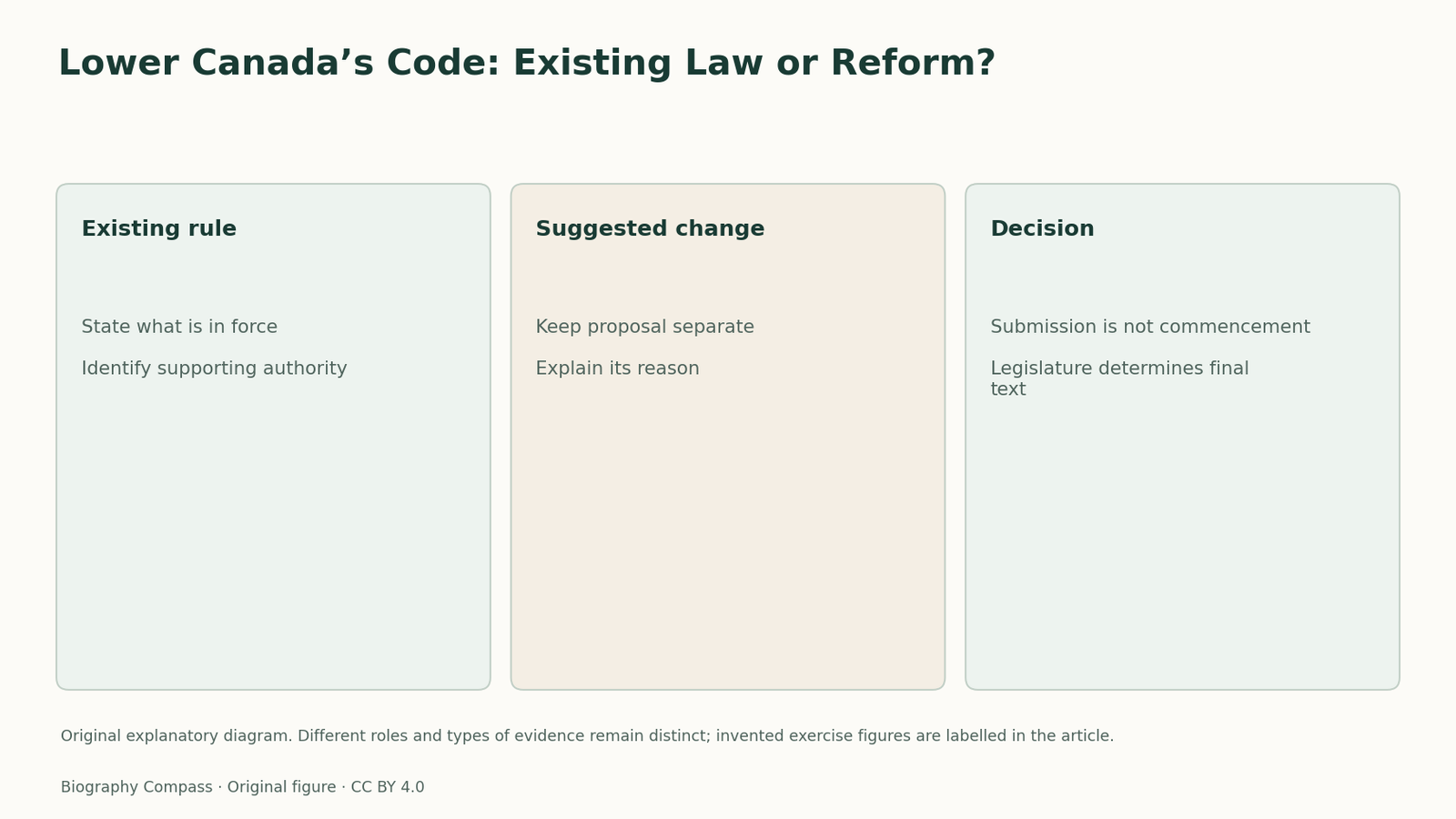
Sections 4 and 6 of the 1857 enabling Act, reproduced in Brierley’s study, distinguish the law the commissioners believed already in force from changes they wanted to recommend. The first required supporting authorities; the second required a separately identified proposal and reasons. That is a difference in the status of an assertion, not merely a preference for one page layout. A reader confronted with a polished draft provision should ask which claim it makes. An orderly statement can describe an inherited rule, while an equally orderly neighbouring statement can ask the legislature to replace it. Appearance alone cannot settle that question.
Sources for this section: [4]
A code’s organising model was not its whole law
The mandate also referred to the general plan and level of detail of the French Civil Code. Following a model of arrangement did not automatically import every modern French rule into Lower Canada. An outline can organise material without determining its substance. This distinction helps make sense of the commissioners’ collaboration: research into what local law was and judgment about what it should become were connected tasks, but neither could be silently substituted for the other. The Justice Department’s history places the work within the 1857 mandate, the 1865 submission and the 1866 commencement. Submission, legislative adoption and commencement are successive institutional events.
The publication record is not a substitute for its pages
Canadiana’s catalogue identifies the 1865 First, Second and Third Reports and the three commissioners, with English and French on facing pages. It confirms the existence and organisation of a published record; it does not by itself establish how a particular disputed article was decided. Our comparison uses the enabling provisions actually reproduced in the scholarly study rather than claiming access to report pages that could not be retrieved. This access boundary leaves the central question answerable: the instruction explicitly separated statement from recommendation. It does not justify inventing an example from Morin’s personal notes or attributing an uninspected amendment to him alone.
Drafting exercise and reference answer
Invent a club rule saying that members may borrow one book for seven days. On a first card, state that existing rule and cite the club’s imaginary minute book. On a second, propose fourteen days and give a reason, such as allowing readers more time. Ask whether placing both cards in a neatly numbered code makes the longer period already operative. The answer is no: the second card remains a proposal until the appropriate decision-maker adopts it. The example is deliberately fictional and is not nineteenth-century Canadian law. Its value is that the evidence supporting an existing rule and the argument supporting a change must occupy distinguishable places. Applied back to the codification mandate, it prevents a reader from treating every draft provision as either pure preservation or automatic reform.
Continue the chronology
Related history guides
Biography context
Explore Canada through connected lives
Connected biographies
People behind the collaboration
1803–1865
Augustin-Norbert Morin
Lawyer, politician and civil-code commissionerAugustin-Norbert Morin combined journalism, parliamentary reform and judicial service before helping Caron and Charles Dewey Day prepare Lower Canada’s Civil Code.Read biography1806–1884
Charles Dewey Day
Judge, educator and civil-code commissionerCharles Dewey Day brought a commercial legal practice and educational institution building to the commission that prepared Lower Canada’s bilingual Civil Code.Read biographyQuick answers
Common questions
- Did using the French code’s plan mean copying all French law?
- No. The mandate distinguished the organisation of the code from the duty to establish Lower Canada’s existing law and separately recommend changes.
Primary and institutional sources
How this history was checked
The bibliography distinguishes contemporary records, retrospective participant accounts and later institutional research. Access limits and uncertain attributions are identified in the article; the exercise is an original teaching example. This article was reviewed on 7 November 2026.
- Dictionary of Canadian BiographyMorin, Augustin-Norbert
- Répertoire du patrimoine culturel du QuébecAugustin-Norbert Morin
- Department of Justice CanadaHistorical origins of the Canadian legal system
- John E. C. Brierley / McGill Law JournalQuebec’s Civil Law Codification Viewed and Reviewed
- Canadiana / original commission publicationCivil Code: First, Second and Third Reports 1865