
The short answer
How did a bilingual civil-code commission organise parallel texts and reasons?
Compare the documents
Authority, evidence and limits
These records describe different responsibilities; one should not silently substitute for another.
| Record | What it establishes | What it does not establish |
|---|---|---|
| 1865 publication catalogue | Confirms facing-page English/French publication. | Page arrangement alone cannot prove matching meaning. |
| Commission procedure as reproduced in Brierley | Describes translation, verification and collective review. | The language of an initial draft is not an automatic priority rule. |
| Historical Article 2615, reproduced in Brierley | Addresses differences through existing law or intended change. | The provision is historical evidence, not current legal advice. |
Parallel publication was an institutional requirement
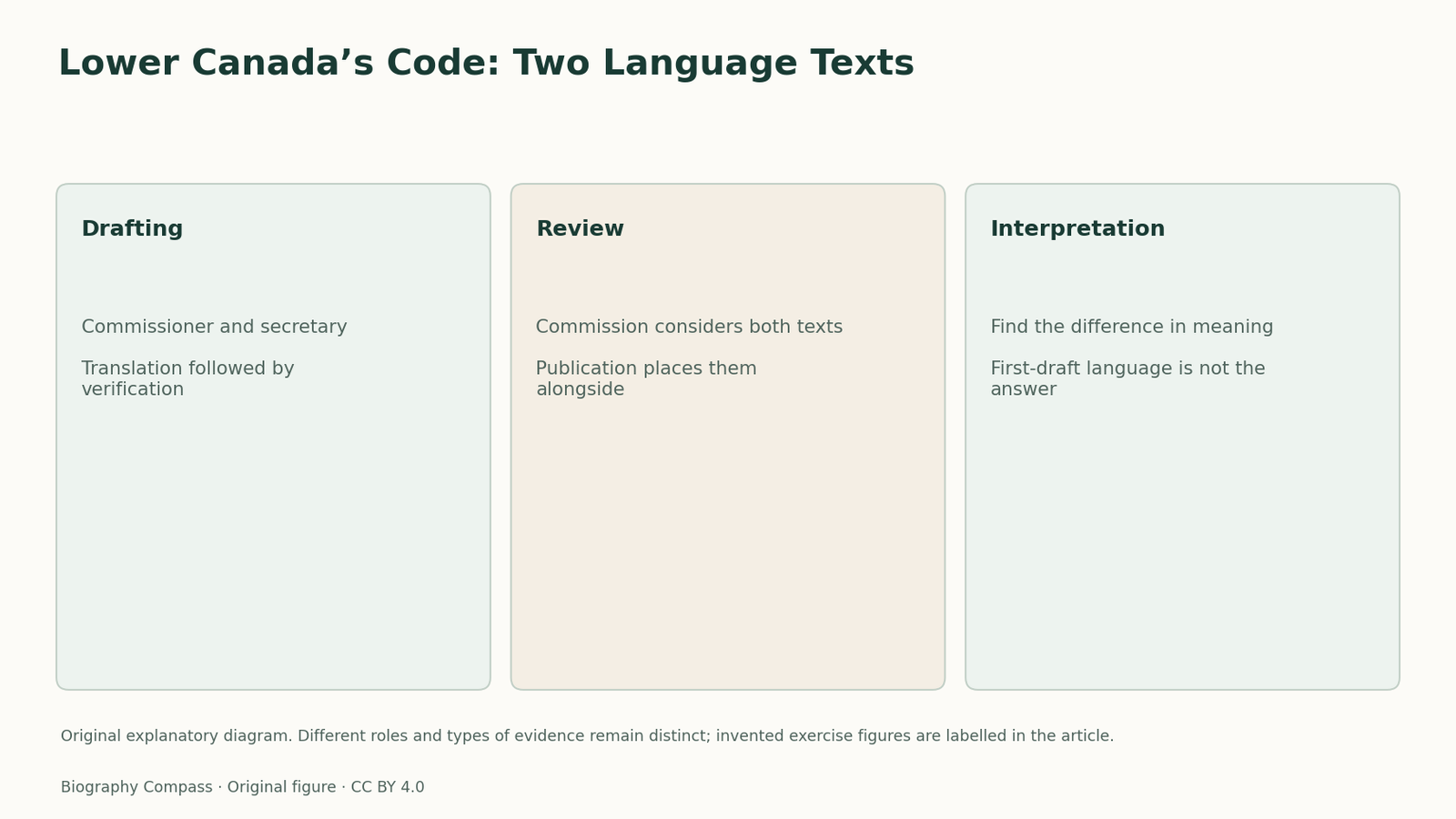
The 1865 report catalogue records English and French on facing pages. The statutory instruction reproduced by Brierley required both-language reports and code provisions, while the commission’s recorded procedure involved bilingual review. These are three different matters: what the enabling instruction required, how drafting was organised, and how the result was printed. A facing-page layout makes comparison possible, but it cannot itself guarantee equivalent meaning. That distinction explains why this question is separate from the companion guide on existing law and amendments. Here the issue is how two versions of the same provision could be prepared and used together.
The historical code supplied a rule for differences
Article 2615, reproduced in both languages in Brierley’s study, distinguished provisions founded on existing law from provisions changing it when addressing differences between the texts. Its test concerned the underlying law or the article’s intention, rather than automatically rewarding the language used for the first draft. This guide treats that provision as historical evidence about the 1866 code, not advice about a present-day dispute. The Justice Department’s chronology identifies commencement in 1866; a later source’s discussion of the rule should not be mistaken for an instruction newly issued by the original commissioners. The distinction lets a reader separate a historical interpretive rule from the workflow through which a draft was made.
Two-version exercise and a reference answer
Invent a committee rule in two versions: version A permits a loan to every member, while version B permits it only to paying members. Suppose a clerk drafted A first and a second clerk produced B. Ask three questions: what does the earlier club rule allow, did the committee intend a change, and did the whole committee approve both versions? A supported answer does not choose A merely because it came first or B merely because it looks more precise. It identifies the difference in the class of eligible people and seeks the governing evidence. This original fictional exercise is not a translation of an actual code article. It demonstrates why document chronology, collective approval and substantive meaning are separate questions, and why the historical rule and the recorded drafting process must be read together.
Continue the chronology
Related history guides
Biography context
Explore Canada through connected lives
Connected biographies
People behind the collaboration
1806–1884
Charles Dewey Day
Judge, educator and civil-code commissionerCharles Dewey Day brought a commercial legal practice and educational institution building to the commission that prepared Lower Canada’s bilingual Civil Code.Read biography1803–1865
Augustin-Norbert Morin
Lawyer, politician and civil-code commissionerAugustin-Norbert Morin combined journalism, parliamentary reform and judicial service before helping Caron and Charles Dewey Day prepare Lower Canada’s Civil Code.Read biographyQuick answers
Common questions
- Was the English text simply an unofficial translation?
- No. The mandate required both languages, and the recorded process involved verification and collective adjustment. A first draft’s language did not automatically settle a difference in meaning.
Primary and institutional sources
How this history was checked
The bibliography distinguishes contemporary records, retrospective participant accounts and later institutional research. Access limits and uncertain attributions are identified in the article; the exercise is an original teaching example. This article was reviewed on 7 November 2026.
- Dictionary of Canadian BiographyDay, Charles Dewey
- McGill University 200The First Decades: Faculty of Law
- Department of Justice CanadaHistorical origins of the Canadian legal system
- John E. C. Brierley / McGill Law JournalQuebec’s Civil Law Codification Viewed and Reviewed
- Canadiana / original commission publicationCivil Code: First, Second and Third Reports 1865