
The short answer
A tiny specimen attracted attention that its investigator thought misleading. What did she establish, what did she infer and what did later publicity turn her into?
Original source comparison
Separate the claims before grading the evidence
A conclusion can be well supported in one column and open in another.
| Country | What the evidence supports | What it does not establish |
|---|---|---|
| Material identity | Lonsdale reports that the tested speck was diamond. | That she manufactured it. |
| Artificial origin | She considered the origin probable from records. | An independently replicated manufacturing process. |
| Career emphasis | She names crystallographic problems as more substantial. | A universal objective ranking of all her work. |
| Election | Certificate dates election to 22 March 1945. | That the previous day’s letter was an award-acceptance speech. |
Chronology
A timeline of the turning points
Letter to Peet
Lonsdale distinguishes a brief diamond investigation from her wider research.
Royal Society election
The election record supplies the following day’s institutional event.
Begin with the letter’s place in the record
On 21 March 1945 Kathleen Lonsdale wrote to Hubert Peet, editor of The Friend. A UCL-hosted anthology reproduces the letter in its chapter on Lonsdale, identifying her archival papers. This guide reads the typed reproduction on printed pages 385–386 and its editorial context on pages 384–388, rather than claiming inspection of the original archival item. The date is consequential: the Royal Society election certificate records her election on 22 March. The letter was written before that event, not as an acceptance speech looking back on an already announced honour. Its immediate setting was a request for biographical material.
A material test and a manufacturing history are different claims
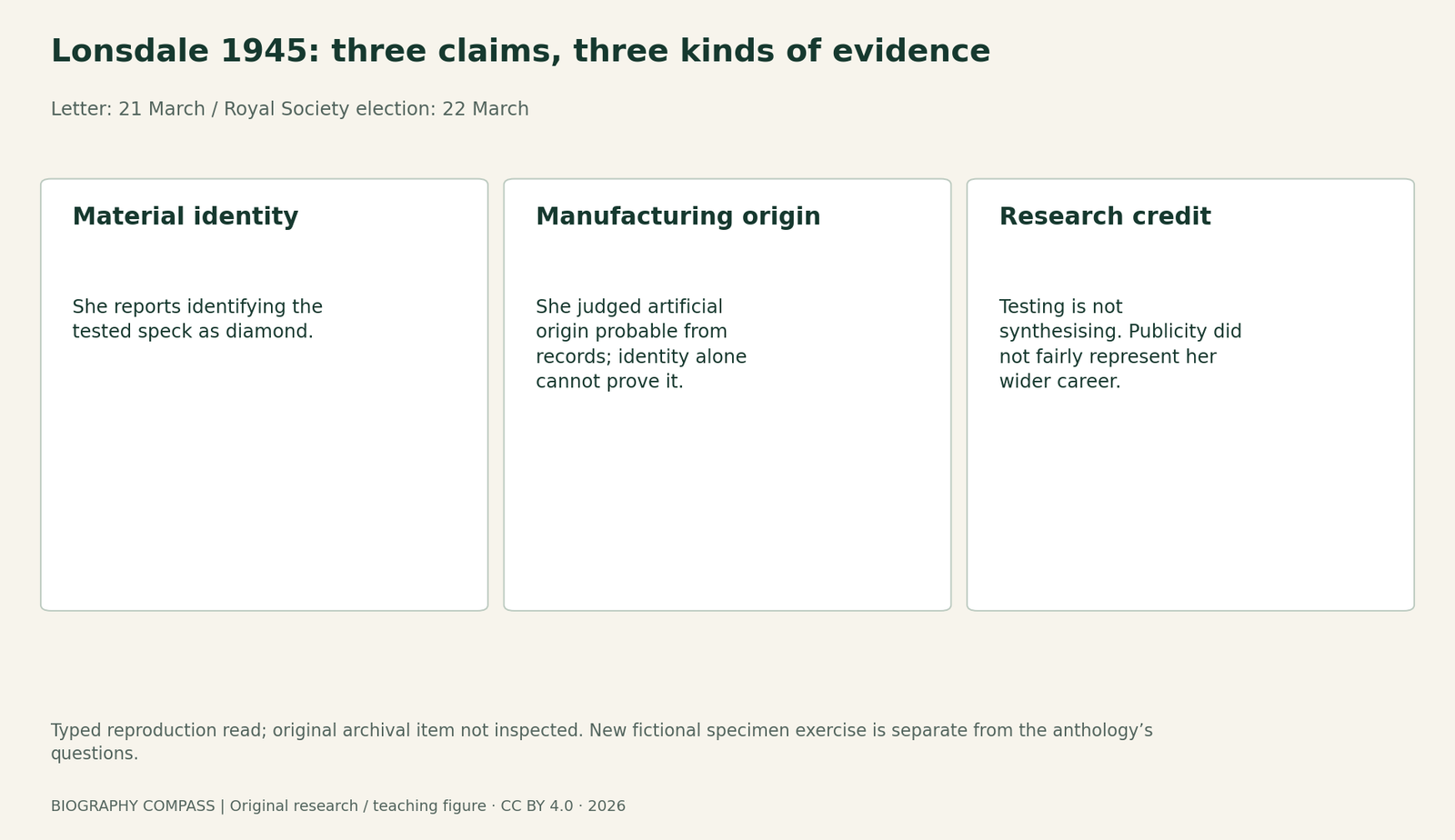
Lonsdale described examining a minute speck from material associated with James Ballantyne Hannay’s claimed artificial diamonds of 1879–1880, held by the British Museum. She identified the tested material as diamond. She separately judged an artificial origin probable from the records. The first proposition concerns what the specimen is; the second concerns how it came to exist. Even a strong identification does not by itself establish a manufacturing process, date or maker. Her distinction is valuable without using this letter to settle the entire later controversy over Hannay’s claims. No complete chain of custody or independent synthesis replication is supplied here.
Sources for this section: [1]
Testing a specimen did not make her its synthesiser
The letter objects to publicity that made a short investigation seem like the centre of her career. Lonsdale had not manufactured the specimen. Assigning her that action would change both the verb and the actor in the historical account. A useful research ledger therefore has separate columns for identification, provenance evidence, experimenter and claimed producer. The same discipline applies to a museum label: tested by and made by are not interchangeable credits. A historian can preserve the excitement around a purported artificial diamond while refusing to convert a reported test into an invented synthesis achievement.
Sources for this section: [1]
Her account of important work was broader
Lonsdale directed attention toward benzene-ring structure and dimensions, mathematical crystallographic tables, atomic motion and new methods of X-ray investigation. The Royal Society election citation independently describes a substantial research programme, including molecular and crystallographic work. Put the two documents side by side. The letter is a scientist’s situated account of what mattered to her; the certificate is a nomination and election record prepared within a learned society. Neither is a neutral ranking of every discovery. Together they explain why reducing her career to a sensational diamond story misses work that both she and her scientific peers identified as substantial.
A favourable personal account does not erase a barrier
The letter also discusses colleagues’ responses to her religious commitments and the possibility of a woman’s nomination. Lonsdale says disagreements had not spoiled their attitude toward her work and describes checking whether nomination would generate resentment. This is evidence about her own inquiry and reported experience. It does not establish that all women had equal access to scientific employment or election. She and Marjory Stephenson became the first women Fellows in 1945. A careful reading can recognise supportive colleagues and a historic institutional barrier without forcing either observation to cancel the other.
Exercise: classify an independent specimen ledger
Use this fictional teaching record, unrelated to Hannay’s specimens. Sample A is identified as diamond by a stated laboratory test, but its origin log is missing. Sample B has a dated maker’s label but has not been tested. Sample C is identified as diamond and has a production log, although a transfer between containers is undocumented. For each sample, mark material identity and manufacturing provenance as supported, untested or incomplete. Then repair this fictional headline: “Researcher invents diamonds after testing Sample A.” Name the action actually supported and list one further record needed for the stronger claim.
Sources for this section: [1]
Reference answer: attach confidence to a proposition
For Sample A, identity is supported within the stated test, while manufacturing provenance remains unestablished. For B, the label makes an origin claim but does not establish material identity or independently verify that claim. For C, identification is supported, but the undocumented transfer leaves the link between the tested piece and the production log incomplete. The repaired headline should say the researcher identified a tested specimen as diamond. A synthesis claim needs evidence of production and a secure connection to the tested material. This exercise is original editorial teaching material, not one of the anthology’s reproduced questions. Its lesson is to qualify each proposition rather than label an entire source simply reliable or unreliable.
Sources for this section: [1]
Continue the chronology
Related history guides
Connected biographies
People behind the work
1903–1971
Kathleen Lonsdale
Crystallographer and peace campaignerKathleen Lonsdale used X-ray crystallography to investigate molecular structure, helped organise tools for other researchers and became a professor at UCL. Her career also included Quaker pacifism, imprisonment and sustained work for prison reform.Read biographyQuick answers
Common questions
- Does this guide prove or disprove Hannay’s manufacturing claim?
- No. It examines what Lonsdale’s letter says and distinguishes identity from origin; it does not supply a complete later adjudication.
- Are the exercise specimens historical objects?
- No. Samples A, B and C are invented teaching cases, explicitly separate from the historic specimen.
Primary and institutional sources
How this history was checked
Compare the identified original texts, participant accounts and institutional records; the teaching examples are separately labelled. This article was reviewed on 27 October 2026.
- Ash Arcadian; UCL Press anthology, UCL DiscoveryWomen in the History of Science, chapter 47: Kathleen Lonsdale’s letter of 21 March 1945, pp.384–388
- Royal SocietyKathleen Yardley Lonsdale: election certificate EC/1945/13
- Dictionary of Irish BiographyLonsdale, Kathleen: scholarly biography
- Royal InstitutionSpotlight on Kathleen Lonsdale